Paris Arrivals: Choose Airport Transfer Vehicles With Meet & Greet

The fastest, most predictable way to leave any airport is to pre-book a private transfer with flight tracking, a meet & greet, and a fixed-price confirmation instead of gambling on a taxi rank. For most travelers, that means choosing between a sedan, an executive sedan, a 7-seat van, or an 8-seat minibus. Check three things before you confirm: how many waiting minutes are included, whether flight tracking is automatic, and who meets you at arrivals.
TL;DR:
- Private airport transfers with flight tracking include up to 60 minutes of free waiting time, with fixed prices confirmed before travel to avoid surprises.
- Vehicle choices should be based on passenger count, luggage volume, and mobility needs; premium sedans suit solo travelers, while vans or minibuses are better for groups or families.
- Drivers must be licensed with proper registration, insurance, and professional VTC cards, and booking should specify accessibility, child seats, and luggage accommodations in advance.
- During peak travel times, booking 48 to 72 hours ahead is recommended to secure availability and better rates, especially for larger vehicles and during local events or holidays.
- In France, fixed taxi fares from airports serve as useful benchmarks; private transfers typically match these prices but include additional services like meet & greet and flight tracking.
Table of Contents
- What Are the Main Types of Airport Transfer Vehicles?
- What Does a Premium Airport Transfer Actually Include?
- How Does Booking and Pickup Actually Work?
- How Much Should an Airport Transfer Cost?
- What Luggage, Child Seat, and Accessibility Options Should You Expect?
- What Safety Standards and Driver Qualifications Should You Check?
- What Are Typical Cancellation and Refund Policies?
- How Do You Match a Vehicle to Your Group Size and Needs?
- Why Do Prices and Availability Change During Peak Travel Times?
- What Insurance Coverage Applies to Airport Transfers?
- Why Flight Tracking and Meet & Greet Actually Change the Arrival Experience
- Book a Premium Transfer That Matches Your Trip
- Where to Verify Fares, Registration, and Pickup Rules
- Sources
- FAQ
What Are the Main Types of Airport Transfer Vehicles?
Vehicle choice comes down to three variables: how many people are traveling, how much luggage they’re hauling, and how much comfort matters for the ride. Get those three right and the rest of the booking is easy.
The premium sedan fits one to three passengers with two standard suitcases plus carry-ons. It’s the default pick for solo business travelers or couples who just need a clean, air-conditioned car that shows up on time.
The executive or luxury sedan (often an S-Class or equivalent) is the same passenger capacity but with more legroom, a quieter cabin, and a driver who treats the ride like a small event rather than a commute. This is what you book when the trip itself is part of the impression you’re making, a client pickup, an anniversary trip, a red-eye landing you want to survive in comfort.
The 7-seat van, typically a Mercedes V-Class, handles families or small groups with real luggage: think four adults with checked bags, or two adults and three kids with strollers and car seats. It’s the vehicle that solves the “we didn’t realize how much stuff we’d have” problem.

The 8-seat minibus is built for groups and events, up to eight passengers with a shared luggage compartment. Wedding parties, corporate teams flying in together, and multi-generational family trips lean on this class most.
A short mental checklist before you book:
- How many passengers, including kids who need their own seat?
- How many bags, and are any oversized (golf clubs, ski gear, extra suitcases)?
- Does anyone need a child seat, a wheelchair-accessible vehicle, or extra mobility space?
- Is comfort or price the priority for this specific trip?
Some operators now list electric or hybrid premium vehicles as an option. They’re quieter and often just as comfortable, but ask about trunk space. Battery packs sometimes eat into cargo volume compared to a combustion-engine sedan of the same class.
What Does a Premium Airport Transfer Actually Include?
“Premium” should mean something specific, not just a nicer car. Here’s what separates a real premium service from a rebranded taxi:
- Meet & greet at arrivals. A driver waits inside the terminal, past customs where permitted, holding a name sign. No wandering the curb trying to flag someone down.
- Automated flight tracking. The operator’s system monitors your flight number in real time and adjusts driver dispatch if you land early, late, or get rerouted.
- Free waiting minutes built in. Most reputable operators include a grace period, often 30 to 60 minutes for international arrivals, before any waiting fee kicks in.
- A fixed price confirmed at booking. The fare you see is the fare you pay, tolls and standard routing included, though extra stops or major detours are usually billed separately.
Extras worth checking on the confirmation page include bottled water, Wi-Fi, phone chargers, and whether the driver speaks your language.
Pro Tip: Read the fine print on “free waiting time” before you book. A service advertising a fixed price with only 15 included minutes after an international flight is setting you up for a surprise fee if baggage claim runs long.
How Does Booking and Pickup Actually Work?
The mechanics are simpler than most first-time bookers expect, but the sequence matters.
- At booking, you provide your flight number, arrival terminal, destination address, passenger count, and a working phone number, no more.
- Automated tracking takes over once your flight number is on file. If your flight moves up or slips by two hours, the system adjusts your driver’s schedule automatically. You shouldn’t have to call anyone to update a delay.
- Pickup happens in designated zones, not wherever looks convenient. Major airports route professional drivers to specific loading areas or a Parking Pro-style zone with license-plate-controlled access, which keeps curbside chaos out of your pickup experience.
- If your flight is delayed or diverted, contact the operator’s support line directly rather than assuming the system caught it. Diversions to a different airport aren’t always automatically detected.
This structure exists because unmanaged arrivals areas are genuinely hard to navigate on a tight schedule. A driver who already knows your gate, your terminal, and your bag count has already solved half the stress before you’ve cleared passport control.
How Much Should an Airport Transfer Cost?
Five things move the price: vehicle class, distance and drive time, whether you’re arriving at night or during peak hours, any waiting time beyond what’s included, and extra stops along the route.
France pricing benchmark: French regulators publish fixed taxi forfaits for specific airport routes, useful as a reference point even if you’re booking a private transfer instead. Between Charles de Gaulle and central Paris, regulated taxi fares run €56 to the Right Bank and €65 to the Left Bank; from Orly, it’s €45 and €36 respectively. Taxis must also issue an invoice for any ride reaching €25.
Those forfaits matter for two reasons. First, they give you a real number to compare against a private transfer quote, if a sedan quote for CDG to central Paris comes in noticeably above €65, ask what’s driving the difference. Second, they show why fixed pricing works: French authorities already built predictability into the taxi system for these specific routes, and private operators extend that same logic across their entire fleet and every destination, not just a handful of standard runs.
Airport charge stability also plays a quiet role here. Regulatory decisions have kept most airport fees in Paris steady into the 2026 tariff period, which is one reason operators can commit to a fixed fare weeks in advance without pricing in guesswork.
The practical takeaway: when a booking confirmation lands, hold it up against the relevant forfait table. If it’s a private sedan or van and the price sits in a reasonable range above the regulated taxi fare, you’re paying for the meet & greet, tracking, and guaranteed vehicle, not for an inflated fare.
What Luggage, Child Seat, and Accessibility Options Should You Expect?
A premium sedan typically handles two large suitcases and two carry-ons comfortably. Push past that and you’re better off in a van or minibus before you even get to the airport, curbside upgrades rarely go smoothly.
- Sedans: two large bags plus hand luggage.
- Vans (7-seat): four to five large bags depending on passenger count.
- Minibuses (8-seat): shared cargo space, generally one bag per passenger comfortably.
Child seats are not optional extras to sort out at curbside. France enforces child restraint requirements, and reputable operators provide certified seats on request, but you need to reserve the seat type (infant, booster, convertible) when you book, not when the car pulls up.
Accessibility works the same way: if you need a wheelchair-capable vehicle or space for a folding mobility aid, flag it at booking. Airports design passenger loading zones with accessibility in mind, but the vehicle itself has to be requested in advance to guarantee a match.

Pro Tip: Confirm exact vehicle dimensions and equipment at booking, not at the curb. A “van” advertised online can vary a lot between operators, and finding out your stroller doesn’t fit after the driver has already arrived is a bad way to start a trip.
What Safety Standards and Driver Qualifications Should You Check?
Every vehicle used for paid passenger transport in France falls under defined categories with registration, insurance, and roadworthiness compliance obligations, and those checks aren’t optional paperwork operators can skip. A legitimate transfer vehicle carries valid registration, current insurance covering commercial passenger transport, and a roadworthiness certificate renewed on a fixed schedule.
Drivers matter as much as the vehicle. Private-hire drivers operating in France must hold a professional VTC card, which requires passing a knowledge exam covering road safety, local geography, and passenger regulations, plus proof of a clean driving record. Ask directly, or check the booking platform, whether the driver assigned to your ride is a registered professional rather than a freelance contractor with looser oversight.
Beyond licensing, look for operational habits that signal a serious operator: routine vehicle inspections between trips, a dispatch system that tracks driver location in real time, and a support line you can actually reach if something goes wrong mid-journey. A driver who knows the fastest legal route to your terminal, understands airport access rules, and carries proper documentation for the vehicle isn’t a bonus feature, it’s the baseline.
If a quote seems unusually low compared to others in the same vehicle class, that’s often where corners get cut, insurance lapses, unlicensed drivers, or vehicles overdue for inspection. A fixed price from a registered operator tends to hold up better than a bargain fare from an unverified one.
What Are Typical Cancellation and Refund Policies?
Cancellation terms vary by operator, but a few patterns show up across most reputable services. Free cancellation windows commonly run anywhere from 24 hours to a few hours before pickup, with the exact cutoff stated clearly on the booking confirmation.
Cancel within that window and you typically get a full refund processed back to your original payment method within a few business days. Cancel later, especially inside a two-to-four-hour window before pickup, and many operators charge a partial fee or the full fare, since a driver has often already been dispatched or blocked out for your trip.
No-shows work differently from late cancellations. If a driver arrives at the agreed pickup point and waits through the included grace period without contact from you, most services bill the full fare and don’t offer a refund. This is exactly why accurate flight numbers and a working phone number at booking matter so much; they’re what let the system reach you if plans shift.
Flight delays and diversions generally get more flexibility than a simple change of mind. Because flight tracking already adjusts your pickup time automatically, most operators don’t penalize you for a delayed landing. A diversion to a different airport is different territory, since automated tracking doesn’t always catch that on its own, so contacting support directly protects your booking and avoids a no-show charge.
Before confirming any transfer, read the specific cancellation window and refund terms on that booking page rather than assuming a standard policy applies across every operator.
How Do You Match a Vehicle to Your Group Size and Needs?
Start with a hard headcount, not a guess. Two adults with one carry-on each is a different booking than two adults, two kids, and a double stroller, even though both are technically “four people.”
For solo and business travel: a premium sedan covers almost every case. Upgrade to an executive sedan only when the trip itself calls for extra polish, a client meeting straight off the plane, or a red-eye where legroom and quiet matter more than usual.
For families: count car seats as passengers for space purposes, not just headcount. A family of four with two young kids often needs the 7-seat van’s cargo room even though four humans could technically fit in a sedan, because strollers, car seats, and extra bags eat space fast.
For groups and events: default to the 8-seat minibus once you cross six passengers, and book it a few days out rather than same-day. Group transfers get harder to arrange on short notice, especially around conferences or wedding weekends when demand spikes locally.
For mixed-mobility groups: request an accessible vehicle explicitly rather than assuming any van works. Wheelchair space and folding mobility aid storage aren’t universal across every 7-seat or 8-seat vehicle.
One rule holds across every group size: when you’re unsure between two vehicle classes, size up. A slightly larger vehicle with room to spare costs less stress than realizing at curbside that four suitcases don’t fit where you expected.
Why Do Prices and Availability Change During Peak Travel Times?
Airport transfer pricing and vehicle availability shift noticeably during peak periods, and understanding why helps you book smarter. Early morning departures, red-eye arrivals, major holidays, and large local events (conferences, festivals, marathons) all compress demand into narrow windows, which pulls available vehicles thin exactly when you need one most.
Night and early-morning surcharges are common and legitimate, they reflect real costs for operators running drivers outside standard hours. What’s worth watching is whether that surcharge is disclosed upfront in your fixed price or added afterward.
The bigger risk during peak windows isn’t price, it’s availability. Book a transfer for a holiday weekend or a major event two days out and you may find your preferred vehicle class already gone, leaving you to either upgrade at a higher price or downgrade below what your group actually needs.
Practical timing guidance:
- Book 48 to 72 hours ahead for standard weekday travel.
- Book five to seven days ahead around holidays, school breaks, or known local events.
- For 8-seat minibus requests during peak season, book as early as your travel plans allow, group vehicles sell out first.
If you’re arriving somewhere unfamiliar, or connecting quickly to a second flight, build in extra buffer during peak periods. A flight-tracking service adjusts your pickup automatically for delays, but no service can conjure an available vehicle from thin air if you book at the last minute during a holiday surge.
What Insurance Coverage Applies to Airport Transfers?
Every vehicle used for commercial passenger transport in France must carry insurance covering that specific use, not just standard personal auto coverage. This distinction matters more than most travelers realize: a personal insurance policy typically doesn’t extend to paid passenger trips, which is exactly why vehicle categories tied to passenger transport carry their own registration and compliance requirements.
For riders, this means a properly licensed transfer vehicle carries commercial liability coverage that protects passengers in the event of an accident, mechanical failure, or injury during the trip. That’s a meaningfully different protection level than an unlicensed driver operating a personal vehicle for cash, where coverage in an incident becomes murky fast.
Ask directly, or check the operator’s terms, whether commercial passenger insurance is confirmed for every vehicle in the fleet, not just flagship cars. Some smaller or newer operators lean on a limited number of properly insured vehicles while filling gaps with less-documented cars during high demand, a detail that rarely shows up until something goes wrong.
Travel insurance you’ve purchased separately for the trip is a different layer entirely and usually doesn’t cover the transfer vehicle itself; it covers your belongings, trip cancellation, or medical costs. Don’t assume one substitutes for the other. If the details aren’t clearly stated on the booking page, it’s worth asking before you confirm, particularly for group bookings where more passengers mean more exposure if something goes sideways.
Why Flight Tracking and Meet & Greet Actually Change the Arrival Experience
Most of what makes an airport transfer stressful isn’t the ride itself, it’s the uncertainty before it. Will the driver know your flight landed early? Will anyone be there if baggage claim runs 40 minutes long? That’s the entire case for flight tracking and meet & greet as standard features, not upsells.
Zont builds its airport transfer service around exactly that gap: automated flight monitoring, a driver who meets you inside arrivals with a name sign, fixed pricing confirmed before you fly, and premium vehicles including Mercedes sedans and vans. The company reports over 50,000 completed trips and a 4.5-star average across verified TripAdvisor reviews, and operates across more than 120 cities in Europe.
What that scale actually buys you is fewer missed pickups and a bill that matches what you agreed to weeks earlier, no surprise surcharges, no wondering if the driver is still coming. For a traveler landing after a long-haul flight, that predictability matters more than almost any other feature on the booking page.
— Arthur
Book a Premium Transfer That Matches Your Trip
Once you know your vehicle class and what a premium service should include, booking is the easy part. Zont’s Paris airport transfer page covers every vehicle type this guide walks through: the Premium Sedan at €65 for CDG to central Paris, the Luxury Sedan at €95, the Van 7 Seats at €130, and the Minibus 8 Seats at €190, all one-off fixed prices confirmed before you travel. Orly transfers start from €45, and Beauvais routes start from €120.
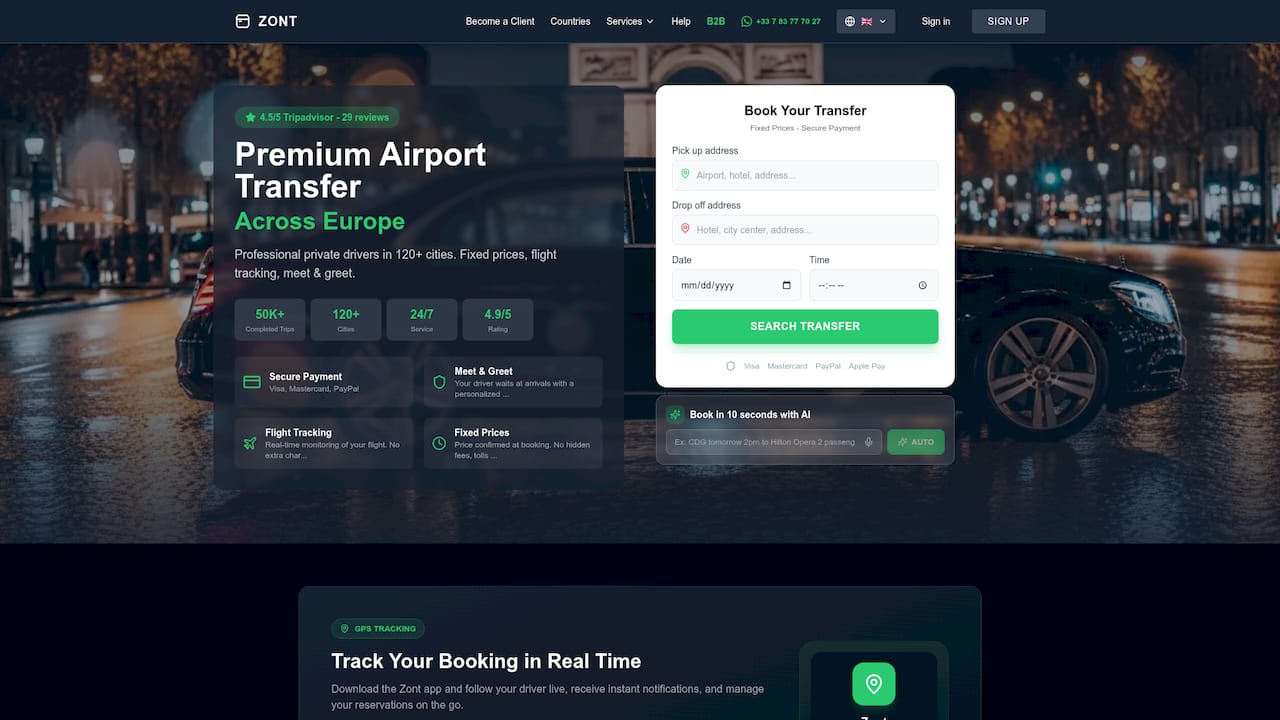
Group travelers and families needing more room can check the 8-seat VTC options, covering CDG, Orly, Disneyland Paris, Versailles, and Beauvais routes starting from €170. Before you confirm any booking, three things: how many waiting minutes are included after landing, whether a certified child seat can be reserved in advance, and what luggage allowance applies to your vehicle class. If your plans involve a full day of meetings or an event with multiple stops, Zont’s concierge services cover full-day chauffeur bookings and event transport with pricing available on request.
Landing at CDG, Orly, or Beauvais and want the exact vehicle matched to your group before you fly? Confirm your pickup, flight number, and vehicle class on the Paris airport transfer booking page now.
Where to Verify Fares, Registration, and Pickup Rules
For official details beyond this guide, check France’s taxi fare and forfait rules, the REVTC operator registration process, and Paris Aéroport’s professional pickup and LPV permit guide for pickup zone procedures.
Sources
- Taxis : tarifs, obligations et affichage | Service-public.fr
- Aéroports de Paris SA — 2026 airport charges in Paris
FAQ
What Are the Different Types of Airport Transfers Available?
The main options are shared shuttles, standard taxis, and private transfers, which range from a premium sedan up to an 8-seat minibus. Private pre-booked transfers with flight tracking and meet & greet, like those offered through Zont’s airport transfer service, tend to offer the most predictable pickup experience since the price and vehicle are confirmed before you fly.
How Much Does It Cost to Hire a Private Chauffeur in Paris?
Cost depends on vehicle class and route. Zont’s fixed one-off fares run from €65 for a Premium Sedan CDG to Paris, €95 for a Luxury Sedan, €130 for a 7-seat van, and €190 for an 8-seat minibus, with Orly transfers starting from €45. Hourly chauffeur rental is available too, with pricing listed on request.
What Is Transport From the Airport Called?
It generally falls under “ground transportation,” which includes taxis, shared shuttles, and private hire vehicles known in France as VTC (voiture de transport avec chauffeur). A pre-booked VTC with fixed pricing and flight tracking is often described as a “private airport transfer.”
How Can I Book an Airport Transfer in France?
Book online or through an operator’s app by entering your flight number, terminal, destination, and passenger count, ideally 48 to 72 hours ahead for standard travel and longer during peak periods. Look for operators registered in the REVTC database, since registration confirms the driver meets France’s professional transport requirements.
Is a Private Transfer Cheaper Than a Taxi in Paris?
Not always, but it’s often comparable once you factor in France’s fixed taxi forfaits, which run €56 to €65 between CDG and central Paris depending on the bank. A private transfer at a similar price point adds fixed pricing certainty, flight tracking, and a guaranteed vehicle class, which a street-hailed taxi doesn’t offer.