Send This Transfer Brief Before Landing for Multi Stop Transfers

Yes, multiple stops on an airport transfer make sense when you have one pickup, a short list of drop-offs, and want a single pre-planned ride instead of juggling separate bookings. It works best with a clear stop sequence, an accurate headcount, and enough luggage room built in. Add flight tracking and a meet-and-greet, and the last-minute chaos mostly disappears. A tracked professional service handles this kind of itinerary as standard.
TL;DR:
- Booking a single multi-stop transfer is most cost-effective when all arrivals occur within about 30 to 45 minutes of each other, avoiding excess waiting time.
- Proper planning with a complete transfer brief, including flight details, stop order, luggage, and special requirements, significantly reduces delays and misunderstandings.
- Confirm that the vehicle capacity matches the actual luggage volume, especially for groups with large bags, to prevent seating issues or the need for multiple rides.
- Fixed-price quotes that cover all stops, wait times, and surcharges before travel help avoid unexpected costs and clarify what is included.
- Flight tracking and inside terminal meet-and-greet services improve timing reliability, especially for large groups, reducing delays caused by customs, late flights, or terminal confusion.
Table of Contents
- What Is a Multi-Stop Airport Transfer, Exactly?
- Should You Book One Multi-Stop Ride or Separate Pickups?
- The Transfer Brief: What to Send Your Driver Before You Land
- Picking the Right Vehicle for Multiple Stops
- How Multi-Stop Airport Transfers Are Priced
- Why Flight Tracking and Meet-and-Greet Change the Outcome
- What I’d Actually Prioritize Before Booking
- Book a Multi-Stop Transfer That Actually Runs on Time
- Sources
- FAQ
What Is a Multi-Stop Airport Transfer, Exactly?
A multi-stop transfer is a pre-arranged ground transport route with one or more intermediate stops between the airport and your final destination, planned out in advance down to the stop sequence and estimated stop durations. That planning is what separates it from a point-to-point transfer, which takes you from Point A to Point B with no detours and a flat, predictable price.
An hourly chauffeur booking works differently again. You pay for a block of time, and the driver stays at your disposal for whatever you need during that window, which suits open-ended days but costs more if your plan is actually fixed. A multi-stop transfer sits between the two: structured like a point-to-point trip, flexible enough to handle a real itinerary.
Common airport-related cases: dropping colleagues at different hotels after a conference flight, picking up a business partner en route to a meeting, combining a cruise port drop with a hotel stop, or handling staggered family arrivals that end at the same house. Multi-stop transfers are built for exactly this kind of layered pickup, where a single flight lands multiple obligations at once.
Should You Book One Multi-Stop Ride or Separate Pickups?
The decision comes down to four things: how spread out your arrivals are, how much luggage you’re carrying, how many passengers need to move, and whether you value speed or cost more.
If everyone lands within roughly 30 to 45 minutes of each other, one vehicle with a multi-stop route usually beats booking separate cars. You get single-point coordination, one invoice, and one driver who already knows the full plan. Push much beyond that window and the math flips: the earliest arrivals sit waiting at the curb while a later flight clears customs, and that dead time adds up fast for people who just spent six hours in economy.
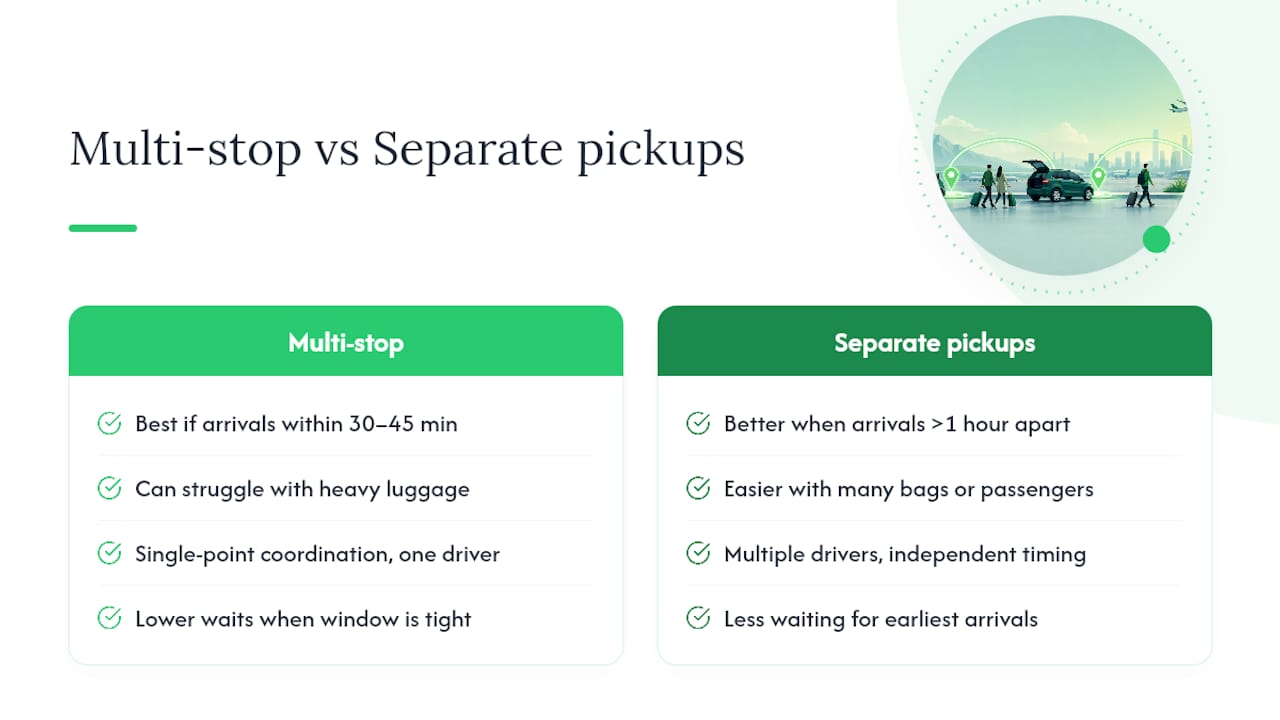
Heavy luggage changes the calculation too. A group with four passengers and four checked bags each looks fine on paper for a standard sedan, but bags eat seating capacity before people do. When arrivals are staggered by more than an hour, or when the group is large enough that one vehicle would mean real waiting, splitting into two pickups timed independently is often faster and less frustrating, even though it costs more. Convenience and cost pull in opposite directions here. Know which one you’re optimizing for before you book.
The Transfer Brief: What to Send Your Driver Before You Land
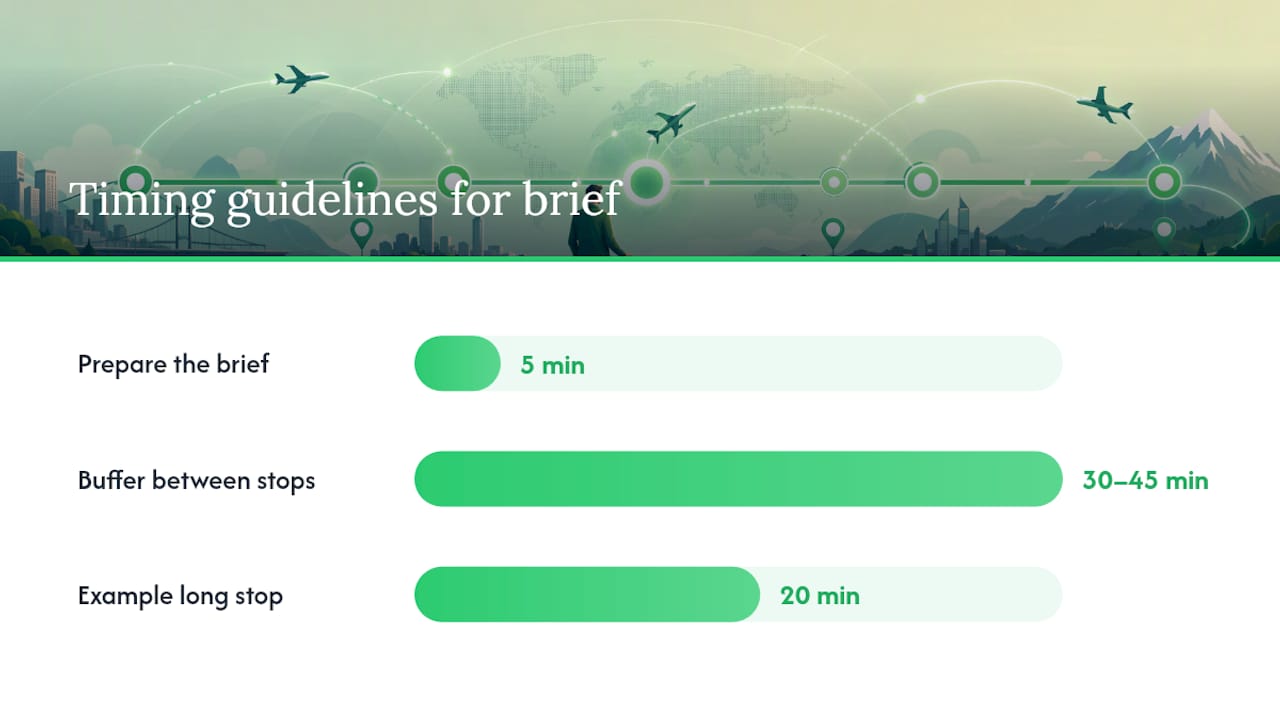
The single biggest factor in a smooth multi-stop pickup isn’t the vehicle or the driver. It’s whether the operator got a complete brief before your wheels touched down. Providers consistently point to a one-page transfer brief as the most effective coordination tool for group and multi-stop airport pickups, and it costs you nothing but five minutes to put together.
Here’s what belongs in it:
- Passenger names, flight numbers, and airlines for every traveler in the group
- Arrival times and terminal information, including any known gate or customs quirks
- Full addresses for every stop, in the order you want them visited
- Estimated time you’ll need at each stop (a quick errand versus a 20-minute unload)
- Total passenger count and bag count, counted separately, not estimated together
- Special equipment: child seats, musical instruments, sports gear, oversized bags
- One named point of contact who the driver can reach if plans shift
- Where the meet-and-greet should happen, whether that’s baggage claim, the arrivals hall, or curbside
For staggered pickups, build in 30 to 45 minute buffer windows between each stop; that’s the window most professional operators plan around to absorb customs delays and slow baggage carousels. If your spread is wider than that, it’s usually the signal to split into two bookings rather than force one vehicle to cover it.
Pro Tip: Attach your transfer brief as a short PDF or a single message when you book, and ask the provider directly what their free-wait window is and what they charge per minute after that. Getting this in writing before you land removes almost every surprise a multi-stop trip can throw at you.
Picking the Right Vehicle for Multiple Stops
Count people and bags as two separate numbers, not one combined guess. A sedan rated for four passengers can technically seat four adults, but four adults with four large suitcases and two carry-ons will not fit, and that mismatch is the most common reason multi-stop bookings go wrong on the day. Operators generally recommend that if your passenger count is close to a vehicle’s rated capacity, size up rather than assume it’ll work out.
Larger vehicles solve capacity problems but introduce their own friction. A minivan or larger consolidates a whole group into one ride, which is genuinely convenient for staggered family pickups, but bigger vehicles can complicate staging and curb access at busy terminals where pickup zones are tight and time-limited. Sometimes two mid-size cars maneuver a chaotic arrivals curb better than one large van waiting for a slot.
Flag anything unusual at booking, not on arrival: child seats, wheelchair access, oversized instrument cases. Confirm exactly how the provider handles it before travel day, not after you’re already standing at the curb with a cello.
How Multi-Stop Airport Transfers Are Priced
Most operators price multi-stop transfers one of three ways: a fixed itinerary quote covering the whole route, a per-stop fee added to a base fare, or hourly billing once the trip starts resembling a chauffeur booking more than a fixed route.
Ask for a written fixed-price quote covering every stop before you confirm anything. That quote should spell out any airport surcharge, the free-wait allowance at each stop, and the per-minute rate that kicks in once you exceed it. These are the numbers that turn a reasonable-looking fare into an unpleasant final invoice if nobody asked upfront.
Extra stops and heavier luggage both push the price up, and staggered pickups that force the driver to circle or wait longer than planned usually do too. If a quote feels vague, push back and ask for the itemized version. A provider confident in its own pricing will hand you a fixed number for the entire itinerary rather than a range that leaves room to move. Locking that number in before travel day, rather than mid-trip, is what actually protects your budget.
Why Flight Tracking and Meet-and-Greet Change the Outcome
Most of what goes wrong on a multi-stop airport transfer traces back to timing: a delayed flight, a slow customs line, a driver who doesn’t know the pickup zone rules at that particular terminal. Flight tracking removes the first problem by adjusting the pickup automatically instead of leaving you to call and explain a delay. A meet-and-greet inside the terminal removes the second, and it’s especially valuable for larger groups, where confusion at the arrivals hall can mean someone gets separated from the group entirely.
Some airport transfer services build their offerings around flight tracking, personalized meet-and-greet, and fixed transparent pricing with no hidden per-stop surprises across multiple cities in Europe. They may carry high ratings on review platforms from verified reviews, and offer premium vehicles that can accommodate various group sizes and luggage needs.
When you’re ready to book, map your transfer brief directly onto the booking form: stop order, timing, passenger and bag counts. Then confirm the free-wait window in writing before your flight lands.
What I’d Actually Prioritize Before Booking
If you take one thing from this guide, make it the transfer brief. Every other decision, vehicle size, pricing structure, whether to stagger or consolidate pickups, gets easier once a provider has your flight numbers, stop sequence, and luggage count in writing. The single biggest operational risk in a multi-stop airport trip isn’t traffic or a late flight. It’s a traveler who underestimates how much luggage four people actually bring, or how far apart two arrival times really are once customs gets involved.
Confirm three things before you book anything: the transfer brief is complete, the vehicle fits your actual bag count and not just your passenger count, and the provider tracks your flight with a real free-wait window attached.
— Arthur
Book a Multi-Stop Transfer That Actually Runs on Time
Certain airport transfer providers specialize in trips like those described in this guide: families landing together with multiple drop-offs, business groups needing intermediate stops, or cruise passengers routing through a hotel in multi-stop itineraries. These services typically use transfer briefs, flight tracking, and meet-and-greet inside the terminal to enhance the experience.
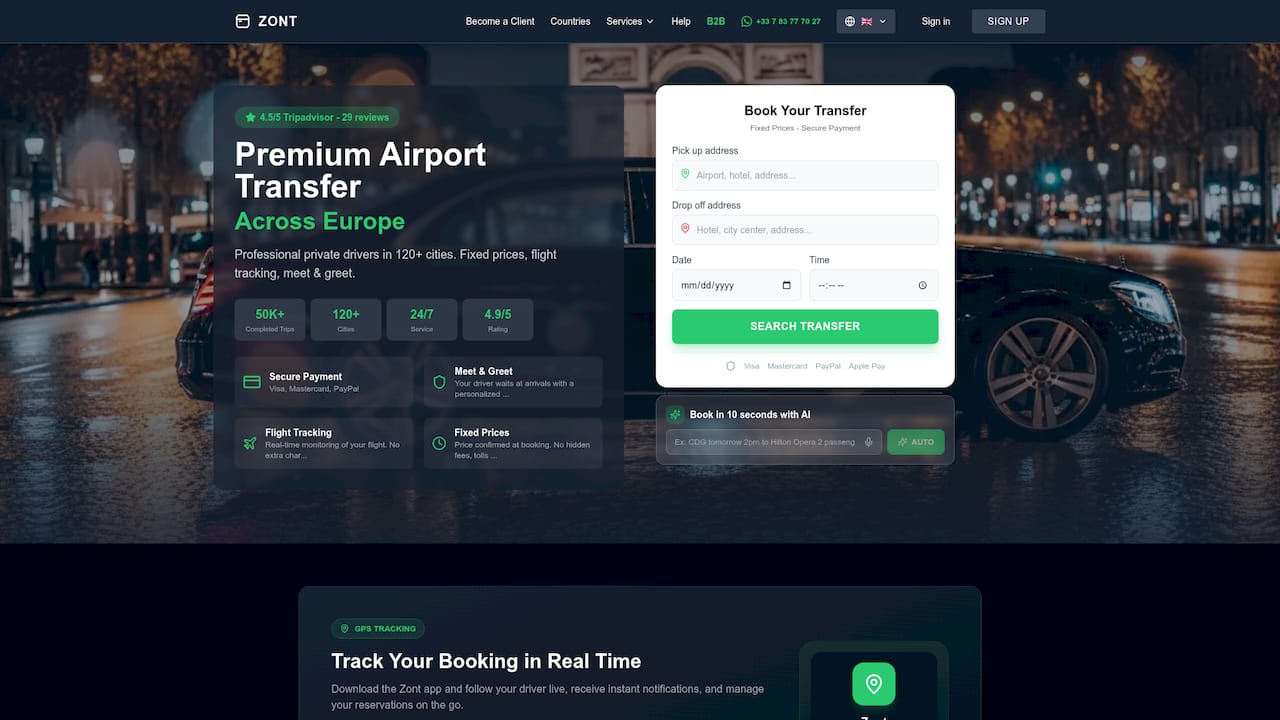
Every quote is fixed before you travel, covering stops, waiting allowances, and any airport surcharge, so there’s no per-minute guessing when you land. Vehicles range from a standard sedan to a Mercedes V-Class for larger groups with more luggage, and coverage spans over 120 cities across Europe, including destinations like Berlin and Alicante. If your itinerary is open-ended rather than fixed, the hourly chauffeur option covers that too.
Check availability and get a fixed quote for your route through Zont’s European destinations page, and send your stop sequence, passenger count, and luggage details when you book so the driver has everything before your flight lands.
Sources
This guide draws on operational best practices from multi-stop transfer definitions, group transfer planning guidance from My Private Transfers, airport logistics planning from Charter a Coach, and chauffeur service notes on multi-stop trip coordination.
- What Is a Multi-Stop Transfer? Definition & Guide
- How to Arrange Transport for Large Groups to & From Airports | My Private Transfers
- How to Build a Group Airport Transfer Plan - Charter a Coach
FAQ
Can you book an airport transfer with more than one stop?
Yes, most professional airport transfer providers offer multi-stop bookings where you specify each address and stop duration in advance rather than booking separate rides.
How far apart can arrivals be for one multi-stop vehicle?
Operators generally recommend keeping arrivals within 30 to 45 minutes of each other for one vehicle; beyond that, staggered separate pickups usually work better.
What information does a driver need for a multi-stop trip?
A complete transfer brief with passenger names, flight numbers, arrival times, full stop addresses in order, luggage count, and one point of contact covers what most providers ask for.
How far in advance should I book a multi-stop airport transfer?
Small groups can often book with 48 hours’ notice, but larger groups or peak travel periods are safer booked two to four weeks ahead.
Does a multi-stop transfer cost more than a direct ride?
Usually yes, since pricing accounts for extra stops, luggage volume, and any waiting time beyond the provider’s free allowance, though a fixed quote covering the whole route keeps costs predictable.
Is a meet-and-greet worth it for a multi-stop pickup?
For larger groups especially, a meet-and-greet inside the terminal prevents arrival-area confusion and ensures everyone reaches the vehicle together rather than splitting up at the curb.