Travel Managers: Close the 11.5% Blind Spot with a Chauffeur Account

A corporate chauffeur account is a centralized business profile that lets travel managers book, track, and pay for chauffeur and airport transfer rides across an organization from one place. If your company sends employees or clients through airports on a regular basis, setting one up almost always beats booking rides one at a time. Zont offers a ready-made B2B version of this setup, and the fastest next step is requesting access through its corporate account page.
TL;DR:
- Using a corporate chauffeur account centralizes booking, tracking, and billing, improving cost visibility and reducing last-minute booking errors.
- Flight tracking integration ensures drivers are aware of delays, minimizing wait times and improving traveler safety and satisfaction.
- Implementing approval thresholds and role-based access controls prevents overspending and maintains policy adherence across the organization.
- A monthly consolidated invoicing model offers the cleanest financial reconciliation, especially when combined with detailed invoice fields.
- Regular monitoring of pickup punctuality and service quality ensures ongoing compliance with duty-of-care standards and cost controls.
Table of Contents
- What Is a Company Chauffeur Account and How Does It Work?
- Why Should Travel Managers Set Up a Business Driver Account?
- How Do You Set Up a Corporate Chauffeur Account? A Step-by-Step Checklist
- Billing, Invoicing, and Expense Reconciliation Options
- Best Practices for Duty of Care and Supplier Oversight
- What Actually Matters When You’re the One Managing This
- Getting Your Company Set Up With Zont
- Sources
What Is a Company Chauffeur Account and How Does It Work?
A compte entreprise chauffeur, or business driver account, replaces one-off bookings with a managed system built for repeat corporate use. Instead of an assistant paying out of pocket and submitting a receipt, the company holds a single account that covers every ride, every traveler, and every invoice.
The core setup usually includes:
- Centralized booking portal where admins or approved staff schedule rides for any employee.
- Role-based access, separating admins (who set policy and see all bookings) from standard users (who can only book for themselves or their team).
- Traveler profiles storing flight numbers, preferred vehicle class, and special requests.
- Flight tracking tied to each airport pickup, so a delayed inbound flight doesn’t strand a traveler curbside.
- Fixed fares agreed in advance, removing the guesswork of metered pricing or surge charges.
Booking usually happens through a web portal or app, though most providers, including Zont, keep phone and email as a fallback for last-minute changes. Admin controls typically govern which vehicle classes are permitted, whether a booking needs manager approval above a certain price, and how exceptions for VIP travelers get handled.
Why Should Travel Managers Set Up a Business Driver Account?
Corporate travel management centralizes booking, approvals, and reporting, and ground transportation fits naturally into that structure once it moves off personal cards and into a managed account. The payoff shows up in three places: spend visibility, traveler experience, and duty of care.
Cost control comes first. When every ride runs through one account, finance sees exactly what ground transport costs per employee, per route, per month, instead of reconstructing it from scattered expense reports.
Managed ground transportation averages roughly 11.5% of travel budgets where companies actually track it, and that figure is likely understated because chauffeured rides often go unrecorded unless they’re tied to a corporate card or booking tool. A dedicated account fixes that blind spot immediately.
Traveler experience improves too:
- Flight tracking means a driver adjusts automatically to delays, so no one waits at an empty curb.
- Meet and greet service removes the stress of finding transport in an unfamiliar airport.
- A single point of contact for support simplifies duty-of-care reporting compared with ad hoc local hires arranged trip by trip.
How Do You Set Up a Corporate Chauffeur Account? A Step-by-Step Checklist
Getting from “we should do this” to a fully working account takes structure. Here’s the order that avoids rework later.
- Decide your admin model first. Determine who approves bookings, which vehicle classes are allowed by traveler tier (standard sedan versus a Mercedes S-Class for executives), and whether spend caps apply per ride or per month.
- Gather your documents. Most providers ask for business registration details, a billing contact, and payment verification before activating a company profile. Identify who’s authorized to sign off on the account and any future contract changes.
- Create the account and add users. Set up traveler profiles with names, frequent-flyer or contact details, and default preferences. Assign roles so junior staff can book for themselves while admins retain visibility over everything.
- Configure approval and payment rules. Decide whether bookings above a threshold need sign-off, and connect the account to your chosen billing method.
- Run acceptance tests before rollout. Test end-to-end with a sample booking, confirm flight tracking correctly reassigns a pickup time, verify meet-and-greet protocol at your busiest airport, and pull a sample invoice to check the fields finance needs.
- Set a realistic timeline. Document collection and verification usually take the longest. Budget a few business days for account activation, then a short testing window before opening it to the wider team.
Pro Tip: Book a live test ride for your own trip before rolling the account out company-wide. Nothing exposes a gap in flight tracking or driver communication faster than experiencing it yourself.
Billing, Invoicing, and Expense Reconciliation Options
The billing model you pick determines how much manual work finance does every month, and how cleanly ground transport lines up with the rest of your travel program. Corporate travel platforms often bundle ground transport into existing expense and booking tools, which cuts down on reconciliation headaches considerably.
Four models cover most companies:
- Per-ride corporate card charge, simple to set up but generates a separate line item for every trip.
- Centralized corporate card, where all chauffeur spend routes through one card, easier to track but still requires manual matching to cost centers.
- Monthly consolidated invoicing, where the provider bills once for all activity, the cleanest option for finance teams reconciling by department or project.
- TMC or third-party chargeback integration, useful for companies that already route all travel spend through a managed platform.
Whichever you choose, ask what fields appear on the invoice. VAT treatment, per-ride cost breakdowns, and traveler names all matter if you need to allocate spend by department. A clean export to your expense system saves someone an afternoon of manual entry every month.
Best Practices for Duty of Care and Supplier Oversight
Setting up the account is the easy part. Running it well over time means building in guardrails that protect travelers and keep costs predictable.
Start with when to mandate a chauffeured service versus when a rental car or rideshare is acceptable. Airport transfers for executives, late-night arrivals, and client-facing pickups are the clearest cases for requiring a chauffeur. Many travel programs have detailed policies for rental cars and rideshare apps but leave chauffeured services vaguely defined, which invites inconsistent bookings and higher costs. Closing that gap by naming a preferred supplier is one of the simplest policy fixes available.
Your duty-of-care checklist should include:
- Flight tracking on every airport pickup, not just for VIP travelers.
- Verified driver identification, shared with the traveler ahead of pickup.
- 24/7 support in case a flight changes gates, is delayed, or diverts.
- A check-in process for high-risk routes or late arrivals.
On the supplier side, monitor on-time pickup rate, invoice exception rate, and spend by route on a recurring basis. A short quarterly review with your provider, paired with a clear complaint resolution path, keeps service quality from drifting once the novelty of a new account wears off.
Pro Tip: Track your on-time pickup rate separately from overall satisfaction scores. A provider can score well on friendliness while still missing pickup windows that matter for tight connections.
What Actually Matters When You’re the One Managing This
Most guides on corporate ground transport focus on policy language and spend caps. Fewer talk about the actual failure point: chauffeured services are usually the least documented category in a travel program, which means they’re also the easiest for someone to book badly, overpay for, or skip reporting altogether. Fixing that isn’t complicated. It just requires treating a chauffeur account with the same rigor as air travel or hotel bookings, instead of as an afterthought handled with a personal card and a receipt.
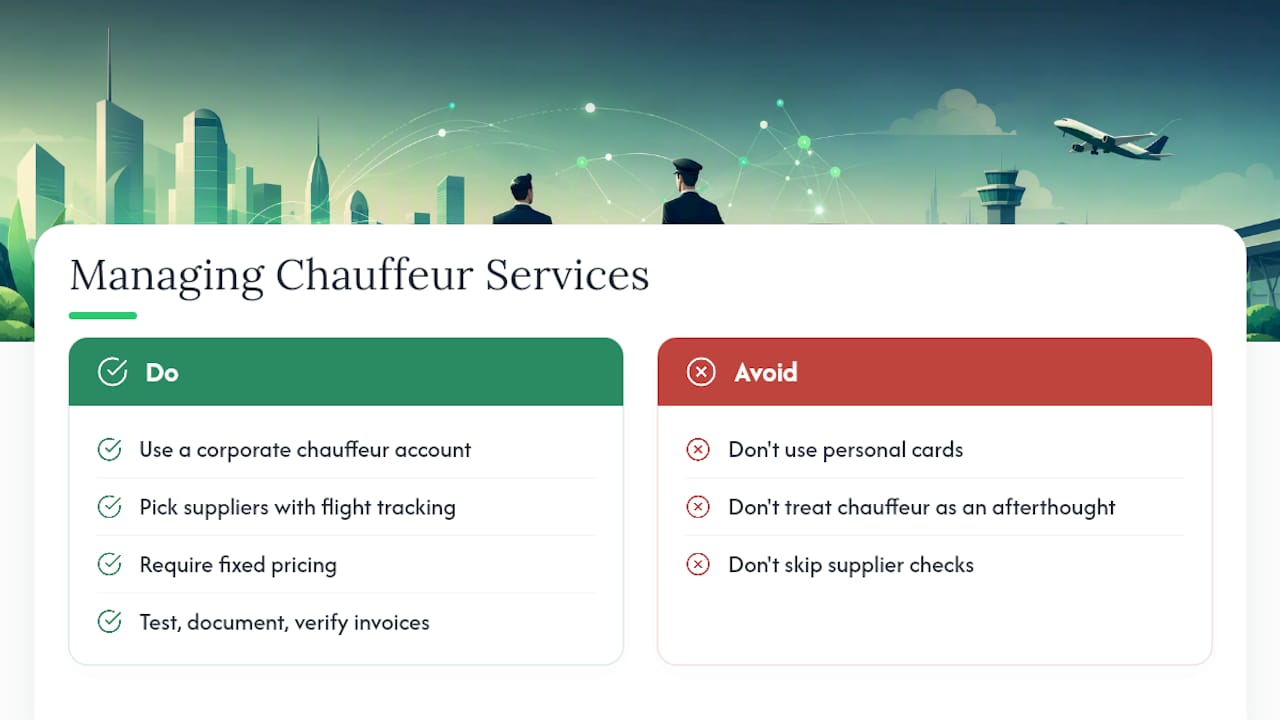
Zont fits this operational approach well. It runs corporate chauffeur and airport transfer services with flight tracking, meet and greet, and fixed pricing across more than 120 European cities, and the company has built a track record backed by a 4.5 star TripAdvisor rating from more than 50,000 completed trips. For executive travel specifically, its Mercedes Classe E hourly chauffeur option covers the kind of business use case where a fixed-price, premium vehicle actually earns its cost.
The account setup itself is rarely the hard part. What separates a program that works from one that quietly leaks money is whether someone actually tests it, documents it, and checks the invoice fields before rolling it out to fifty travelers.
— Arthur
Getting Your Company Set Up With Zont
If the checklist above sounds like more coordination than your team wants to manage solo, that’s exactly what a Zont company account is built to absorb. It maps directly to what travel managers need: flight tracking on every pickup, fixed fares with no surprise charges at the curb, centralized billing instead of scattered receipts, premium vehicles from executive sedans to seven-seat vans, and 24/7 support when a flight changes at the last minute.
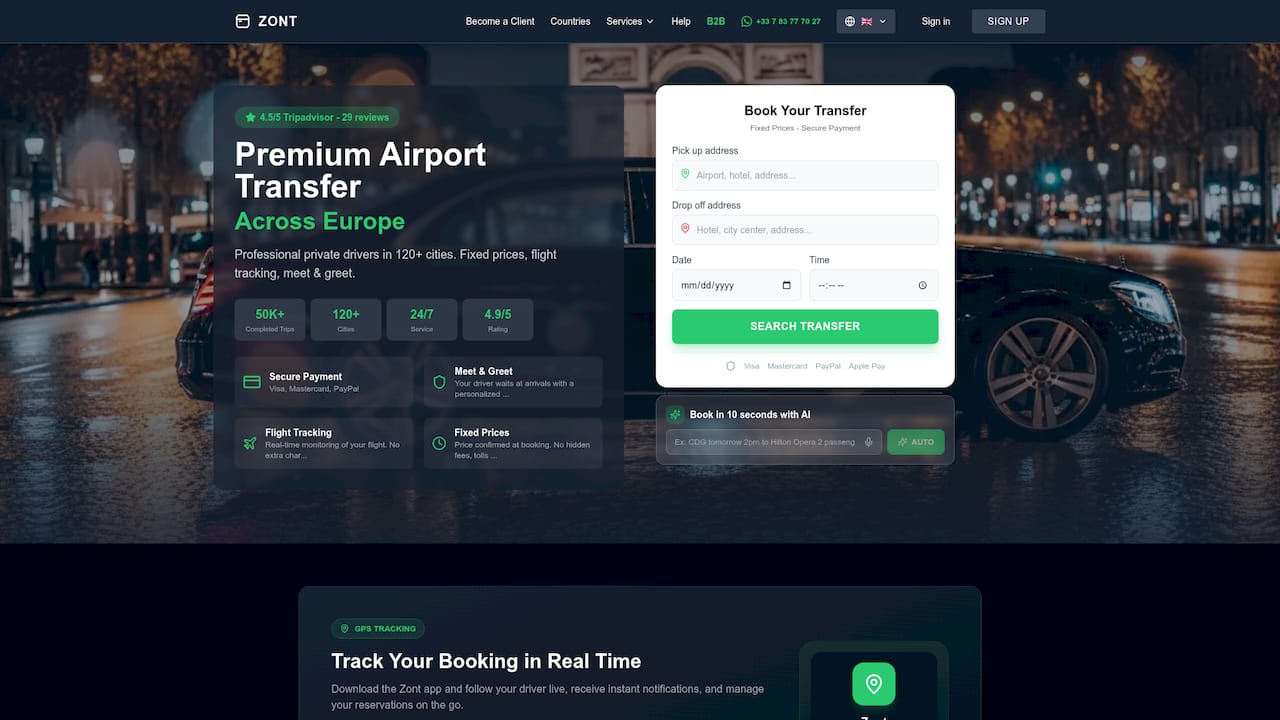
Setting it up doesn’t require a long procurement process. Visit the corporate accounts page to request access, review coverage across Zont’s European destinations, and get a company profile running before your next round of business travel books out.
Sources
- What Is Corporate Travel Management and Why Do You Need It?
- Ground Transportation Strategy | Enterprise Rent-A-Car
- Survey: Policies Limit Some Ground Transport, Buyers Prioritize Safety