Flight Tracking Service Benefits List for Travelers

A flight tracking service is defined as a real-time data platform that monitors aircraft position, status, and schedule changes using live feeds from multiple aviation data sources. The flight tracking service benefits list for travelers is longer than most people realize: early delay warnings, gate change alerts, inbound aircraft monitoring, and predictive disruption intelligence all sit within reach of a free app. Real-time flight tracking has shifted from a convenience to an operational necessity for anyone managing complex travel. Approximately 70% of global commercial aircraft carry ADS-B transponders, giving tracking services near-real-time position data on most flights worldwide. That coverage, combined with FAA and ICAO data-sharing standards, means travelers now have access to the same flight intelligence that airline dispatchers once kept to themselves.
1. Real-time flight status and position updates
Real-time position tracking is the foundation of every other benefit on this list. When you open a flight tracking app, you see the aircraft’s current altitude, speed, and ground track updated every few seconds. That live picture removes the guesswork from questions like “Is my flight even in the air yet?” or “How far out is the inbound plane?”
The practical payoff is immediate. You stop refreshing the airline’s app and start making decisions based on actual data. For anyone meeting a traveler at the airport, live position data means you leave home at the right time instead of sitting in a terminal for an hour.

2. Early delay and gate change notifications
Flight tracking apps send alerts up to 30 minutes before official airline apps push the same notification. That half-hour window is the difference between rebooking a connection at your gate and sprinting to a customer service line. Gate changes, cancellations, and departure time shifts all arrive faster through third-party tracking services than through most carrier apps.
Pro Tip: Set push notifications for both departure and arrival airports. A gate change at your origin airport often signals a delay before the airline updates the departure board.
The speed advantage exists because tracking services pull directly from FAA data feeds and airline operations systems, bypassing the internal approval layers that slow official airline communications.
3. Inbound aircraft monitoring for disruption forecasting
Savvy travelers monitor the inbound aircraft to anticipate delays hours before airlines announce changes. Every commercial flight uses a specific tail number, and that aircraft typically flies multiple legs in a day. If the plane assigned to your 6:00 PM departure is currently sitting on the ground in Denver with a mechanical hold, you know a delay is coming long before the gate agent does.
This technique turns passive waiting into active planning. You can call the airline, explore alternate routes, or adjust your ground transportation while other travelers are still unaware. For connecting flights with tight layovers, inbound monitoring is the single most useful habit a frequent traveler can build.
4. Detailed delay reason intelligence
Most airline apps tell you a flight is delayed. Flight tracking services tell you why. Many apps pull from METAR and TAF weather reports to surface specific delay causes: runway closures, de-icing requirements, air traffic control ground stops, or crew availability issues. That level of detail changes how you respond.
A weather delay at your destination airport might clear in 45 minutes. A crew rest delay could mean a two-hour hold. Knowing the cause lets you decide whether to grab dinner, call your hotel, or head to the rebooking desk. Generic “delayed” status messages do not give you that decision-making power.
5. How flight tracking technology works
Flight tracking services aggregate data from ADS-B transponders, multilateration (MLAT), radar feeds, satellite receivers, and official airline schedules. Each source fills a different gap in global coverage.
| Data source | Coverage area | Update speed |
|---|---|---|
| ADS-B transponders | Major flight corridors, land-based routes | Every 1–5 seconds |
| MLAT (multilateration) | Areas with multiple ground receivers | Every 5–15 seconds |
| Radar feeds | Controlled airspace near airports | Every 4–12 seconds |
| Satellite ADS-B | Oceanic and remote routes | Every 15–60 seconds |
| Airline schedule data | All routes | Updated at departure/arrival |
Coverage gaps exist in remote areas and over oceans where MLAT and scheduled reporting replace direct ADS-B signals. Those gaps are a technical limitation of ground-based receiver networks, not an indication of any safety issue. Understanding this distinction matters: a flight that disappears from your tracking app over the Atlantic is almost certainly fine.
6. Predictive delay analysis using historical data
Predictive intelligence in flight tracking reduces decision time during disruptions from hours to minutes. Advanced tracking services combine historical on-time performance data with live operational feeds to calculate the probability that your specific flight will depart on time. A flight with a 40% on-time rate on Friday afternoons out of Newark is a different risk than the same route on a Tuesday morning.
This feature separates entry-level free tools from paid tiers. Paid subscriptions range from $4.99 per month to $59.99 per year and unlock predictive delay scores, historical performance charts, and faster alert delivery. For frequent travelers, that cost is trivial compared to the value of one avoided missed connection.
Pro Tip: Check the historical on-time performance for your specific flight number before you book. A route with chronic delays at certain times of day is worth avoiding or pricing in extra buffer time.
7. Flight sharing with friends and family
Flight sharing lets you send a live tracking link to anyone who needs to know your status. Your family member picking you up at the airport sees your exact position and estimated arrival time without calling you mid-flight. The link updates automatically, so there is no need to text updates from the gate.
This feature also works well for coordinating group travel. When multiple travelers are converging on the same destination from different origins, a shared tracking view keeps everyone aligned without a chain of status-update messages. Ground transportation providers who use live flight data, like Zont Cab, take this coordination a step further by adjusting pickup timing automatically.
8. Integration with calendar and travel apps
Modern flight tracking services connect with Google Calendar, Apple Calendar, and travel management platforms to pull in itinerary data automatically. Once your booking confirmation lands in your inbox, the app detects the flight details and begins monitoring without any manual entry. Status changes then appear as calendar alerts alongside your other travel commitments.
For business travelers managing multi-leg itineraries, this integration removes a significant administrative burden. You do not need to manually update a spreadsheet or re-enter flight numbers. The tracking service handles the data layer while you focus on the trip itself.
9. Practical ways to use flight tracking to optimize your trip
The advantages of flight tracking compound when you apply them systematically. Here are the highest-value scenarios:
- Rebook before the crowd. When inbound aircraft monitoring shows a two-hour delay, call the airline immediately. Most rebooking queues fill within minutes of an official delay announcement. Acting on tracking data before the announcement puts you ahead of every other passenger on your flight.
- Time your airport arrival precisely. Check the inbound aircraft status 90 minutes before your scheduled departure. If the plane is on time, leave as planned. If it is running 45 minutes late, you have time to adjust without rushing.
- Coordinate ground transportation with live arrival data. Share your flight tracking link with your driver or use a service like Zont Cab that monitors real-time flight arrivals automatically. Your driver adjusts pickup timing based on actual landing data, not the scheduled arrival time.
- Monitor connections during the flight. If your connecting flight departs from a different terminal, use tracking to check its status while you are still airborne. A delayed connection means you can walk instead of run.
- Reduce airport waiting time. When picking someone up, track their inbound flight and leave home when the plane lands. Circling an airport for 30 minutes costs fuel, time, and stress. Accurate arrival data eliminates that waste entirely.
- Anticipate weather disruptions. When a storm system is moving through a hub, check all flights routing through that hub on your itinerary. A delay at a connecting airport two time zones away can cascade into a missed final leg hours later.
10. Comparing flight tracking tiers by feature and use case
Not every traveler needs the same depth of data. The table below maps feature categories to user types without naming specific products.
| Feature category | Free tier | Paid tier | Best for |
|---|---|---|---|
| Live position tracking | Yes | Yes | All travelers |
| Delay and gate alerts | Basic, slower | Advanced, faster | Frequent flyers |
| Predictive delay scores | No | Yes | Business travelers |
| Inbound aircraft monitoring | Limited | Full history | Connecting flight travelers |
| METAR and TAF delay reasons | No | Yes | Aviation enthusiasts |
| Flight sharing links | Yes | Yes | Families, group travelers |
| Calendar and app integration | No | Yes | Corporate travelers |
Free tools cover the basics well for occasional travelers. Paid tiers deliver the predictive and historical data that frequent flyers and aviation enthusiasts need. The ground logistics analogy holds here too: early warning systems are only as useful as the action you take on them. A paid subscription is worthless if you do not act on the alerts it sends.
Key takeaways
Flight tracking services give travelers the same real-time operational intelligence that airline dispatchers use, turning reactive waiting into proactive trip management.
| Point | Details |
|---|---|
| ADS-B powers most tracking | 70% of commercial aircraft broadcast live position data, enabling near-real-time updates. |
| Early alerts beat airline apps | Tracking services send delay and gate change notifications up to 30 minutes ahead of carriers. |
| Inbound monitoring is the top skill | Watching the inbound aircraft reveals delays hours before official announcements. |
| Paid tiers add predictive value | Subscriptions from $4.99 per month unlock historical performance data and faster alerts. |
| Live data improves ground coordination | Sharing flight tracking with your transfer provider eliminates unnecessary waiting at the airport. |
Why flight tracking changed how I travel
The data was always there. We just could not see it.
I used to treat flight delays as random acts of bad luck. Then I started monitoring inbound aircraft on a trip through Frankfurt, and I realized delays are almost never random. They cascade in predictable patterns from earlier in the day, and the data is sitting in plain sight for anyone willing to look.
Flight tracking democratizes data that airline dispatchers have used for decades. The shift is not just technological. It is a change in who holds the information advantage at the airport. Before these tools existed, the gate agent knew more than you did. Now you can walk up to the desk already knowing the inbound plane is 90 minutes out and which alternate flights still have seats.
The travelers who get the most value from tracking are not the ones who obsessively check their app every five minutes. They are the ones who set smart alerts, act on early signals, and integrate tracking data with their ground transportation and hotel plans. The technology is only as good as the decisions it informs.
I now consider a paid flight tracking subscription as non-negotiable as travel insurance. The cost is low. The upside, on even one disrupted trip per year, pays for years of subscription fees.
— Arthur
Zont Cab and flight tracking: a natural fit
Flight tracking tells you exactly when a plane lands. What happens next, getting from the terminal to your destination, is where many travelers lose the time they saved by monitoring their flight.
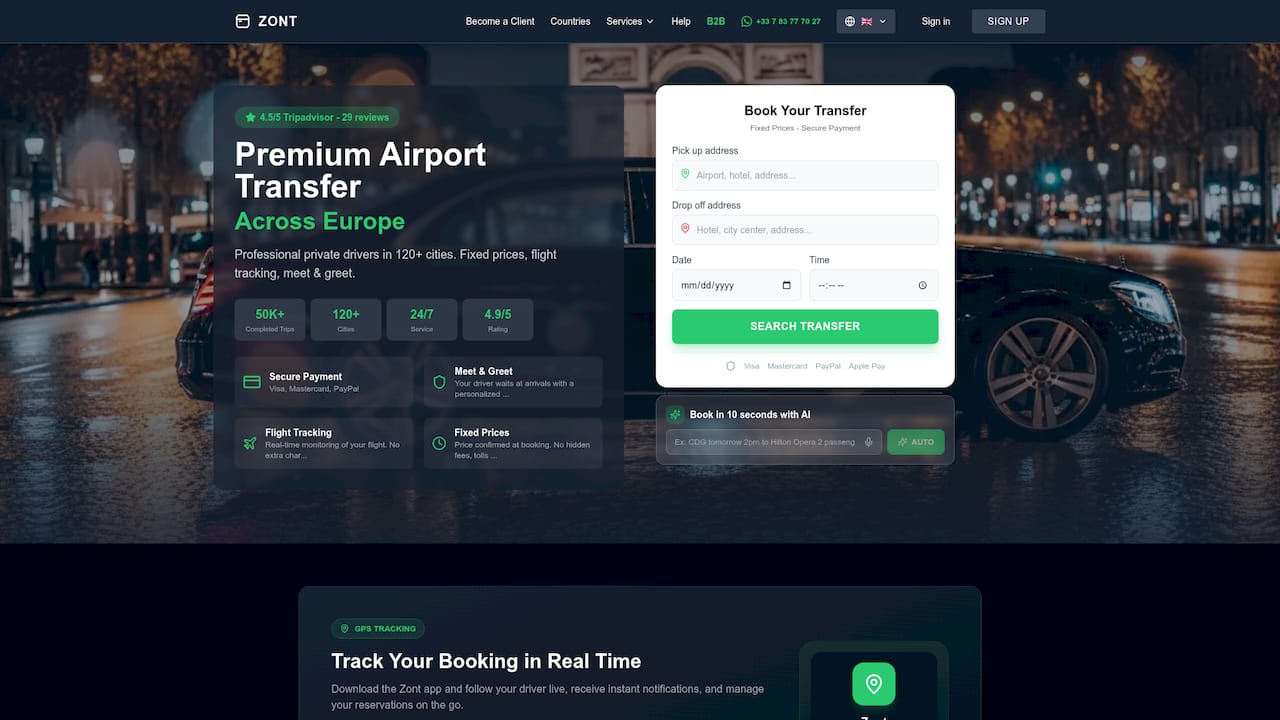
Zont Cab monitors live flight arrivals and adjusts driver dispatch timing automatically, so your transfer is waiting when you clear customs, not 20 minutes later. With fixed pricing, no hidden fees, and coverage across airport transfers throughout Europe, Zont Cab turns the data advantage of flight tracking into a complete, stress-free arrival. The service holds a 4.5-star rating on TripAdvisor across more than 50,000 completed trips. Booking takes two minutes, and your driver tracks your flight from the moment you depart.
FAQ
What is a flight tracking service?
A flight tracking service is a platform that aggregates live data from ADS-B transponders, radar, satellite feeds, and airline schedules to display real-time aircraft position and flight status information.
How early do flight tracking apps send delay alerts?
Flight tracking apps send delay and gate change notifications up to 30 minutes before official airline apps, giving travelers a meaningful head start on rebooking or adjusting plans.
Why does a flight disappear from tracking over the ocean?
Coverage gaps over oceans occur because ADS-B ground receivers do not reach those areas. Satellite ADS-B fills part of the gap, but update intervals are longer. The absence of tracking data does not indicate a safety issue.
Are paid flight tracking subscriptions worth the cost?
Paid tiers, which range from $4.99 per month to $59.99 per year, add predictive delay scores, full inbound aircraft history, and faster alerts. For frequent travelers, the value of one avoided missed connection exceeds the annual subscription cost.
How does flight tracking improve airport transfers?
Live arrival data lets ground transportation providers adjust pickup timing based on actual landing times rather than scheduled arrivals. Services like Zont Cab use this data to time driver dispatch precisely, eliminating unnecessary waiting at the terminal.