How Transfer Companies Monitor Flight Status in 2026

Transfer companies monitor flight status by binding each booking to a specific flight number, subscribing to live status APIs, and running automated dispatch logic that reacts instantly to arrivals, delays, diversions, and cancellations. The flight number is not just a reference field. It is the unique identifier that links a passenger reservation to a physical aircraft moving through the airspace. When that aircraft’s status changes, the dispatch system changes with it.
The core data pipeline works like this:
- A passenger books a pickup and provides their flight number, which the system validates against a live schedule feed.
- The booking engine subscribes to real-time status events for that specific flight number and departure date.
- Status codes such as Scheduled, Active, Landed, Diverted, and Cancelled fire as webhook triggers into the dispatch engine.
- The engine recalculates driver release time, sends app notifications to the driver, and pushes an updated ETA to the passenger.
- On cancellation, an orphaned booking protocol automatically releases the assigned driver back to the available pool.
OAG) processes over 1 million flight status updates daily, covering 97% of worldwide flights. That scale is what makes automated dispatch viable at any volume.
How transfer companies monitor flight status: APIs and data sources
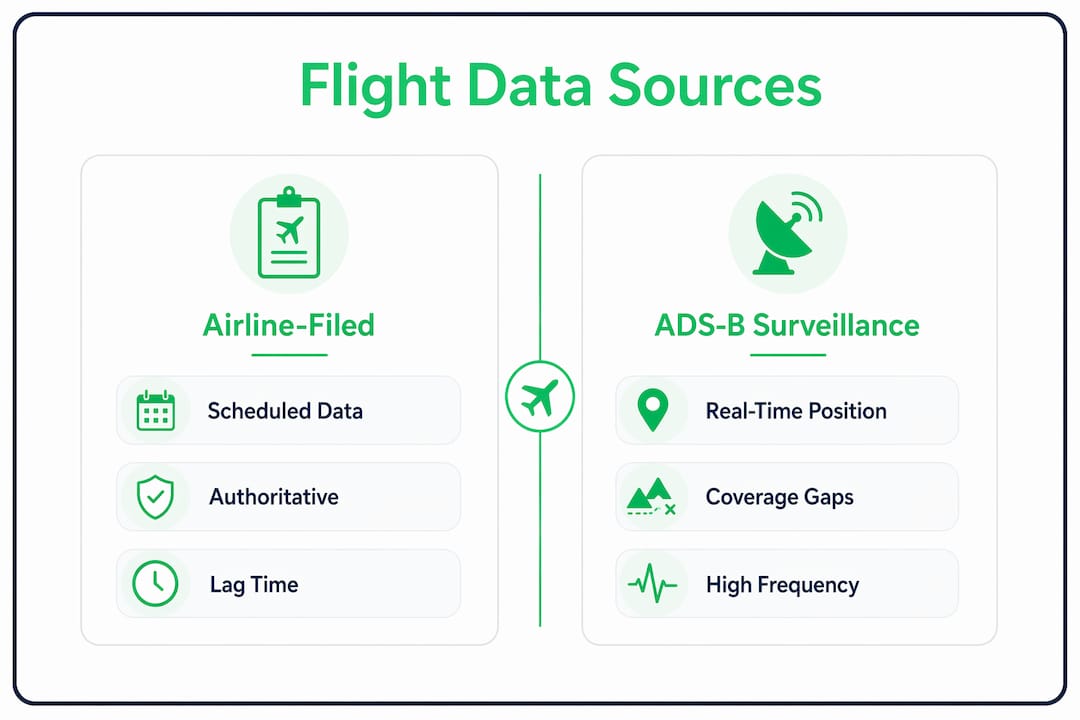
Two complementary data streams power flight status tracking for transfer operations: airline-filed schedule feeds and live ADS-B positional data.
Airline-filed feeds come from providers like FlightAware, OAG, and VariFlight. These aggregate the data airlines and airports file directly: scheduled and estimated departure and arrival times, terminal and gate assignments, baggage carousel numbers, and status codes. This is the structured, machine-readable layer your dispatch system uses to retime a job and allocate a driver. Flight information from these APIs is typically available from three days before departure through seven days after arrival, giving operators a clean window for subscription-based tracking.

ADS-B feeds are a different animal. Modern aircraft continuously broadcast their position, altitude, and speed via ADS-B transponders. Networks of ground stations receive these signals and republish them as live position streams. Where airline-filed estimates can lag the aircraft’s actual position by 5–15 minutes during final approach, ADS-B data closes that gap. For a driver timing a curbside arrival, those minutes matter.
VariFlight specializes in Asian airspace data and is particularly valuable for operators handling routes into or out of Chinese airports, where airspace complexity creates high data volatility. FlightAware’s AeroAPI and OAG cover global networks with strong North American and European depth. Most enterprise dispatch platforms normalize all these feeds into a single data schema, so the same dispatch rules apply whether the arrival airport is Chicago O’Hare or Munich.
Common integration challenges include normalizing IATA and ICAO flight number formats across data sources, handling duplicate or conflicting status events from multiple feeds, and managing webhook reliability during high-traffic periods like holiday travel surges.
What flight data points actually trigger dispatch actions
Not every data field in a flight status payload is equally useful. Transfer operations focus on a specific subset.
Essential data points to monitor:
- Scheduled arrival time and estimated arrival time (the gap between these two is your delay signal)
- Gate and terminal assignment (drivers need this before they park)
- Baggage carousel number (passengers need this the moment they land)
- On-Blocks status (the moment the aircraft docks at the gate, not just when it lands)
- Flight status codes: Scheduled, Active, Landed, Diverted, Returned, Cancelled
The distinction between “Landed” and “On-Blocks” trips up a lot of operators. An aircraft can touch down and then taxi for 10–20 minutes before reaching the gate. Dispatching on “Landed” rather than “On-Blocks” sends drivers to the curb too early, especially at large hub airports.
| Flight event | Dispatch action |
|---|---|
| Status: Scheduled | Monitor only; no driver movement |
| Status: Delay detected | Suspend dispatch countdown; recalculate release time |
| Status: Active (airborne) | Begin pre-dispatch preparation; confirm driver availability |
| Status: On-Blocks (gate arrival) | Start curbside ETA countdown with buffer applied |
| Status: Diverted | Flag to dispatcher; trigger reassignment workflow |
| Status: Cancelled | Release driver immediately via orphaned booking protocol |
Advanced systems treat these status transitions as a state machine, where each status change executes a specific physical action in the fleet. A shift from Scheduled to Delay does not just update a timestamp. It suspends the dispatch countdown and recalculates the entire driver timeline automatically.
Curbside ETA calculation adds a dynamic buffer on top of gate arrival time. Buffer values are typically around 20 minutes for domestic flights and 45 minutes for international flights, but should be tuned per airport using historical landed-to-curb data rather than applied as flat universal values.
Operational benefits of real-time flight monitoring for transfer companies
The clearest win from live flight status tracking is the elimination of ghost-flight dispatches. Without real-time monitoring, a driver gets sent to the airport for a flight that was quietly cancelled two hours ago. With an orphaned booking protocol in place, the cancellation API trigger releases that driver automatically before they ever leave the depot.
Beyond cancellations, the operational gains stack up across several dimensions:
- Reduced idle time: Drivers arrive at the curb when passengers do, not 45 minutes before. Parking fees and unpaid wait time drop accordingly.
- Accurate billing: Documented actual landing time, wait time, and any overage gives corporate accounts defensible invoice data without requiring a call to your operations team.
- Proactive passenger communication: SMS and app notifications fire on three events only: flight landed, driver dispatched, driver at pickup. Sending alerts on every minor status change creates noise that passengers learn to ignore.
- Diversion handling: A robust setup flags the job to the dispatcher with the new destination airport, calculates whether it falls within the service area, and presents pre-set resolution options automatically.
- Scalability during irregular operations: When weather or airspace restrictions hit an entire hub, a real-time system lets dispatchers manage by exception rather than manually reworking every booking in the queue.
For group airport pickups, these benefits compound. Coordinating multiple passengers across several inbound flights without live status data is essentially guesswork.
Example workflow: from booking to curbside pickup
A well-integrated dispatch system follows a clear sequence from the moment a passenger books to the moment they reach the vehicle.
- Booking capture: The flight number is a required field, validated against a live schedule at entry. The system pre-fills airport, terminal, and estimated arrival time automatically.
- API subscription: The booking engine pushes the flight number and departure date to the flight status API, opening a webhook subscription for all status events on that specific flight.
- Continuous monitoring: The system polls or receives push updates every 2–5 minutes once the flight is within two hours of arrival, comparing estimated arrival time against the scheduled time and flagging any delta.
- Auto-retiming: When a status change fires, the dispatch engine recalculates the driver release time using the updated ETA plus the configured curbside buffer.
- Driver notification: The driver app displays a single consolidated timeline: flight number, scheduled landing, current estimated landing, gate, terminal, baggage carousel, and release time. One screen, no ambiguity.
- Passenger communication: Three trigger points only. Flight landed. Driver dispatched. Driver at pickup point.
- Dispatcher dashboard: Shows all active bookings with live flight status, flagging exceptions (delays beyond threshold, diversions, cancellations) for human intervention. The dispatcher’s job shifts from building schedules to managing the exceptions the system cannot resolve automatically.
This workflow applies identically whether the arrival airport is a regional hub or a major international gateway. The underlying API schema normalizes data across geographies, so the same logic that handles a domestic arrival at Dallas/Fort Worth works for an international arrival at London Heathrow.
Best practices and advanced insights from flight monitoring experts
Design dispatch as a state machine, not a schedule. Static schedules are the primary driver of high idle costs. A system that reacts automatically to each status transition eliminates the manual rework that static planning requires.

Implement orphaned booking interception. Every cancellation that reaches a driver already en route costs money. The protocol is simple: when the API reports a cancellation against a tracked flight number, the system releases the driver before dispatch, not after.
Augment airline data with ADS-B feeds. Airline-filed ETAs lag the aircraft’s actual position during final approach. Live ADS-B feeds validate that ETA against where the plane physically is, giving dispatchers a more accurate release trigger for the driver.
Track delay history, not just current status. VariFlight’s “delta” tracking approach analyzes historical delay frequency by route and carrier. A flight that runs late 60% of the time on Tuesday afternoons should be treated differently in dispatch planning than one with a clean on-time record. This kind of risk-aware scheduling shifts operations from reactive to proactive.
Shift dispatcher focus to exception management. Cloud-native data infrastructure and machine learning models handle routine monitoring. Dispatchers should be reviewing flagged exceptions, not watching status boards for changes the system should catch automatically.
Pro Tip: Machine learning models trained on combined ADS-B surveillance data and historical delay patterns can predict arrival congestion and flag high-risk flights before the delay officially registers in the airline feed. Integrating these predictions into your dispatch engine lets you pre-position drivers rather than react after the fact.
For operators building out a reliable airport car service, these practices represent the difference between a system that handles normal operations and one that holds up under irregular conditions.
How reliable are different flight data sources?
No single data source is perfect, and understanding where each one breaks down is as important as knowing what it delivers.
Airline-filed feeds are authoritative for scheduled data but can lag real-world events by several minutes. Airlines file status updates on their own schedules, and during high-disruption periods, those updates slow down. Gate changes in particular often appear in the feed after passengers have already been redirected at the airport.
ADS-B networks provide high-frequency positional accuracy but have geographic gaps. Coverage is dense over North America and Europe, thinner over oceanic routes and parts of Asia and Africa. An aircraft crossing the Atlantic may drop off ADS-B coverage for portions of the flight, requiring fallback to satellite-based tracking or ACARS data.
VariFlight offers strong coverage in Chinese and Asian airspace, where ADS-B ground station density and airline data-filing practices differ from Western markets. For operators handling Asia-Pacific routes, this specialization matters.
The practical answer for transfer operations is to use airline-filed feeds as the primary status source and ADS-B as a validation and precision layer, particularly in the final 30 minutes of approach. Neither source alone covers every scenario. Together, they handle the vast majority of operational cases.
Data latency is also a real variable. API response times, webhook delivery delays, and normalization processing all add time between a real-world event and the moment your dispatch system sees it. Building a small latency buffer into your system architecture prevents false triggers from data that arrives out of sequence.
Data privacy and compliance considerations in flight monitoring
Flight status data itself is publicly available aviation information, so monitoring a flight number does not raise privacy concerns. The compliance exposure sits in how you handle the passenger data attached to that flight number within your booking and dispatch systems.
In the United States, the primary frameworks are state-level privacy laws such as the California Consumer Privacy Act (CCPA), which governs how personal data including travel itineraries and location information is collected, stored, and shared. If your operation serves European passengers or operates in Europe, the General Data Protection Regulation (GDPR) applies to any personal data processed in connection with those bookings.
Practically, this means several things for dispatch system design. Passenger flight details should be stored only as long as operationally necessary, typically through the completion of the trip plus any billing dispute window. Driver location data collected during active dispatch should be governed by a clear retention policy. Any third-party API provider that receives passenger-linked flight data should be covered by a data processing agreement.
For corporate accounts, the data trail is actually a feature. Documented actual landing times, wait times, and driver dispatch records give travel managers the audit trail they need for expense reporting and duty-of-care compliance. Build your data retention policy to preserve this record for a defined period, then purge it cleanly.
Key Takeaways
Transfer companies that integrate live flight status APIs with automated dispatch logic reduce idle time, eliminate ghost-flight dispatches, and deliver more accurate curbside pickups than any static scheduling system can match.
| Point | Details |
|---|---|
| Flight number as booking anchor | The flight number combined with departure date is the exact parameter for real-time API subscriptions. |
| OAG coverage scale | OAG processes over 1 million flight status updates daily, covering 97% of worldwide flights. |
| Curbside ETA buffers | Apply approximately 20 minutes for domestic and 45 minutes for international flights above gate-arrival time, but always tune these values to your airport using real landed-to-curb data. |
| ADS-B fills the gap | Airline-filed ETAs lag actual aircraft position by 5–15 minutes during final approach; ADS-B closes that gap. |
| Orphaned booking protocol | Automatic driver release on cancellation prevents fleet lock-up and eliminates costly idle time at the curb. |
Zont Cab builds every airport pickup around exactly this infrastructure: live flight tracking, automated retiming, and proactive passenger communication across over 120 cities in Europe. If you want a transfer service that adjusts to your flight before you even land, that is what Zont Cab delivers.