How the Transfer Confirmation Process Works for Luxury Transfers

A professional luxury airport transfer sends you two things: an immediate booking confirmation the moment you pay, and a reconfirmation 12–24 hours before pickup with your driver’s name, vehicle details, and license plate. If you’re not getting both, you’re not working with a serious operator.
Here’s what those messages must contain:
- Immediate booking confirmation: reservation reference, vehicle type, pickup date and time, route, and operator contact
- Reconfirmation (12–24 hours out): driver name, direct phone or dispatch number, vehicle model, color, and license plate
- Day-of update: for monitored flights, a short message confirming adjusted pickup time based on actual arrival
The single detail that separates a luxury provider from a basic one is the meeting-point instruction. “Meet at arrivals” is not a meeting point. “Door 3, Level 1, Domestic Arrivals, Terminal B” is.
Pro Tip: Screenshot your reconfirmation before you board. Airport Wi-Fi and roaming are unreliable exactly when you need them most.
Table of Contents
- How the transfer confirmation process works, step by step
- What every confirmation must include: a verification checklist
- How flight tracking and automatic updates handle delays and early arrivals
- Red flags in confirmations and how to vet a provider before you prepay
- Your day-of checklist to avoid last-mile communication failures
- What a model confirmation timeline looks like
- Why luxury providers treat confirmations as an operating plan
- Key Takeaways
How the transfer confirmation process works, step by step
The workflow starts the moment you pay, not when you land. Understanding the full sequence helps you spot gaps before they become problems at the curb.

Step 1: Immediate booking confirmation. Within minutes of payment, you should receive a written receipt with your reservation reference, pickup date and time, vehicle type, route, and a way to reach the operator. This is your proof of booking and the document you’ll reference if anything needs correcting.
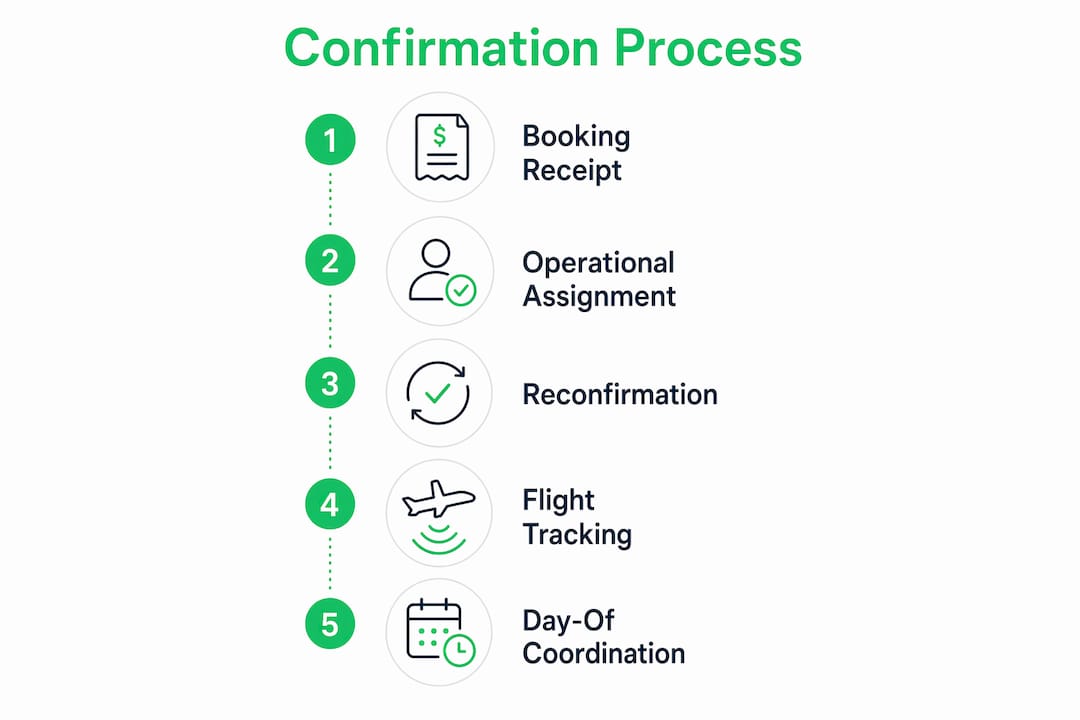
Step 2: Operational assignment. Behind the scenes, a reputable provider assigns a specific chauffeur and vehicle matched to your luggage profile and passenger count, often selecting from our luxury fleet that includes sedans, SUVs, and sprinter vans designed for premium airport transfers. Premium operations treat your reservation as a scheduled operation, not an informal pickup request. The vehicle is commercially insured and prepared for airport work.
Step 3: Reconfirmation (12–24 hours before pickup). This is where the transfer verification method earns its keep. The provider checks your flight number, terminal, and passenger count, then sends updated driver and vehicle details. A 24–48 hour check-in catches terminal changes, luggage additions, and flight edits that would otherwise cause day-of failures.
Step 4: Active flight monitoring. A serious operator doesn’t rely on your scheduled arrival time. Real-time flight tracking lets the service move the pickup earlier or later based on actual conditions, so your chauffeur isn’t standing at the curb an hour before you clear customs.
Step 5: Day-of driver update. For monitored flights, expect a message 1–3 hours before pickup confirming the chauffeur is en route, along with the vehicle description and exact meeting point.
A confirmation that locks in your reservation reference and driver details is the operating plan the chauffeur works from. If it’s vague, the handoff will be too.
Pro Tip: If your flight number changes due to a rebooking or airline switch, call the operator directly. Flight tracking follows the original number, not the new one.
What every confirmation must include: a verification checklist
Use this against any confirmation you receive. Missing fields are a signal worth acting on before you travel.
Immediate booking confirmation must include:
- Reservation reference number
- Pickup date, time, and location (terminal and door/level)
- Vehicle type and capacity
- Route or destination address
- Fare type (fixed or metered) and what’s included (tolls, gratuity, parking)
- Operator name and contact number
Reconfirmation must add:
- Driver’s full name and direct phone number
- Vehicle make, model, color, and license plate
- Confirmed meeting point (inside terminal with sign, or curbside zone)
- Wait-time policy after landing
- Flight monitoring status (confirmed active or not)
| Confirmation field | Why it matters |
|---|---|
| Reservation reference | Your proof of booking and dispute anchor |
| Driver name and phone | Direct contact if you can’t find each other |
| Vehicle model, color, plate | Safety check before you get in |
| Exact meeting point | Eliminates curbside confusion at large airports |
| Wait-time policy | Prevents surprise charges if customs runs long |
| Flight tracking confirmed | Tells you whether pickup adjusts automatically |
Meet-and-greet terminology is inconsistent across providers. Always verify in writing whether your pickup is inside the terminal with a name sign or curbside in a commercial vehicle zone. Those are two very different experiences at a busy airport like JFK or LAX.
How flight tracking and automatic updates handle delays and early arrivals
“Flight tracking included” should mean active, real-time monitoring that adjusts your pickup time without you having to call anyone. Here’s how it plays out across common scenarios.
Normal arrival: The chauffeur tracks your inbound flight, accounts for taxi-in time and baggage claim, and times the vehicle around your actual arrival rather than the scheduled one. Active flight monitoring is one of the most operationally important features a luxury transfer can offer.
Delay: The provider adjusts the chauffeur’s dispatch time automatically. You should still receive a message confirming the new pickup window, especially if the delay exceeds 30 minutes.
Early arrival: This is where many providers stumble. If your flight lands 45 minutes ahead of schedule, a chauffeur dispatched on the original timeline may not be there yet. Providers built for this scenario adjust pickup for early arrivals proactively. Ask your provider explicitly how they handle it.
Diversion or cancellation: Flight tracking won’t help here. You need to call the operator directly with your new flight number and estimated arrival. The sooner you communicate, the more flexibility the provider has.
Rebooking: If your airline puts you on a different flight, treat it as a new itinerary. Send the updated flight number to your provider before the new departure.
Even when a provider tracks your flight, a quick message from you confirming a major change adds a layer of protection. It signals you’re aware of the shift and still need the ride.
Pro Tip: Save the operator’s dispatch number as a phone contact before you board, not after you land. Searching for it in a crowded arrivals hall with low battery is avoidable stress.
Red flags in confirmations and how to vet a provider before you prepay
Vague confirmation language is a direct signal of operational discipline, or the lack of it. High-quality providers give specific meeting points; low-quality ones give phrases that shift responsibility to you.
Red flags to watch for:
- “The driver will contact you” with no direct number provided
- “Meet at arrivals” with no terminal, door, or zone specified
- No reservation reference in the confirmation email
- No stated wait-time policy
- No mention of flight tracking
- Confirmation arrives hours after payment, not within minutes
Trust signals that indicate a serious operation:
- Written reconfirmation window stated at booking (12–24 hours)
- Driver name, vehicle model, color, and plate in the reconfirmation
- Specific terminal and door in the meeting-point instructions
- Insurance and licensing statements in the booking terms
- Named escalation contact (dispatch phone or WhatsApp) for day-of issues
Before prepaying, confirm five things: operator identity, day-of contact, wait-time policy, baggage allowances, and cancellation terms. If any are missing, the booking is not fully clear.
Questions worth asking before you pay: Who specifically is responsible on the ground? What happens if my flight diverts? Is the fare fixed, and does it include tolls and airport fees? What’s the cancellation window? For a deeper look at airport transfer red flags, the pattern is consistent: vague language costs you time and money at the worst possible moment.
Your day-of checklist to avoid last-mile communication failures
Most airport pickup failures happen in the gap between booking and arrival, not because the driver is missing, but because the traveler and driver are working from slightly different information.
Before you board:
- Screenshot your reconfirmation (driver name, plate, meeting point)
- Save the operator’s dispatch number as a phone contact
- Download terminal maps for your arrival airport offline
- Confirm your phone can receive calls and texts after landing (roaming or local SIM)
- Share your booking reference and pickup point with a travel companion
After landing:
- Turn on your phone before you reach baggage claim
- Follow the meeting-point instructions exactly as written
- Call the driver’s direct number if you don’t see them within 10 minutes of the stated meeting point
- If no answer, call the dispatch number immediately
Fallbacks if something breaks down:
- Show your confirmation screenshot to airport information staff
- Use the provider’s platform support if the driver is unreachable
- Check whether the driver is waiting at an alternate exit (common at terminals with multiple customs exits)
A confirmation screenshot saved offline is your single most useful tool at the airport. It gives you the driver’s name, plate, and meeting point without needing Wi-Fi, roaming, or battery to spare.
A standardized pre-arrival routine removes the avoidable mistakes that cause most missed meetups. Five items on your phone before every trip: booking code, operator phone, pickup point, fare type, and destination address.
What a model confirmation timeline looks like
Here’s the sequence a well-run luxury transfer should follow from booking to pickup.
- At booking (immediate): Written confirmation with reservation reference, vehicle type, pickup time, route, and operator contact
- 12–24 hours before pickup: Reconfirmation with driver name, direct phone, vehicle model/color/plate, confirmed meeting point, and wait-time policy
- 1–3 hours before pickup (for monitored flights): Final update confirming chauffeur is en route and pickup time reflects actual flight status
Sample confirmation fields you should see in the reconfirmation message:
| Field | Example |
|---|---|
| Reservation reference | ZC-XXXXX |
| Driver name and phone | James R., +1 (XXX) XXX-XXXX |
| Vehicle | Black Mercedes E-Class, plate [redacted] |
| Meeting point | Terminal 4, JFK — Arrivals Level 1, Door 4, name sign |
| Wait-time policy | complimentary wait-time after wheels-down |
| Flight monitoring | Active — pickup adjusts to actual arrival |
For delays, expect a message like: “Your flight is showing a 40-minute delay. We’ve adjusted your pickup window accordingly. Your chauffeur will be at Door 4 at the updated time.” For early arrivals, a well-coordinated provider sends a proactive update rather than waiting for you to call. For diversions, the message should include a direct number and ask you to confirm your new routing.
Why luxury providers treat confirmations as an operating plan
The confirmation isn’t paperwork. It’s the document the chauffeur works from, and the gap between a vague confirmation and a precise one shows up at the curb.
The best luxury operators understand that passenger and flight details are an active operating plan, not passive administration. Chauffeur assignment, vehicle preparation for luggage profiles, and real-time flight monitoring are coordinated before the vehicle is dispatched. That’s the difference between a service built around accountability and one built around availability.
What I find most telling is how providers handle the edge cases: the early arrival, the diversion, the passenger who exits from the wrong customs door. Operators with disciplined confirmation workflows have already planned for those scenarios. They’ve named an escalation contact, stated a wait-time policy, and given the chauffeur a specific meeting point rather than a vague zone.
Zont Cab’s approach reflects this: real-time flight updates, personalized meet-and-greet protocols, and fixed transparent pricing across its fleet. With over 50,000 trips completed and a 4.5-star TripAdvisor rating, the confirmation workflow is the operating backbone, not an afterthought. For travelers who want to see what a complete booking flow looks like, the step-by-step booking guide walks through each stage from reservation to pickup.
The travelers who arrive without friction are the ones who treated the confirmation as a document to verify, not just acknowledge.
Key Takeaways
A luxury airport transfer confirmation process works in three stages: immediate booking receipt, 12–24 hour reconfirmation with driver and vehicle details, and a day-of update tied to active flight monitoring.
| Point | Details |
|---|---|
| Two confirmations, not one | Expect an immediate receipt at booking and a reconfirmation 12–24 hours before pickup with driver details. |
| Exact meeting point is non-negotiable | Terminal, door, and level must be specified in writing; “meet at arrivals” is a red flag. |
| Flight tracking changes the pickup time | Active monitoring adjusts your chauffeur’s arrival to actual flight conditions, not the scheduled time. |
| Screenshot before you board | Save driver name, plate, and meeting point offline before landing. |
| Vague language signals low discipline | Missing driver contact, no wait-time policy, or no reservation reference means ask before you prepay. |