3 Hours From Lyon Airport to Val d’Isère: Flight Tracked Transfers

For most travelers, the best route from Lyon Airport to Val d’Isère is a pre-booked private transfer: door to door, no transfers, and no standing around with ski bags. Budget travelers do well with a shared shuttle instead. The trip covers about 240 km and takes roughly 3 hours in normal conditions, so book ahead, especially during French school holidays.
TL;DR:
- Private transfers offer the most reliable, direct service, especially for families or travelers with heavy luggage, but cost more than shared shuttles.
- Shared shuttles are cheaper and operate on fixed schedules, but seats can sell out during peak weeks and delays may occur if not pre-booked.
- The typical drive from Lyon Airport to Val d’Isère is about 240 km and takes roughly 3 hours, with longer times during winter weather or peak periods.
- Booking with flight tracking, a meet and greet driver, and fixed pricing reduces the risk of delays, additional fees, or missed connections.
- During winter, pre-booking is essential to secure a transfer, especially during French school holidays, as last-minute options are limited and prices can unexpectedly increase.
Table of Contents
- Which transfer option fits your trip?
- What to expect for travel time, distance and cost
- How to choose and book without getting caught out
- Why flight tracking and fixed pricing matter more in winter
- Cancellation and refund policies for each transfer type
- Accessibility options for travelers with reduced mobility
- Handling delays and contingencies along the way
- What this trip actually teaches about winter transfers
- Booking a private transfer that matches this guide’s advice
- Where to verify schedules and arrival details
- Sources
- FAQ
Which transfer option fits your trip?
Four realistic ways exist to get from Lyon Saint-Exupéry Airport to Val d’Isère, and the right one depends on your group size, luggage, and patience for connections.
A private pre-booked transfer takes you straight from the terminal to your accommodation. The driver tracks your flight, meets you at arrivals, and handles ski bags without you switching vehicles. It suits families, groups with heavy luggage, or anyone landing late at night when public options thin out.
A shared shuttle costs less per person and runs on a set schedule between the airport and several resorts, Val d’Isère included. The catch is limited seating on weekends and during peak weeks, so pre-booking is recommended once demand spikes.
Taking the train to Bourg-Saint-Maurice and finishing the journey by bus or taxi works for travelers with a flexible schedule and light luggage. It’s usually the cheapest combination, but it adds at least one change of vehicle, which means more handling of skis and suitcases and more exposure to delays.
Renting a car gives you full control over timing but comes with conditions. Winter tires or snow chains are often required on the mountain approach, and the route includes toll sections.
- Private transfer: most reliable, best for families and heavy luggage, higher cost.
- Shared shuttle: economical, fixed schedule, seats can sell out on peak days.
- Train plus bus or taxi: cheapest for light travelers, more handling and timing risk.
- Self-drive: flexible, but requires winter driving readiness and toll payments.
Pro Tip: If you’re traveling with skis, boots, and a family of four, price out a private transfer before assuming the shuttle is cheaper. Once you add shuttle transfers or a taxi leg from the train station, the gap often narrows.
What to expect for travel time, distance and cost
The drive from Lyon Saint-Exupéry Airport to Val d’Isère covers roughly 240 km and takes about 3 hours under normal road and weather conditions, a distance that makes this one of the longer airport-to-resort runs in the French Alps.
That estimate moves around depending on when you travel. Weekend arrivals during French school holidays add traffic on the mountain approach roads, and snowfall can slow the final stretch into the resort considerably. Shuttle programs covering Val d’Isère publish seasonal timetables and connection details through Bourg-Saint-Maurice, and those windows shift as the season progresses.
Pricing follows a predictable shape. Shared shuttles sit at the economy end. Private transfers cost more but scale with vehicle size and extras rather than per-seat pricing, which often makes them better value for three or more travelers.
Before you book anything, confirm what’s actually included:
- Toll charges on the route from Lyon.
- Night or early-morning pickup surcharges.
- Extra fees for ski bags or oversized luggage.
How to choose and book without getting caught out
Start with four questions: how many people are traveling, how much luggage you’re carrying, what time your flight lands, and how much flexibility you have on cost. A family of four landing at 9 p.m. with four ski bags has a very different calculus than a solo traveler on a midday flight with a backpack.
Once you know your profile, work through this checklist before confirming anything:
- Confirm your flight number with the operator so they can track delays.
- Choose a vehicle size that matches your group and luggage, not just your headcount.
- Ask directly about the ski-luggage policy: some operators charge extra or cap the number of bags.
- Verify the exact pick-up point inside arrivals, since large airports often have more than one meeting zone.
- If you’re taking a shared shuttle during a peak week, reserve your seats as early as possible.
Watch for a few warning signs while comparing operators. A quoted “from” price with no explanation of what pushes it higher is one. No stated flight-tracking policy is another; if a driver isn’t watching your flight, a delay becomes your problem to solve alone. A vague or missing cancellation policy is the third red flag worth walking away from.
Pro Tip: Before you land, have your booking reference printed or saved offline, your phone charged with the driver’s contact number visible, and your skis boxed or bagged if your operator requires it for meet and greet.
Why flight tracking and fixed pricing matter more in winter
Winter transfers fail in predictable ways: a delayed flight leaves no one waiting at arrivals, a shuttle is already full, or a quoted fare balloons once tolls and luggage fees get added.
A transfer model built around flight tracking, meet and greet, and fixed pricing addresses each of those points directly.
- Flight tracking means the driver adjusts to your actual landing time, not the scheduled one, so a delay doesn’t strand you.
- Meet and greet puts a named driver at arrivals holding a sign, which matters more in a large airport during a busy ski weekend than it sounds.
- Fixed pricing set before departure removes the guesswork around tolls and surcharges that catches travelers out on shared services.
- Premium vehicles, including larger vans, mean ski bags and car seats fit without a second trip or a rooftop box.
- Coverage across many European cities means the same booking experience applies whether you’re flying into Lyon or connecting through another hub.
Cancellation and refund policies for each transfer type
Policies vary sharply by transfer type, and reading the fine print before you pay saves real frustration later.
Private pre-booked transfers typically offer the most flexibility: many operators allow free cancellation up to a set window before pickup, with reduced or no refund closer to the transfer time. Always check the specific cutoff stated at booking rather than assuming a standard window applies.
Shared shuttles tend to be stricter. Seats are sold against a fixed departure, so late cancellations or no-shows often forfeit the fare entirely, particularly during peak weeks when every seat is accounted for in advance.
Train tickets follow SNCF’s own fare rules, which vary by ticket class: flexible fares can be exchanged or refunded for a fee, while the cheapest non-flexible fares are usually non-refundable.
Car rental cancellation terms depend on the rental company and the rate you select; a prepaid rate is typically cheaper but harder to change than a pay-later rate.
Whatever option you choose, confirm the cancellation window and whether a late flight qualifies for an exception before you commit. A transfer that looks cheap on paper isn’t worth much if a missed connection leaves you with no refund and no ride.

Accessibility options for travelers with reduced mobility
Travelers with reduced mobility or specific medical needs have more reliable options with private transfers than with shared services.
A private pre-booked vehicle can be arranged with advance notice of mobility requirements, whether that means extra time for boarding, a specific vehicle type, or assistance with luggage at both ends of the journey. Because the vehicle and driver are dedicated to your booking, there’s no fixed schedule to accommodate and no other passengers to coordinate around.

Shared shuttles and trains are harder to adapt. Shuttle seating and boarding are built around a set schedule, and the last-mile bus or taxi connection from Bourg-Saint-Maurice adds another point where support isn’t guaranteed. If you have a wheelchair, a mobility aid, or need step-free access, it’s worth contacting the operator directly before booking rather than assuming standard provisions.
Val d’Isère’s own access guidance covers local drop-off points and practical notes for arriving travelers, which is a useful check before you finalize any booking involving specific accessibility needs. Whatever transfer type you choose, flag any mobility requirement when you book rather than at pickup, since that’s when an operator can actually plan for it.
Handling delays and contingencies along the way
Winter transfers to the Alps run into delays often enough that it’s worth planning for one rather than hoping to avoid it entirely.
Flight delays are the most common disruption, and they matter most for shared shuttles and pre-scheduled pickups. If your flight lands late, contact your transfer provider immediately. Anyone offering flight-tracking as part of their service will already have adjusted; anyone who isn’t tracking your flight needs a call the moment you know you’re delayed.
Road conditions are the second major variable. Snow and traffic on the final approach into Val d’Isère can add real time to a 3-hour drive, particularly on a weekend during a French school holiday week. Build in a buffer rather than booking a transfer with a tight connection on the other end.
If you’re on a shared shuttle or train connection and miss your scheduled departure, have a backup plan ready: a taxi number, the next available shuttle slot, or a private operator you can call directly. Keep your booking confirmation and driver contact details accessible offline, since mountain connectivity isn’t always reliable the moment you need it most.
What this trip actually teaches about winter transfers
The conventional advice here treats the train-plus-bus route as the smart budget move, and on paper it often is. What that advice skips is the handling cost: two changes of vehicle with ski bags, a tight connection window at Bourg-Saint-Maurice, and zero flexibility if your train runs late.
The bigger issue with most transfer research is that it treats Lyon to Val d’Isère like a short airport hop. At roughly 240 km and 3 hours, it’s a genuine long-distance transfer, and the things that go wrong on a long winter drive (traffic, weather, a late flight) are exactly what a fixed schedule or a multi-leg journey handles worst.
If there’s one thing worth prioritizing, it’s not price per seat. It’s whether the operator is actually watching your flight and whether the price you’re quoted is the price you’ll pay. Everything else, vehicle comfort included, matters less than those two things once you’re standing in arrivals at 10 p.m. with ski bags and a resort still three hours away.
— Arthur
Booking a private transfer that matches this guide’s advice
If you’ve decided a private transfer is worth the extra cost for this trip, the booking itself should take a few minutes, not a few tabs of comparison. Some private transfer providers run pre-booked services with flight tracking, a driver meeting you inside arrivals, and fixed pricing agreed before you travel, which is especially beneficial for a long, weather-dependent transfer like Lyon to Val d’Isère.
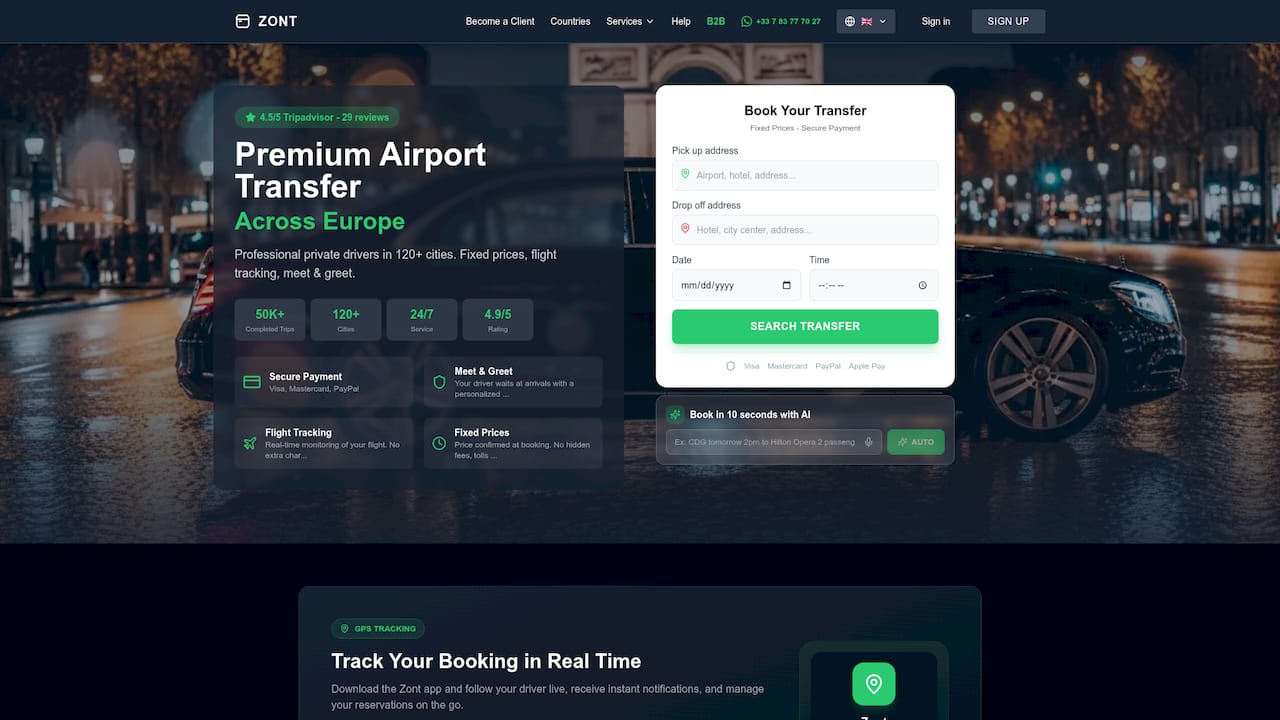
For a group with ski bags, a 7-seat van avoids the multiple trips a standard sedan would need. Before you confirm, check three things: the vehicle size matches your group and luggage, the ski-baggage policy is stated upfront, and the pick-up point inside Lyon Saint-Exupéry is clear so you’re not searching arrivals for a driver.
- Flight tracking adjusts your pickup automatically if your flight lands late.
- Meet and greet means a driver is waiting inside arrivals with your name visible.
- Fixed pricing is confirmed at booking, with no surprise tolls or surcharges added afterward.
Zont Cab covers transfers across more than 120 cities in Europe, so the same booking process applies whether you’re flying into Lyon or connecting elsewhere on your way to the Alps. You can check vehicle options and availability on Zont’s European transfer page.
Where to verify schedules and arrival details
Check Val d’Isère’s official access page for resort drop-off points and local practicalities, and Lyon Aéroport’s ski shuttle page along with its seasonal shuttle program PDF for current shuttle timetables and stations served.
Sources
FAQ
Which airport is best for flying into Val d’Isère?
Lyon Saint-Exupéry Airport (LYS) is the main gateway, sitting roughly 240 km from Val d’Isère with a drive time of about 3 hours. It has the widest range of transfer options, including private transfers, shared shuttles, and train connections through Bourg-Saint-Maurice.
How long does the transfer from Lyon to Val d’Isère take?
In normal conditions, the drive covers about 240 km and takes roughly 3 hours. Weekend traffic, snowfall, or peak school-holiday demand can extend that on the final mountain stretch, so it’s worth building in a buffer.
How do I get to Val d’Isère from Lyon Airport?
The most reliable option is a pre-booked private transfer, which takes you directly from the terminal to your accommodation without changing vehicles. Budget travelers can take a shared shuttle or combine a train to Bourg-Saint-Maurice with a local bus or taxi for the final leg, though both require pre-booking during French school holiday weeks.
Do I need to pre-book a transfer in winter?
Yes, pre-booking is strongly advised, since shuttle seats sell out during peak French school holiday weeks and weekend arrivals. Private transfers also fill up fast during these windows, so confirming your booking well ahead of travel avoids being left without a reliable option.
What should I check before booking a private transfer?
Confirm the vehicle size fits your group and luggage, ask about the ski-baggage policy, and verify the exact pick-up point inside arrivals. Some private transfer services set pricing at the time of booking and track flights automatically, allowing pickup times to adjust if the flight is delayed.