Avoid Night Surcharges: 7 VTC Fare Steps Backed by French Law

VTC operators can legally add a night surcharge to airport rides, but nothing forces them to, and they must show you the final price before the trip starts. If you’re booking late at night or during an early flight, the safest move is a pre-booked, fixed-price transfer rather than gambling on an app quote generated at 2 AM. Get a written price or confirmed fixed fare before you get in the car.
TL;DR:
- Night surcharge rules for taxis are regulated and capped, while VTC operators have flexible pricing that must be disclosed before the ride begins.
- Many VTC companies either include a no-surcharge policy or apply variable night surcharges between 10% and 50%, depending on the operator.
- Fixed airport fares are either government-regulated and exclude night surcharges or established by private contract, so confirm in writing to avoid surprises.
- Booking a fixed-price transfer with flight tracking and clear documentation provides the best protection against late landing fees.
- Always request a detailed, itemized receipt after the ride to verify charges and retain evidence in case of disputes.
Table of Contents
- Majoration Nuit VTC Aéroport: What the Law Actually Says
- When Do Night Surcharges Usually Kick In?
- How Do Airport Fixed Fares Interact With Night Fees?
- Booking Checklist: 7 Steps to Avoid Surprise Night Charges
- What Should Your Receipt Show, and How Do You Dispute a Charge?
- Why Fixed-Price Night Transfers Beat Guessing at 3 AM
- Book a Night Airport Transfer With One Price, No Surprises
- Sources
- FAQ
Majoration Nuit VTC Aéroport: What the Law Actually Says
Taxis and VTCs play by different rulebooks, and that gap is exactly why night pricing at French airports feels so inconsistent. A taxi’s fare is set by prefectural and ministerial decree, including exactly how much a driver can add after dark. A VTC, by contrast, sets its own prices. Article L3122-9 of the French Transport Code gives VTC operators pricing freedom, on one condition: the passenger has to see the final price before the ride begins.
That single rule explains most of the confusion around “majoration nuit vtc aéroport” searches. A taxi’s night majoration is a regulated, capped add on. A VTC’s night charge, if there is one, is a business decision the operator built into its own rate card, and it can vary from one company to the next, even for the same route.
For travelers comparing offers at midnight, this creates a practical split:
- Taxis: night majoration amount is fixed by decree, so it’s predictable but non-negotiable.
- VTCs: pricing is flexible, so a night surcharge might exist, might not, or might already be baked into the quoted fare.
- Either way, the price you’re shown before booking is the price that legally applies once you accept it.
The upshot: don’t assume a VTC quote at night mirrors a taxi’s night rate. Ask, or better, book something that already displays the total.
When Do Night Surcharges Usually Kick In?
Night majorations for regulated taxis typically apply between 7 PM and 7 AM, though the exact window and the amount are set out in the ministerial taxi tariff decree, which caps how much can be added and how surcharges stack with other supplements like Sunday or holiday rates.
VTCs don’t answer to that decree, so their behavior splits into two camps.
Night pricing snapshot: Some VTC operators advertise a flat “no night surcharge” policy and build the cost into one all-hours fare. Others publish a rate grid with an explicit night supplement, sometimes in the 10% to 50% range, depending on the hour and the city.
A comparison of taxi and VTC pricing across Paris, Lyon, Marseille, and Bordeaux shows just how much this varies operator to operator, even within the same market. Some regional operator rate cards, including examples for Nice airport transfers, list specific night windows and percentage add-ons right on their public pricing pages.
A few things to keep in mind before you compare quotes:
- A “no night surcharge” claim is only as good as the written confirmation behind it.
- The percentage range quoted by one operator doesn’t apply to another, so treat every figure as company-specific.
- Airport pickups at 3 AM often carry different logic than a city-to-city night ride, since waiting time and traffic conditions differ.
How Do Airport Fixed Fares Interact With Night Fees?
Some French airports operate under a regulated taxi forfait, a flat fare set by local authority for a specific route, like center-city to a named airport. Service-public’s guidance on taxi tariffs confirms that where one of these forfaits applies, drivers cannot pile a night majoration on top. The forfait is the ceiling.
VTCs work differently again. There’s no regulated forfait involved. Instead, you get a contractual fixed price, a number the company agrees to before pickup, which may or may not already include a time-of-day adjustment.
The practical difference:
- Regulated taxi forfait: government-set flat rate, night majoration excluded by rule.
- VTC fixed-price booking: company-set flat rate, night pricing already factored in or added separately, depending on the operator.
If you want zero ambiguity, choose whichever option gives you a number in writing before you travel. Both routes can work. Only one of them depends on trusting a private company’s rate card rather than a government tariff.
Booking Checklist: 7 Steps to Avoid Surprise Night Charges
Booking a 4 AM airport run shouldn’t feel like a gamble. Run through this before you confirm anything:
- Get the price in writing. Ask for a fixed quote or detailed breakdown that itemizes any night or airport supplement.
- Check the flight-tracking policy. Find out who absorbs the cost if your flight lands late, you or the driver.
- Confirm payment methods. Some drivers take cards only, others cash only. Request an itemized receipt at drop-off.
- Compare at least two quotes for the identical pickup and drop-off, ideally both fixed-price.
- For last-minute night bookings, prioritize operators that state “no night surcharge” in writing, not just in a phone call.
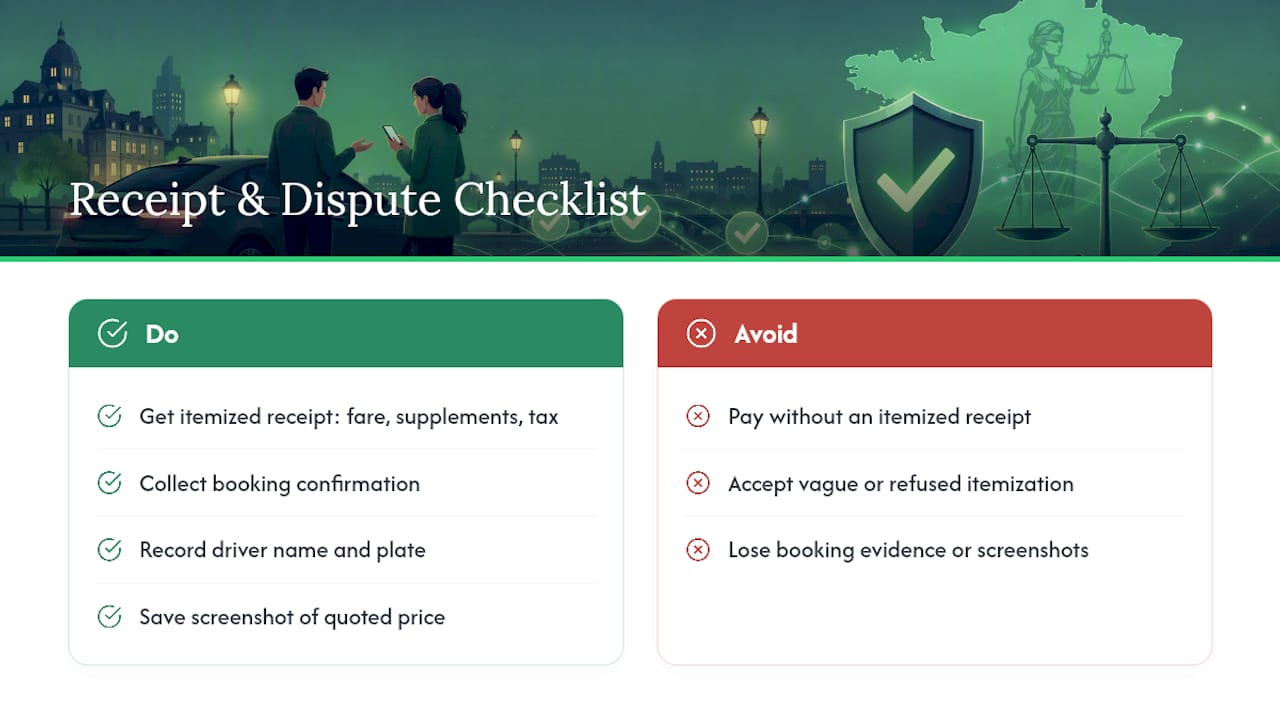
- Save your booking confirmation and driver details. You’ll need them if a dispute comes up later.
- When in doubt, book a transfer product built around price protection rather than a metered, pay-what-shows-up ride.
Pro Tip: Screenshot your quoted price the moment you receive it. If the final charge doesn’t match, that screenshot is your strongest evidence in a dispute, and it takes ten seconds to grab.
What Should Your Receipt Show, and How Do You Dispute a Charge?
A proper receipt has to break down the total cost, not just show one lump number. That means the base fare, any night or airport supplement, and the total including tax listed separately, so you can see exactly where a surcharge came from. If a driver can’t or won’t itemize the charge, that’s a red flag worth noting before you pay.
If a surcharge looks wrong, collect your evidence fast: the original booking confirmation, the driver’s name and plate number, the receipt, and any screenshot of the price you were originally quoted. A detailed chauffeur invoice makes this process far easier to walk through later.
Start with the provider directly. Most billing disputes resolve at that level. If you’re stuck, especially with a platform based outside France, the EU’s online dispute resolution portal is a legitimate next step for consumer complaints that go nowhere internally.
Why Fixed-Price Night Transfers Beat Guessing at 3 AM
Flight delays and night pricing are exactly where a pre-booked, flight-tracked transfer earns its keep. When a driver already knows your flight number and adjusts pickup time automatically, the whole “will I get charged extra for landing late” question disappears before it starts.
Zont Cab runs this model across 120-plus European cities, with a fixed price agreed before you fly and a driver waiting with a meet and greet rather than a text asking where you are. Over 50,000 completed trips and a 4.5-star TripAdvisor rating back that up. It’s not a guess dressed up as a guarantee, it’s a number you see before you commit.
— Arthur
Book a Night Airport Transfer With One Price, No Surprises
This provider replaces the guesswork of late-night pricing with one number, agreed before your flight lands, whether you’re arriving at 6 PM or 2 AM. Every booking includes live flight tracking, so a delayed landing doesn’t turn into a surprise fee, plus a driver ready with meet and greet service instead of a scramble to find your ride at the curb.
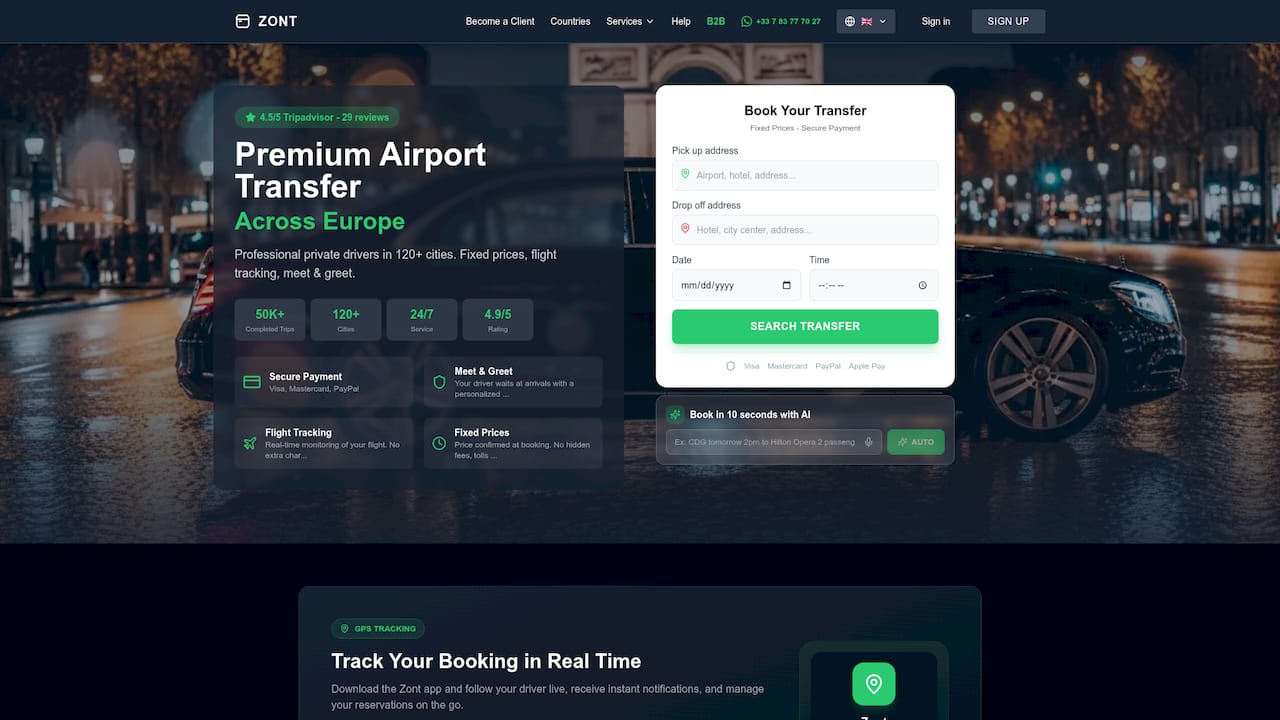
Choose from a premium sedan, a luxury sedan, or a van seating up to seven for the Paris airport transfer, covering CDG, Orly, and Beauvais. Traveling with a larger group? The 8-seat option covers the same routes without splitting into two cars. Every fare includes an itemized invoice, card and cash acceptance, and 24/7 multilingual support if your plans change. Lock in your price now rather than finding out what a night ride costs after you’ve already landed.
Sources
- Legifrance — Article L3122-9, Transport Code
- Service-public — Taxis : tarifs, dispositifs et obligations d’affichage
- Arrêté du 22 January 2024 — Taxi tariff decree (PDF)
- Tarif Taxi vs VTC 2026 : comparatif Paris, Lyon, Marseille, Bordeaux
FAQ
How Much Does a VTC Airport Transfer Cost?
Pricing depends on the route and vehicle. Zont Cab’s Orly to Paris transfer starts from €45, while the CDG to Paris route starts from €65, both fixed prices agreed before pickup.
Do Taxis or VTCs Earn More at Night?
There’s no single answer, since it depends on the city, the volume of night rides, and whether the driver owns their vehicle or works for a fleet. Taxis benefit from regulated, guaranteed night majorations, while VTC drivers depend on demand pricing and platform commission structures, which vary widely.
What’s the Average Income for a Self-Employed VTC Driver?
Earnings vary heavily by city, hours worked, and platform fees, and no single reliable national figure covers every situation. Self-employed VTC drivers set their own schedules, but income depends on local demand and how many hours they choose to work at night versus during the day.
Is There a Minimum Fare for VTC Rides?
VTC operators set their own minimum fares since Article L3122-9 gives them pricing freedom, so there’s no single national minimum the way there is for regulated taxis. Always check the quoted fare before confirming a booking, especially for short trips at night.
Does Zont Cab Charge Extra for Night Airport Pickups?
Zont Cab’s airport transfers use fixed pricing agreed before the trip, so the fare you see when booking is the fare you pay regardless of pickup time. Current routes and rates are listed on the Paris airport transfer page.