Pay a Chauffeur Online: 7 Step Checklist to Prepay Transfers Safely

Use a 3D Secure enabled card, Apple Pay, or Google Pay when prepaying a chauffeur or airport transfer, and skip bank wires, crypto, or P2P apps entirely. Authentication and tokenization shift fraud liability away from you and keep your card number out of the operator’s hands. Complete the payment on your phone’s mobile data or a trusted network, not open airport Wi-Fi, and save the confirmation screen the moment you’re done.
TL;DR:
- Using a 3D Secure enabled card or mobile wallets like Apple Pay and Google Pay offers the strongest protection for chauffeur prepayments.
- Virtual or single-use card numbers provide an extra layer of security, especially when booking with new or unknown operators.
- Avoid bank transfers, cryptocurrencies, or informal P2P payments, as they lack chargeback protections and are difficult to reverse if issues arise.
- Always generate a screenshot of your payment confirmation and check your bank statement to ensure correct billing and improve dispute resolution chances.
- Reliable operators should provide fixed pricing, clear receipts, and built-in flight tracking to minimize uncertainty and facilitate smooth refunds if needed.
Table of Contents
- Which Payment Methods Are Actually Safe for a Chauffeur Booking?
- How 3D Secure and Tokenization Actually Protect Your Payment
- Your Step-by-Step Checklist for Prepaying a Chauffeur Online
- What Happens When You Need a Refund or Dispute a Charge
- What a Well-Run Transfer Operator Builds Around Your Payment
- How Zont Lets You Prepay a Chauffeur Without Second-Guessing It
- Sources
- FAQ
Which Payment Methods Are Actually Safe for a Chauffeur Booking?
Not every payment option carries the same protection, and the differences matter more for an airport transfer booked weeks in advance than for a $12 coffee.
Cards with 3D Secure are the baseline. When your bank supports 3DS authentication, a fraudulent charge typically becomes the issuing bank’s problem to resolve, not yours, because the authentication step shifts liability toward the card issuer. That single design choice is why 3DS has become close to universal on legitimate travel booking sites.
Apple Pay and Google Pay often beat a typed-in card number for security. Both replace your actual card details with a device-specific token and pair it with a fingerprint, face scan, or passcode, so the merchant never sees your real number at all. On a phone screen at a gate, this also happens to be the fastest checkout option, which matters when you’re booking a return transfer between connecting flights.
Virtual or single-use card numbers, if your bank or a fintech app offers them, add another layer. They mask your real account number, and travel-security guidance regularly recommends them for one-off online travel purchases precisely because a compromised virtual number can be shut off without touching your main card.
Bank transfers (SEPA or otherwise) work, but they’re the weakest option here. They’re slow to clear, painful to reverse, and leave you with little recourse if a booking goes sideways.
A short list worth remembering before you check out:
- Prefer 3DS-enabled cards or mobile wallets over typed card numbers
- Use a virtual card number if your bank offers one, especially for a new operator
- Treat SEPA transfers as a fallback, never a first choice, for prepaid travel
- Never wire funds, pay in crypto, or use informal P2P apps to prepay a driver
How 3D Secure and Tokenization Actually Protect Your Payment
The technical terms sound intimidating, but the mechanics are simple once you see how they fit together.
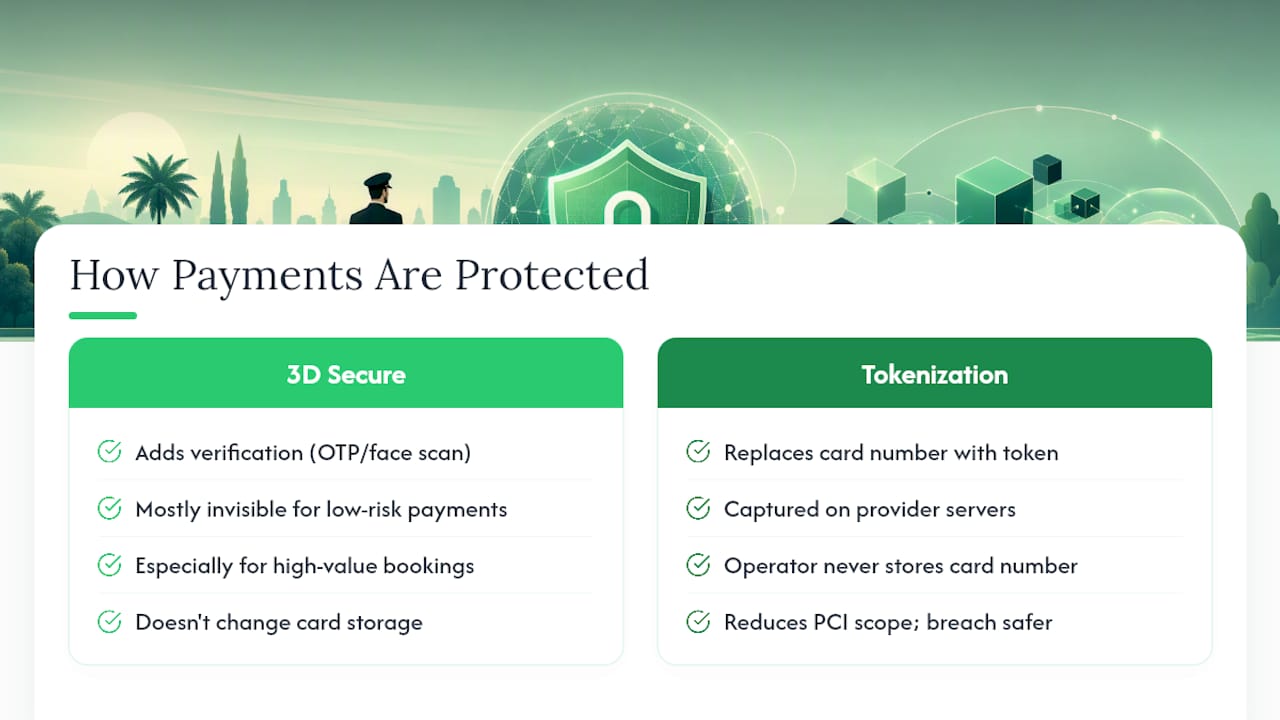
3D Secure, often called SCA (Strong Customer Authentication) in Europe, adds a verification step, a fingerprint, a one-time code, a face scan, when a payment looks risky enough to warrant it. Low-risk transactions frequently sail through with no visible step at all, since modern 3DS2 flows are designed to stay invisible unless the transaction actually needs a second check. That’s worth knowing if you’ve avoided prepaying because you pictured a clunky extra login screen every time. For a high-value, future-dated booking like an airport transfer, this authentication step is exactly the kind of transaction that benefits from it.
Tokenization solves a different problem. Instead of an operator storing your actual card number, a hosted checkout page or embedded payment form captures your card details directly on the payment provider’s servers and hands the operator a token instead.
The most secure setups keep raw card data entirely inside the payment provider’s environment. When an operator uses a hosted or embedded checkout, its own systems never touch your card number, and that single fact is what shrinks its PCI DSS compliance burden dramatically.
That drop in what’s called PCI scope isn’t just a compliance detail for the operator. It’s the reason a data breach at a chauffeur company’s booking system, in a worst case, wouldn’t expose your card number at all, because that number was never stored there to begin with.
Your Step-by-Step Checklist for Prepaying a Chauffeur Online
Follow this sequence and you’ll close most of the common gaps travelers leave open when booking a transfer from a phone in an airport lounge or a hotel lobby.
- Switch off public Wi-Fi. Use mobile data or a VPN instead. Open networks are a known vector for intercepted payment credentials, and this one habit closes off the easiest attack.
- Turn on two-factor authentication on the email account you’ll use for booking confirmations, if it isn’t already active.
- Choose your payment method deliberately. A 3DS-enabled card, Apple Pay, or Google Pay comes first. Generate a virtual card number if your bank supports it and this is a new operator.
- Enter your flight number and a live contact phone number in the booking form. The flight number triggers automated tracking on the operator’s end, which is what lets a chauffeur adjust pickup timing when your flight lands early or late.
- Screenshot the confirmation page the moment payment clears, including the total charged and booking ID.
- Check your bank statement in the days after booking to confirm the descriptor matches the operator’s name, and set a reminder if a balance is due closer to travel dates.
- Get the refund policy in writing before you pay, especially for bookings made months ahead, and confirm exactly when any remaining balance will be charged.
Pro Tip: Save your booking confirmation and any email correspondence in one folder before you even leave for the airport. If a dispute ever comes up, having a clean paper trail from day one cuts resolution time dramatically.
For a deeper look at timing and deposit structures specifically for transfers, see this guide to prepaying airport transfers safely. And if you’re wondering whether that “free Wi-Fi” sign in the car is actually safe to use for anything payment-related, it’s worth understanding the risk first.
What Happens When You Need a Refund or Dispute a Charge
Most premium operators use one of two prepayment structures: a partial deposit at booking with the balance charged closer to the ride, or full prepayment upfront with a defined cancellation window. Full prepayment tends to come with better pricing; deposits give you more flexibility if plans shift.
Refund speed depends on two separate clocks. The operator has to approve and process the refund on their end, and your bank then has to post it, which can add several business days on top of whatever the operator’s own turnaround is. An operator that processes refund requests quickly is doing you a real favor here, because the second clock is largely out of your control.
Documentation speeds everything up:
- Your booking confirmation ID and the original receipt
- Screenshots of the payment confirmation screen
- Any airline notification showing a flight change or cancellation
- Email correspondence with the operator about the refund request
If an operator stalls or refuses a legitimate refund, your card issuer is the next step, not the first one. A chargeback is a real safety net, but it’s meant as a last resort after you’ve given the operator a fair chance to resolve things directly.
What a Well-Run Transfer Operator Builds Around Your Payment
A payment page is only as trustworthy as the operations behind it. Flight tracking, personalized meet and greet, and fixed pricing aren’t just service perks, they’re what makes a prepayment low-risk in the first place; clear meeting instructions and a helicopter safety briefing are similarly important for operational safety and passenger confidence. When a driver already knows your flight number and adjusts for a delay automatically, there’s no ambiguous pickup window for either side to dispute later.
Clear receipt descriptors matter more than travelers realize. A statement line that clearly reads as the operator’s name, paired with a confirmation email, is exactly what reduces friendly fraud, those cases where a traveler genuinely doesn’t recognize a charge weeks later and disputes it unnecessarily. Fixed pricing removes a second point of friction: no surprise surcharge means no reason to second-guess the charge on your statement.
How Zont Lets You Prepay a Chauffeur Without Second-Guessing It
If you’ve read this far, you know what a safe prepayment setup looks like: authenticated checkout, tokenized payment handling, fixed pricing, and a clear paper trail. Zont Cab is built around exactly that combination for private transfers and chauffeur bookings across more than 120 cities in Europe.
On a Zont Cab payment page, you can expect a hosted checkout that keeps your card details off the operator’s own systems, a fixed price agreed before you pay, and a confirmation email with a clear, recognizable receipt. Flight tracking is built into the booking itself, so the flight number you enter isn’t just a form field, it actively adjusts your pickup time if your flight runs early or late.
- Fixed pricing shown before you confirm, with no surprise line items on your statement afterward
- A booking record and receipt clear enough to resolve any question fast, without a drawn-out dispute
Ready to book? Check availability and pricing for your route on the Zont airport transfer booking page, or look at a specific route example like the Paris transfer page to see fixed pricing in action before you commit.
Sources
- Secure travel payments — a practical guide | Stripe
- Secure travel payments — a practical guide | felloh
FAQ
Is It Safe to Pay a Chauffeur Online in Advance?
Yes, when the payment page uses 3D Secure authentication and tokenized or hosted checkout, prepaying is generally safer than paying cash on arrival since the transaction is authenticated and traceable.
What’s the Best Payment Method for Booking a Private Transfer?
A 3DS-enabled credit card or a mobile wallet like Apple Pay or Google Pay is the strongest combination of security and convenience for prepaying a chauffeur service.
Why Shouldn’t I Pay a Chauffeur via Bank Transfer or Crypto?
Bank transfers and crypto payments are difficult or impossible to reverse if something goes wrong, unlike card payments, which carry chargeback protections through your issuing bank.
What Should I Do if My Chauffeur Booking Gets Canceled?
Request a refund in writing with your booking ID and confirmation screenshot, expect the operator’s processing time plus your bank’s posting time, and contact your card issuer only if the operator doesn’t resolve it directly.
Does Zont Cab Use Secure Payment Processing?
Zont Cab uses hosted checkout with fixed pricing and clear receipts across its European coverage, letting travelers prepay transfers without their card details passing through the operator’s own systems.