Real Time Flight Tracking Transfer Service for Luxury Travelers

Book a luxury transfer that actively monitors your flight by flight number, adjusts driver dispatch to live status events, and sends you automated notifications from touchdown to curbside. That is the single requirement that separates a professional airport transfer from a glorified rideshare. Three things to confirm at booking: the provider monitors your flight number continuously, your chauffeur stays assigned through any delay, and you receive automated status notifications without having to call anyone.
- Flight-number monitoring active from booking confirmation
- Chauffeur held through delays, not released at scheduled arrival
- Automated notifications sent at key milestones: driver en route, staged, updated ETA
Table of Contents
- Why does real-time flight tracking transform your airport transfer?
- What should a flight-tracking luxury transfer actually deliver?
- How do flight tracking and event-based dispatch work behind the scenes?
- How do you choose a reliable luxury transfer with real-time flight tracking?
- What should you expect for booking windows, wait times, and pricing?
- Traveler checklist: what to give your provider and what to expect at pickup
- What should you check before sharing your flight and personal data?
- How does a flight-tracking-first operator actually run a transfer?
- Key Takeaways
- What a dispatcher actually prioritizes — and why it matters to you
- Zont Cab: a flight-tracking-first transfer service for Europe
Why does real-time flight tracking transform your airport transfer?
The operational case is straightforward. Precision dispatch prevents drivers from idling at the curb or in staging areas, which cuts parking fees and aligns curbside arrival with actual passenger readiness. For you, that means your car is there when you walk out, not ten minutes before or twenty minutes after.

The passenger burden shift matters just as much. Automated event-based workflows handle delays without you lifting a finger. You do not call the dispatcher. You do not text the driver. The system catches the event and adjusts. Dispatch teams then focus on genuine exceptions rather than manually refreshing flight status pages for every booking in the queue.
At scale, the efficiency gains are real. Reducing idle time by even 15 minutes per pickup compounds quickly across a fleet, freeing vehicles for additional runs and reducing fuel burn. For the traveler, the downstream effect is a provider with more capacity to respond when something genuinely goes wrong.
Pro Tip: If your flight arrives early, a tracking-enabled provider catches it automatically. Check out why early arrivals complicate transfers to understand exactly how that edge case gets handled.
What should a flight-tracking luxury transfer actually deliver?
Flight-integrated dispatch is a core capability for premium transfers, not an optional feature. Here is what a properly equipped provider delivers:
- Flight-number monitoring: Live status checked continuously, not just at scheduled arrival
- Terminal and gate awareness: Driver directed to the correct arrival hall, updated if the gate changes
- Traffic-aware routing: Ground route adjusted in real time so the driver is not stuck when you land
- Automated chauffeur communications: Driver receives updated instructions without dispatcher phone calls
- Meet & greet: Name board, designated meeting point, and baggage assistance confirmed at booking
- Fixed pricing: No meter running while your flight is delayed; the quoted price holds
On notifications, expect at minimum: a driver-assigned confirmation after booking, a “driver en route” alert roughly 30–60 minutes before your adjusted ETA, a “driver staged” message when the car is at the terminal, and a change alert if anything shifts. Providers that send proactive driver-location updates reduce passenger anxiety and eliminate the “where is my car?” call entirely.
A luxury transfer with genuine flight tracking means the driver knows your flight landed before you’ve turned your phone off airplane mode. The best operators stage the chauffeur based on your predicted curbside time, not your scheduled gate arrival — so you walk out to a car, not a wait.
How do flight tracking and event-based dispatch work behind the scenes?
Professional operators pull from three data layers. Aviation APIs deliver the primary events: wheels-down (touchdown), on-blocks (gate arrival), and diversion alerts. Airport FIDS add terminal and baggage carousel confirmation. Traffic feeds handle the ground leg, routing the driver around congestion before it becomes a problem.

The dispatch logic runs on event triggers, not clocks. When the API reports touchdown, the system calculates a custom curbside ETA by adding a dynamic buffer: typically 30 minutes for domestic arrivals (taxiing, deplaning, short baggage claim) and 45 minutes for international (customs, immigration, larger carousels). The driver is dispatched to arrive at that predicted curbside window, not at gate arrival.
Layered verification reduces false dispatches. A single API feed can lag or report incorrectly; combining it with FIDS and airline operational data catches discrepancies before the driver moves. Systems also poll aviation APIs every 2–5 minutes, triggering driver-facing updates when the ETA shifts beyond a defined threshold.
Cancellations are handled through orphaned-booking interception: when the API reports a flight canceled, the system automatically releases the assigned driver rather than leaving a vehicle locked to a flight that will never land.
Statistic callout: Idle reduction per pickup, compounded across a high-volume fleet, recovers meaningful vehicle hours daily — hours that translate directly into additional runs and lower per-trip operating cost.
How do you choose a reliable luxury transfer with real-time flight tracking?
Ask these questions before you book:
- Do you monitor by flight number, or do you rely on scheduled arrival times?
- Can you show me a sample notification sequence (driver assigned, en route, staged)?
- What is your published wait-time policy for domestic and international arrivals?
- What data sources do you use — aviation API, airport FIDS, traffic feeds?
- How do you handle a flight cancellation — is the driver automatically released?
- Is pricing fixed regardless of delay length?
Red flags to watch for:
- Provider asks you to call if your flight changes
- Wait-time policy is vague (“we’ll wait as long as needed”) with no written SLA
- No mention of flight-number monitoring — only “we check the airline website”
- Notifications are manual, not automated
For proof, ask for a screenshot of a sample notification or a short technical note confirming API integration. Then cross-reference with third-party reviews. Verified trip counts and star ratings on platforms like TripAdvisor carry more weight than testimonials on the provider’s own site. A provider with thousands of verified trips and consistent punctuality comments has demonstrated the system works under real conditions.
What should you expect for booking windows, wait times, and pricing?
Provide your flight number at booking, not the day before. The provider should begin monitoring from confirmation. Driver staging typically starts 60–90 minutes before your adjusted curbside ETA, calculated from live flight data rather than the scheduled arrival.
Standard wait-time policies for flight-tracking operators typically allow 45 minutes of free wait time for international arrivals (customs, immigration, baggage claim) and 30 minutes for domestic arrivals. Extended waits beyond those windows may carry an additional charge, so confirm this in writing. With genuine flight tracking, the driver is not staged until the system predicts you are close to the curb, which means the free-wait clock starts at the right moment rather than at scheduled landing.
Fixed pricing is the cleaner arrangement. A metered or time-and-distance model penalizes you for delays you did not cause. Fixed pricing, confirmed at booking, holds regardless of how long your flight runs late. Confirm the cancellation window too: most reputable operators offer free cancellation up to 24–48 hours before pickup, with a clear refund policy for missed connections caused by airline cancellations.
Traveler checklist: what to give your provider and what to expect at pickup
At booking, provide:
- Full flight number (e.g., AA 204, not just “American Airlines”)
- Flight date and whether it is domestic or international
- Mobile number that will be active on arrival (including country code for international trips)
- Preferred meet point: arrivals hall name board, specific gate, or hotel lobby
- Any special assistance needs: extra luggage, child seats, accessibility requirements
At arrival, expect this sequence:
- Touchdown triggers a system update; your driver receives a revised ETA
- You receive a “driver staged” notification with the chauffeur’s name, vehicle plate, and meeting point
- Walk to the designated meet point; the name board or app check-in identifies your car
- Chauffeur handles baggage; you confirm the destination and go
Pro Tip: If your phone is offline on landing, the provider’s system still tracks your flight. Before you board, confirm the meeting point in writing so you know exactly where to walk regardless of connectivity. If your flight diverts to a different airport, call the provider immediately — diversion handling varies, and late-flight transfer solutions differ by operator.
What should you check before sharing your flight and personal data?
A legitimate provider needs three things: your flight number, a mobile contact, and the pickup address. That is it. Do not share passport images unless a specific regulatory requirement demands it (rare for standard transfers).
Privacy checkpoints to run before booking:
- Ask where flight data and personal contact details are stored and for how long
- Confirm whether third-party aviation APIs process your status updates and under what data agreement
- Check that payment is handled through a secure, recognized processor — not a wire transfer or informal method
On safety: verify that chauffeurs are vetted (background-checked, licensed), that vehicles carry commercial insurance, and that the provider has a verifiable track record. Luggage handling is also worth confirming. Services like Bagzee offer separate luggage pickup and airport delivery for travelers who want to separate baggage logistics from the transfer itself. Review badges from TripAdvisor or Google with verified trip counts are the most reliable third-party signal.
How does a flight-tracking-first operator actually run a transfer?
Here is how a well-run pickup unfolds. The booking is created with the flight number bound to the reservation. Monitoring begins immediately. Six hours before scheduled arrival, the system is polling the aviation API every few minutes. At touchdown, the event fires: the system calculates the curbside ETA using the dynamic buffer (45 minutes for an international arrival), then dispatches the chauffeur to stage at the arrivals hall at that predicted window.
The chauffeur receives updated instructions on the driver app: terminal, meeting point, passenger name, and vehicle identification. No phone call between dispatch and driver. The passenger receives a “driver staged” notification. When the traveler exits customs and walks to the arrivals hall, the chauffeur is already there, name board up.
Operational outcome: the driver is not burning time in a parking structure for 90 minutes. The vehicle is productive until the system says move. Parking fees are minimized. The passenger waits zero minutes at the curb.
The difference between a provider that tracks flights and one that just checks the airline website is the difference between a system that acts on events and a person who reacts to surprises. Event-based dispatch means the driver is moving before you’ve cleared customs — not after you’ve called to ask where they are.
Zont Cab’s 4.5-star TripAdvisor rating across more than 50,000 verified trips reflects exactly this kind of operational consistency.
Key Takeaways
A real time flight tracking transfer service is only as good as its event-based dispatch: flight-number monitoring, dynamic curbside buffers, and automated chauffeur communication are the three features that determine whether you wait at the curb or walk straight to your car.
| Point | Details |
|---|---|
| Require flight-number monitoring | Confirm the provider tracks your specific flight, not just the scheduled arrival time. |
| Verify the wait-time policy | Standard is 45 minutes free for international, 30 for domestic — get it in writing. |
| Demand automated notifications | Driver assigned, en route, and staged alerts should arrive without you calling anyone. |
| Choose fixed pricing | A fixed quote holds through delays; metered billing penalizes you for airline problems. |
| Consider Zont Cab for Europe | Zont Cab covers 120+ European cities with flight tracking, meet & greet, and fixed pricing across 50,000+ verified trips. |
What a dispatcher actually prioritizes — and why it matters to you
The conventional wisdom on luxury airport transfers focuses on the vehicle: leather seats, bottled water, a professional-looking driver. Those details matter, but they are downstream of the operational system. A beautiful car driven by a chauffeur who is guessing at your arrival time is still a bad transfer.
From a dispatcher’s perspective, the first thing that matters when a booking appears is whether the flight number is bound to it. Without that, the booking is a liability. With it, the system can do its job: catch the touchdown event, calculate the real curbside window, and move the driver at the right moment. The layered verification step — cross-referencing the API event against FIDS data — is what prevents a false dispatch when an API feed lags. Staggered buffers (shorter for domestic, longer for international) are not arbitrary; they reflect the actual time distribution of how long passengers take to clear each type of arrival.
What travelers underestimate is how much the communication template matters. A chauffeur who receives a clear, updated instruction on their app — terminal, meeting point, passenger name, revised ETA — makes fewer mistakes than one who is working from a printed sheet and a phone call. The notification the passenger receives is the visible output of a system that has already done the hard work invisibly.
Zont Cab: a flight-tracking-first transfer service for Europe
If your itinerary includes a European arrival, Zont Cab is worth a direct look. The service covers airport transfers across 120+ European cities, with flight-number monitoring, automated chauffeur communications, meet & greet at the arrivals hall, and fixed pricing that holds regardless of delay length.
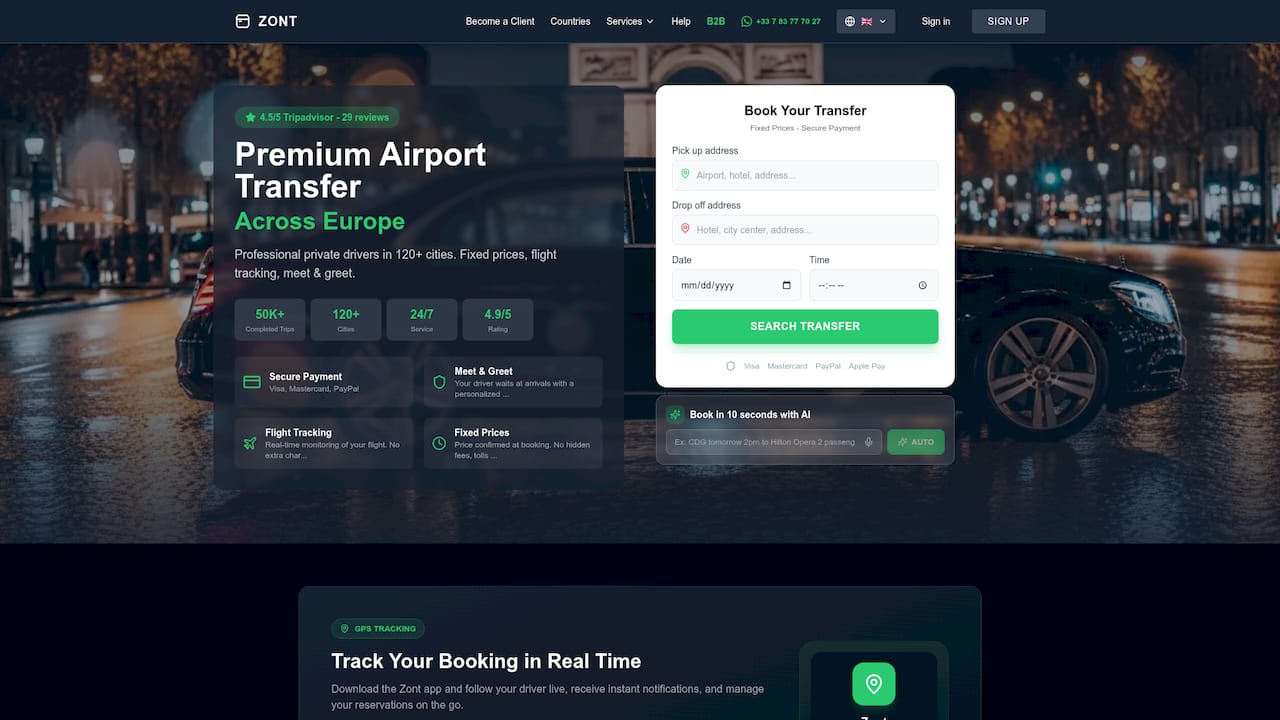
The 4.5-star TripAdvisor rating and 50,000+ verified trips are the kind of third-party signal this article told you to look for. At booking, provide your full flight number, international or domestic indicator, and mobile contact. Flight tracking activates from confirmation. Customer support is available for itinerary changes or connection questions before and during your trip.
To book or check availability across European destinations, visit Zont Cab’s Europe transfers page and enter your flight details at checkout.