Reserve a Transfer for Someone Else in 5 Minutes With Checklist

Yes, you can reserve a transfer for a third party, and every major operator expects it. The single best practice is booking a flight-aware private transfer with a declared free waiting period after landing, and gathering the passenger’s flight number, phone, luggage count, and preferred meeting point before you touch the booking form. When arrival timing matters most, whether the traveler is elderly, part of a group, or a VIP client, private and flight-tracked beats shared and hopeful every time.
TL;DR:
- Booking for a third party requires collecting the passenger’s exact full name, flight details, and contact information, and entering these separately from your own billing data.
- Private transfers are recommended for elderly travelers, large luggage, or groups larger than three, as they offer greater predictability and door-to-door service.
- Prices vary based on distance, vehicle class, and timing, with last-minute or premium bookings incurring higher fees, especially during peak periods.
- Confirm flight monitoring, terminal meeting instructions, and driver contact details with the operator before the arrival day to prevent missed pickups.
- Use platforms that include flight tracking and a fixed “free” waiting period to transfer arrival-variability risk from the traveler to the operator.
Table of Contents
- How Do You Book a Transfer for a Third Party?
- Private vs. Shared: Which Transfer Fits a Third-Party Booking?
- What Does a Third-Party Transfer Cost, and When Should You Book?
- The Information Checklist for Booking a Transfer for Someone Else
- What to Verify With the Operator Before Arrival Day
- Why Flight-Aware, Fixed-Price Booking Matters Most for Third-Party Transfers
- What I’ve Learned Booking Transfers for Other People
- How Zont Cab Handles Bookings Made on Behalf of Someone Else
- Sources
- FAQ
How Do You Book a Transfer for a Third Party?
Booking a transfer on someone else’s behalf follows the same platform, just with two identities instead of one: the person riding and the person paying. Most confusion happens when travelers try to force a single-passenger form to hold two people’s information. Get the sequence right and the booking takes five minutes.
- Gather passenger details first. You need the traveler’s full name exactly as it appears on their ID, their flight number, the arrival terminal, and a phone number that will work on landing, either roaming or a local SIM. Note luggage count and any mobility needs before you open the booking page.
- Choose trip type and vehicle size. Decide between private and shared transport, then pick a vehicle that fits the luggage and passenger count, not just the headcount. A family of four with two golf bags needs a different car than four business travelers with laptops.
- Fill the passenger and payer fields separately. Most booking systems let you enter the traveler as the passenger while keeping your own name and card as the payer. Klook’s own transfer FAQ confirms this directly: you can book a transfer for someone else as long as you enter that person’s correct details at checkout.
- Set the traveler’s phone as the primary contact. Add your own number as a backup so the driver has two ways to reach someone if the first line goes to voicemail at a busy arrivals hall.
- Give terminal-level meeting instructions. Specify the exact terminal, visible landmarks (a specific column, a coffee kiosk, arrivals exit B), and whether the driver is allowed to wait inside the arrivals hall or only curbside.
- Lock in the confirmation and forward it. Save the booking reference, screenshot the confirmation screen, and send both to the traveler along with the driver’s name and contact method the moment you receive them.
Skip step three and you’ll get a booking under your own name with no way for the operator to reach the actual rider. That single mistake causes most missed-pickup complaints in third-party bookings.
Private vs. Shared: Which Transfer Fits a Third-Party Booking?
Private transfers put one vehicle at one passenger’s disposal, with a set pickup time and no detours. Shared transfers group multiple bookings into one van, which costs less but adds stops, waiting, and a wider arrival window. Travel guides note the difference is really about predictability versus price: private transfers deliver door-to-door service, while shared options ask the passenger to tolerate someone else’s schedule.
When you’re arranging a ride for someone else, that predictability matters more than usual. You’re not there to adapt if the shared van runs 40 minutes behind. The traveler is standing alone in an unfamiliar terminal, and every ambiguous instruction becomes their problem to solve, not yours.
- Choose private for elderly parents, solo travelers unfamiliar with the destination, business clients, or any group larger than three.
- Choose shared for budget-conscious solo travelers on a flexible schedule with no early meetings.
- Choose private when luggage exceeds two bags per person or includes sports or medical equipment.
- Choose shared only when the traveler has confirmed they’re comfortable navigating a group pickup alone.
For groups of three or more, private per-vehicle pricing often lands close to what three shared seats would cost anyway, which erases the savings argument entirely.
Pro Tip: Ask the traveler directly how comfortable they are navigating an unfamiliar airport solo. That answer tells you more about which option to book than any price comparison.
What Does a Third-Party Transfer Cost, and When Should You Book?
Price depends on four things: distance, vehicle class, airport access fees, and timing. A short airport hop in a standard sedan generally costs a moderate amount, while mid-distance trips or larger vehicles for families cost more. Long routes, premium vehicles, or last-minute night pickups usually have higher prices, and holidays or event weekends may add surcharges.
- Distance and traffic patterns set the baseline fare.
- Vehicle class (sedan, minivan, premium) shifts price up for space or comfort.
- Night arrivals, holidays, and local events often add a surcharge.
- Waiting time beyond the free period after landing can add extra charges if not clarified upfront.
Same-day bookings are sometimes possible, but booking platforms commonly require several hours’ minimum notice to guarantee vehicle assignment, and that window shrinks fast during peak travel weeks. Booking 24 to 72 hours ahead covers most situations, but for holiday periods, trade shows, or major sporting events, reserve a week or more out. Availability disappears first for premium vehicles and larger family vans, exactly the categories most third-party bookings need.
The Information Checklist for Booking a Transfer for Someone Else
Copy this list before you open any booking form. Missing even one field is the most common reason a third-party pickup goes wrong.
- Passenger full name, exactly as shown on ID or passport
- Phone number capable of receiving calls or texts on arrival (roaming or local SIM)
- Email address, if the passenger will check confirmations themselves
- Number of passengers and total luggage count, including oversized items
- Flight airline, flight number, origin, scheduled arrival time, and terminal (double-check for gate or terminal changes shortly before landing)
- Any accessibility needs: wheelchair access, a booster or child seat, or extra assistance at the curb
- Payer name, invoice email, and any corporate account reference if billing goes through a company
- Meeting point details and explicit permission for the driver to enter the arrivals hall, if the airport allows it
Operators consistently ask for passenger contact and flight details specifically to enable flight monitoring and a proper meet-and-greet, so treat these fields as mandatory, not optional extras.
What to Verify With the Operator Before Arrival Day
A fixed price and a confirmation email tell you almost nothing about how the pickup will actually go. Confirm these details directly with the operator, ideally through chat or phone rather than relying only on the automated confirmation.
- Confirm flight monitoring is active and get the exact free waiting period stated in minutes after actual landing time, not scheduled arrival time.
- Get terminal- and door-specific instructions, plus the driver’s name, vehicle make, and license plate before the passenger lands.
- Ask exactly what the fixed price includes. Tolls, parking, and the waiting window should be spelled out, along with the threshold where extra charges start.
- Ask about the rebooking policy for early arrivals, delays, diversions, or missed flights, since delayed arrivals are one of the most common reasons third-party pickups fall apart.
- Send the arriving passenger a day-of packet: a screenshot of the driver’s photo if available, the direct phone number, and a photo of the meeting point.
Pro Tip: Text the driver’s contact details to the traveler the night before, not the morning of. Jet-lagged passengers scrolling through email at baggage claim miss things.
Why Flight-Aware, Fixed-Price Booking Matters Most for Third-Party Transfers
Ground transfer operators are increasingly selling something more specific than a ride: they’re selling risk transfer. Industry analysis argues that pre-arranged transfers shift arrival-variability risk from the traveler to the operator, but only when flight monitoring and a declared free waiting period are actually part of the deal. Book without those two features and you’ve just paid for a car that might not be there.
A basic “book now” button rarely manages what happens after you click it. Broader booking systems that track flights, show passenger status, and handle modifications cut down on missed pickups and billing disputes compared with simple widgets that just take a payment and a pickup time. That gap matters even more in third-party bookings, where you won’t be there to fix a problem in real time.
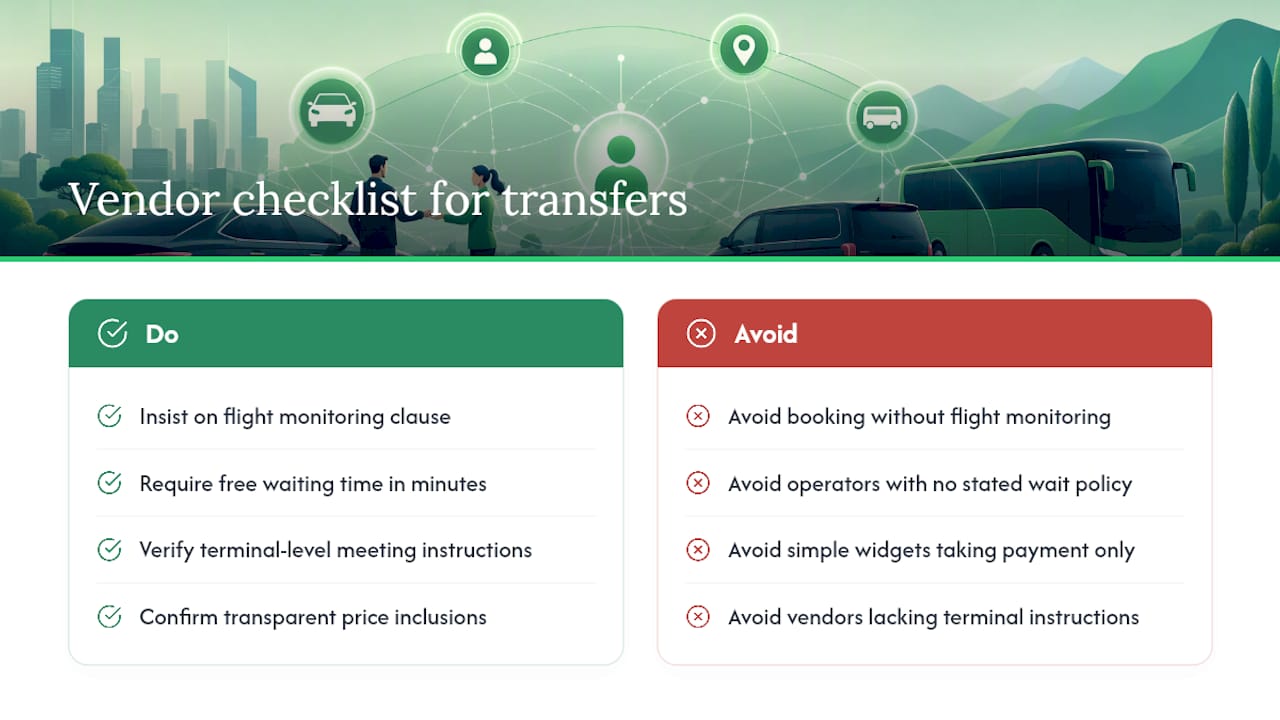
When you’re booking for someone else, insist on a flight-monitoring clause and a specific free waiting time stated in minutes after actual touchdown. That contractual clarity is what prevents disputes when long immigration lines delay your passenger past the scheduled arrival.
Before choosing an operator, run through a short vendor checklist: flight tracking, a stated wait policy, terminal-level meeting instructions, transparent price inclusions, and support that answers in the traveler’s own language if English isn’t their first choice.
What I’ve Learned Booking Transfers for Other People
The worst third-party bookings I’ve reviewed all share one root cause: the booker assumed the traveler would “figure it out” at the airport. Jet-lagged people don’t figure things out well. They stand in the wrong spot, call the wrong number, and panic.
Three rules fix most of that. Always confirm the booking is flight-aware, not just scheduled. Insist on terminal-level meeting instructions, not a vague “arrivals hall.” And send the driver’s contact directly to the passenger, never assume you’ll be reachable to relay it. Keep the booking reference somewhere you can find it fast.
— Arthur
How Zont Cab Handles Bookings Made on Behalf of Someone Else
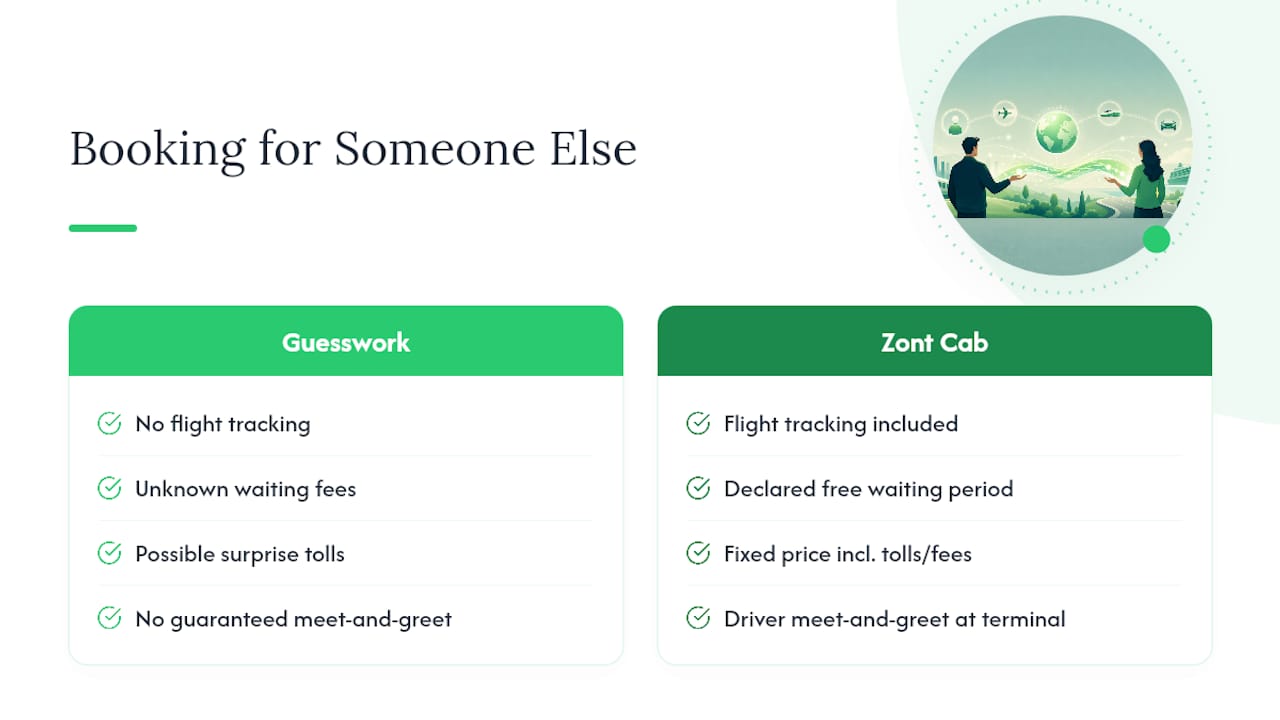
An alternative to guesswork for readers arranging a pickup they won’t personally be present for is choosing a service that includes flight tracking, a declared free waiting period, and a fixed price that covers tolls and airport fees upfront, preventing surprise charges at drop-off.
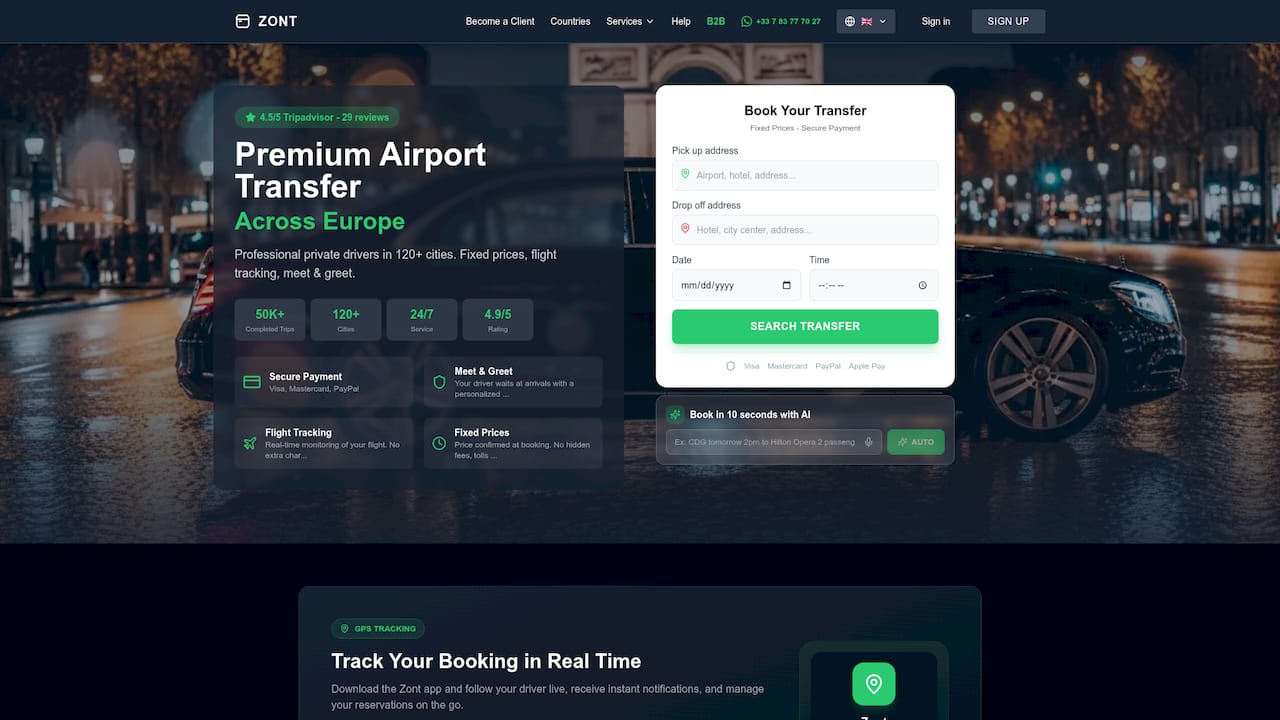
Booking for a parent flying in alone, a client landing for a meeting, or a family member you can’t personally meet at the curb all work the same way: enter the traveler’s name, flight number, and phone at checkout, and Zont Cab’s driver handles the rest with a meet-and-greet at the specified terminal. Coverage may span many cities across Europe, with multilingual support available if the traveler doesn’t speak your language, and options for premium vehicles suited to different group sizes or luggage needs. For structured, transparent rate examples in the industry, operators like Seattle Car Services publish flat-rate pricing the same way Zont Cab does, listing exactly what’s included before you book.
If you’re arranging a pickup right now, check available cities and vehicles and enter the passenger’s flight details directly. You’ll get a fixed price and a confirmation you can forward to the traveler in under five minutes.
Sources
The operational claims in this guide draw on industry coverage of arrival-risk transfer in ground transport, analysis of booking-system limitations, platform documentation from Klook’s transfer FAQ, and practical guidance on booking private transfers in advance. For more on how flight tracking actually works, see this breakdown of flight-tracking airport transfers.
- Why arrival unpredictability is reshaping the ground transfer segment
- Why Airport Transfers Need More Than a Simple Book Now Button - TechBullion
- Airport transfers - Klook
FAQ
Can I book an airport transfer for someone else online?
Yes. Most platforms, including Klook, let you enter the traveler’s name, flight number, and phone at checkout while your own details stay on the payment side.
What is a shared (collective) transfer, and is it suitable for a group trip?
A shared transfer groups multiple bookings into one vehicle, which lowers cost but adds stops and a wider pickup window. It works fine for flexible, budget-conscious groups, but private transfers are usually better when the whole group needs to arrive together on a fixed schedule.
How do I complete a transfer booking online step by step?
Enter the passenger’s name, flight number, and phone, select private or shared transport and vehicle size, confirm the payer’s billing details, then save and forward the confirmation to the traveler once it arrives.
Who pays when I book a transfer for someone else?
Whoever completes the booking is billed by default, but most systems let you enter your own card while listing a different person as the passenger, so the traveler never needs to handle payment themselves.
How do I share pickup instructions with the traveler?
Forward the booking confirmation, driver contact number, and a photo of the meeting point as soon as you receive them, ideally the night before rather than the morning of the flight.
How far in advance should I book a transfer for a third party?
Book 24 to 72 hours ahead for most routes, and a week or more out during holidays or major events, since premium vehicles and larger vans sell out first.