Up to 120 Minutes: Book a Flight Tracking Transfer That Waits for Bags

Book a transfer that explicitly names two things: flight tracking and a stated waiting-time window, so the chauffeur is contractually and operationally committed to staying until you have your bags. That single requirement removes the two failure points that ruin most airport pickups, a driver who leaves too early and a driver who has no idea your flight landed late. Some transfer providers operate this way across their coverage areas, with real-time dispatch tied to actual landing data rather than the printed schedule.
TL;DR:
- Flight tracking should be based on actual landing times rather than scheduled arrivals to ensure drivers arrive only when passengers are curb-ready.
- Waiting-time policies typically vary from 30 to 120 minutes, with international arrivals often granted longer free windows to accommodate customs and baggage delays.
- Providing detailed flight information, baggage counts, and preferred contact methods at booking helps prevent missed pickups caused by baggage or delay issues.
- Communicate with your driver using a three-message pattern: landed, delay noted if necessary, and bags in hand, to keep pickup on schedule and avoid unnecessary circling.
- Most transfer providers do not include baggage delay insurance but offer contractual waiting-time windows; separate travel insurance can cover rebooking or overtime costs.
Table of Contents
- What Does a Transfer That Handles Baggage Delays Actually Do?
- How Do You Book a Transfer That Won’t Leave Without Your Bags?
- What Should You Do Between Landing and the Curb?
- Lost or Mishandled Luggage: What Changes for Your Transfer?
- What Happens If You Miss Your Transfer Entirely?
- Does Transfer Insurance Cover Baggage-Related Delays?
- An Editorial Take on Flight-Tracking Transfers
- Book a Transfer That Actually Waits for Your Bags
- Sources
- FAQ
What Does a Transfer That Handles Baggage Delays Actually Do?
A transfer service built around baggage delays runs on three connected systems: flight tracking, a waiting-time policy, and a dispatch process that adjusts the driver’s timing on the fly. None of these work in isolation. Tracking without a stated waiting policy just tells you your driver knows you’re late, not that they’ll still be there.
Flight tracking changes when the driver actually leaves for the airport. Instead of dispatching based on the scheduled arrival printed on your itinerary, professional transfer providers monitor actual landing and gate-in times and time the driver’s arrival so they show up curbside close to when you’ll actually be curb-ready, not an hour early burning through free parking, and not late either.
Waiting-time allowances vary by provider and route type. Many professional car services build in complimentary waiting time, commonly 30 to 60 minutes for domestic arrivals and a longer window for international flights where customs add uncertainty. Some providers extend that further.
A few things worth checking before you book:
- Whether the waiting clock starts at scheduled landing or actual landing (actual landing is what you want)
- Whether the policy distinguishes domestic from international arrivals
- Whether there’s 24/7 live dispatch you can reach if something changes
- Whether the “included” waiting time is written down anywhere, not just implied
Some operators offer up to 120 minutes of complimentary waiting time on international arrivals specifically to absorb customs and baggage delays. That’s the number to ask for when you compare quotes. Read more on how transfers handle delayed arrivals for a closer look at how dispatch timing actually adjusts in practice.
How Do You Book a Transfer That Won’t Leave Without Your Bags?
Booking well means providing the provider with detailed flight information to ensure planning aligns with your specific arrival. Here’s the checklist to work through before you confirm:
- Flight number. This is what makes tracking possible at all. A pickup time alone tells the driver nothing if your flight lands two hours late.
- Baggage count and type. One carry-on versus four checked bags plus a car seat changes both vehicle choice and expected time at the carousel.
- Terminal and airport code. Large airports have multiple terminals with different pickup zones; get this wrong and you’ll be walking a long way to find your ride.
- A direct phone number or app-based messaging channel. Text works. A dead number doesn’t.
- Preferred update method. Some travelers want a text at each milestone; others want a single message once the driver is confirmed curbside.
Before you confirm, ask the provider three direct questions: Do you track my flight automatically, or do I need to call if I’m delayed? When does the waiting-time clock start? What’s the overtime rate if I go past the included window? A provider that can’t answer these clearly in writing is a red flag, and so is any waiting policy that gets vaguer the more specifically you ask about it.
To set a realistic pickup time, use curb-ready time rather than scheduled landing time: landing time, plus taxi and deplaning, plus baggage claim, plus the walk to the pickup zone. For an international arrival, it is often necessary to allow enough time past wheels-down before reaching the curb to accommodate deplaning, customs, baggage claim, and walking to the pickup zone.
Pro Tip: Copy this into your booking notes: “Flight [number], landing [time], [X] checked bags, please track flight and text when driver is dispatched, en route, and curbside. Confirm waiting-time policy for baggage delays over 30 minutes.” That one message eliminates most of the ambiguity that causes missed pickups. For more on what to declare when you book, see airport transfer luggage tips.
What Should You Do Between Landing and the Curb?
Keep your phone charged and notifications on before you land; that five minutes of battery anxiety at 30,000 feet is exactly when you don’t want your screen to die. Know roughly where your terminal’s pickup zone is relative to baggage claim. Some airports enforce strict curbside rules and route drivers to separate for-hire vehicle lots, which is exactly why holding-lot tactics matter: terminal-specific pickup rules can add a five-minute walk you didn’t plan for.
The communication pattern that works best is three short messages, no more:
- Landed. One word is enough. This tells your driver to start moving toward the pickup zone.
- Delay noted, new ETA. Only send this if baggage is taking longer than expected, with your best guess at timing.
- Bags in hand. This is the signal for the driver to be at the curb within a few minutes.
That three-message pattern resolves the vast majority of pickups smoothly and keeps your driver from circling the terminal burning time and fuel waiting on updates that never come.
If communication breaks down, know your fallback: a designated backup meeting point away from the curb (often a specific pillar, entrance number, or parking level), and a phone number that reaches a live dispatcher, not voicemail. If your delay stretches past the included waiting window, call ahead rather than showing up and hoping. Most providers will accommodate a longer wait for a fee; almost none will accommodate silence.
Lost or Mishandled Luggage: What Changes for Your Transfer?
Lost or mishandled luggage is a different problem from a slow customs line, and it needs a different response from your transfer plan. A delayed bag might mean waiting an extra 40 minutes; a mishandled bag can mean the airline tells you it will arrive on a later flight, sometimes hours away.
The first move is communication, immediately. Text or call your driver or dispatcher as soon as the airline confirms your bag isn’t on the carousel, not after you’ve finished the paperwork at the baggage service counter. This gives the provider time to decide whether to hold the driver, reschedule, or convert the booking into something else entirely.
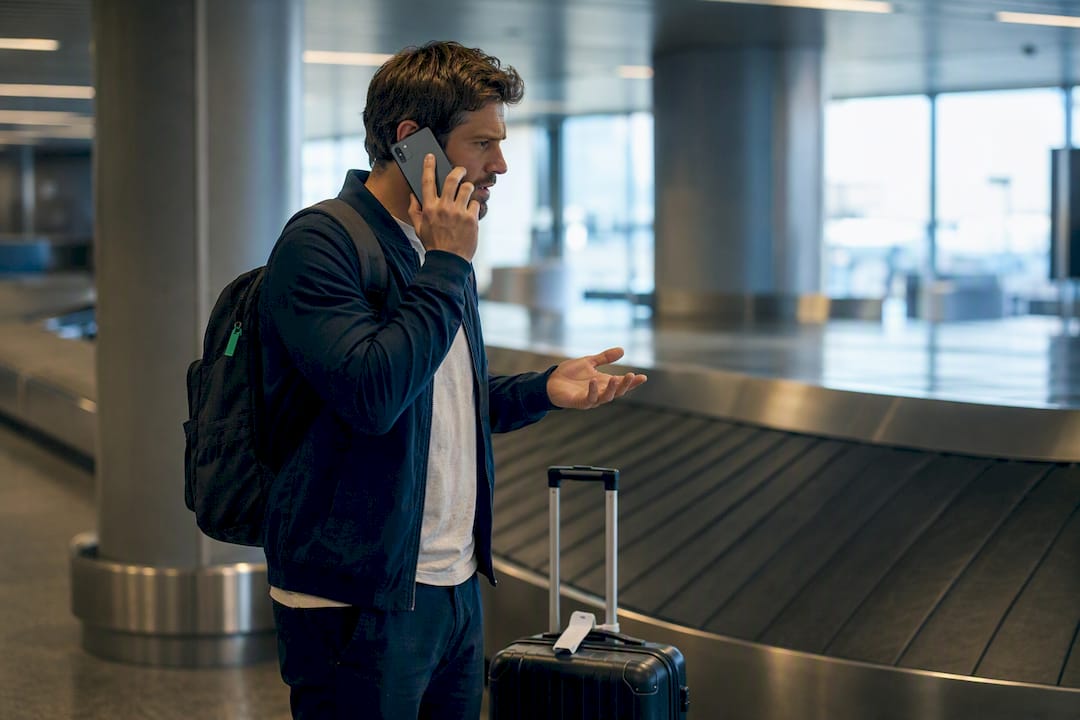
Most transfer bookings weren’t built around an open-ended wait for a bag that might not show up for hours. If the airline tells you your luggage will arrive later that day, ask your provider about options: a shorter-notice pickup once you’ve filed the report and are ready to leave without the bag, or a rebooking for when the bag actually clears. Some travelers in this situation choose to leave the airport without checked luggage and arrange delivery separately; if you need somewhere secure for bags that do arrive later before you can collect them, a local option like secure luggage storage can bridge that gap.
Don’t assume your transfer’s standard waiting-time policy covers an airline mishandling case. Ask directly. A policy built around baggage claim delays is not automatically built around bags that never come off the plane at all.
What Happens If You Miss Your Transfer Entirely?
A prolonged baggage delay, several hours rather than several minutes, can push you well past any reasonable waiting window, and that’s when you need a protocol rather than a hope. Contact the provider the moment you realize your delay is measured in hours, not minutes. Waiting until you’re finally walking out of the terminal to explain what happened wastes time you don’t have.
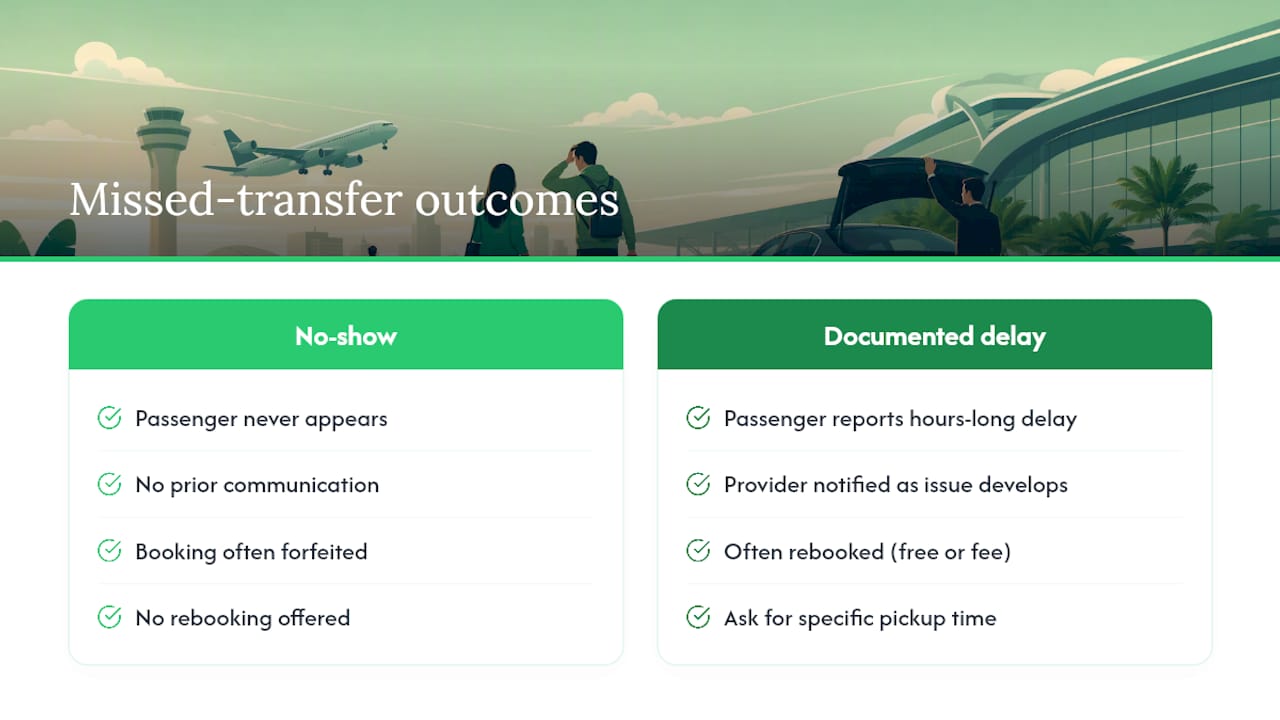
Reputable transfer providers distinguish between a no-show, where a passenger simply never appears with no communication, and a documented extended delay, where the passenger flagged the problem as it developed. The second scenario usually gets you a rebooking option, sometimes at no extra charge, sometimes for a modest rescheduling fee. The first scenario often forfeits the booking entirely, since the driver has no way to know whether to keep waiting or move to the next job.
If you know your baggage situation is bad, ask for a specific rebooked pickup time rather than an open-ended “call when I’m out.” Give the provider a new estimate the moment you have one, even if it’s rough. Overtime charges beyond the included waiting window are standard practice across the industry, and they’re almost always cheaper than the alternative of arranging a same-day replacement ride from scratch at the terminal. Read the cancellation and rebooking terms before you fly, not after you’re standing at an empty pickup zone wondering what your options are.
Does Transfer Insurance Cover Baggage-Related Delays?
Most private transfer bookings don’t carry standalone insurance against baggage delays, and it’s worth being clear about that distinction now rather than assuming coverage exists. What you’re usually working with is a waiting-time policy, not an insurance product: a stated window of complimentary wait time, followed by an overtime rate if you go past it, followed by a no-show forfeiture if there’s no contact at all.
That structure functions like insurance in practice, but it’s contractual, not underwritten. The included waiting-time window is your real protection against ordinary baggage claim delays, which is exactly why the length of that window matters so much when you compare providers. A policy offering 30 minutes leaves you exposed the moment a customs line runs long; one offering 90 to 120 minutes for international arrivals absorbs most realistic delays without triggering extra charges.
Travel insurance purchased separately, through a credit card or a standalone policy, sometimes reimburses transfer no-show fees or rebooking costs tied to documented flight delays, but that’s a claim against your travel insurer, not your transfer provider. Keep documentation: the delay notice from the airline, your communication timestamps with the driver, and the original booking confirmation. If a dispute comes up over an overtime charge, that paper trail is what resolves it quickly.
An Editorial Take on Flight-Tracking Transfers
The honest case for flight-tracking transfers isn’t that they eliminate delay risk. It’s that they shift the burden of monitoring from you to the dispatcher, at scale, which is a meaningfully different thing. A dispatch system that’s tracking dozens of arrivals simultaneously catches a gate change or a delayed landing faster than a tired traveler checking their phone in a jet-lagged fog. Zont’s operational model, applied across its coverage in over 120 European cities, works on exactly this principle: the system watches the flight so the passenger doesn’t have to.
Where I’d push back on the marketing gloss most providers put on this: no waiting-time policy, however generous, covers every scenario. A three-hour customs backlog or genuinely lost luggage sits outside what any 90 or 120 minute window was built to absorb. That’s not a flaw in the system, it’s a limit worth knowing before you fly, so you’re not surprised by an overtime conversation at exactly the moment you least want to have one.
— Arthur
Book a Transfer That Actually Waits for Your Bags
Some transfer services are built specifically to solve the waiting problem the sections above walk through: real-time flight tracking, an explicit included waiting-time window, meet and greet at the terminal, and fixed pricing with no surprise fees, across many cities in Europe. When you book, give Zont your flight number, your baggage count, and a phone number or messaging preference. That’s what lets the dispatch system adjust your driver’s timing automatically if your flight or your bags run late.
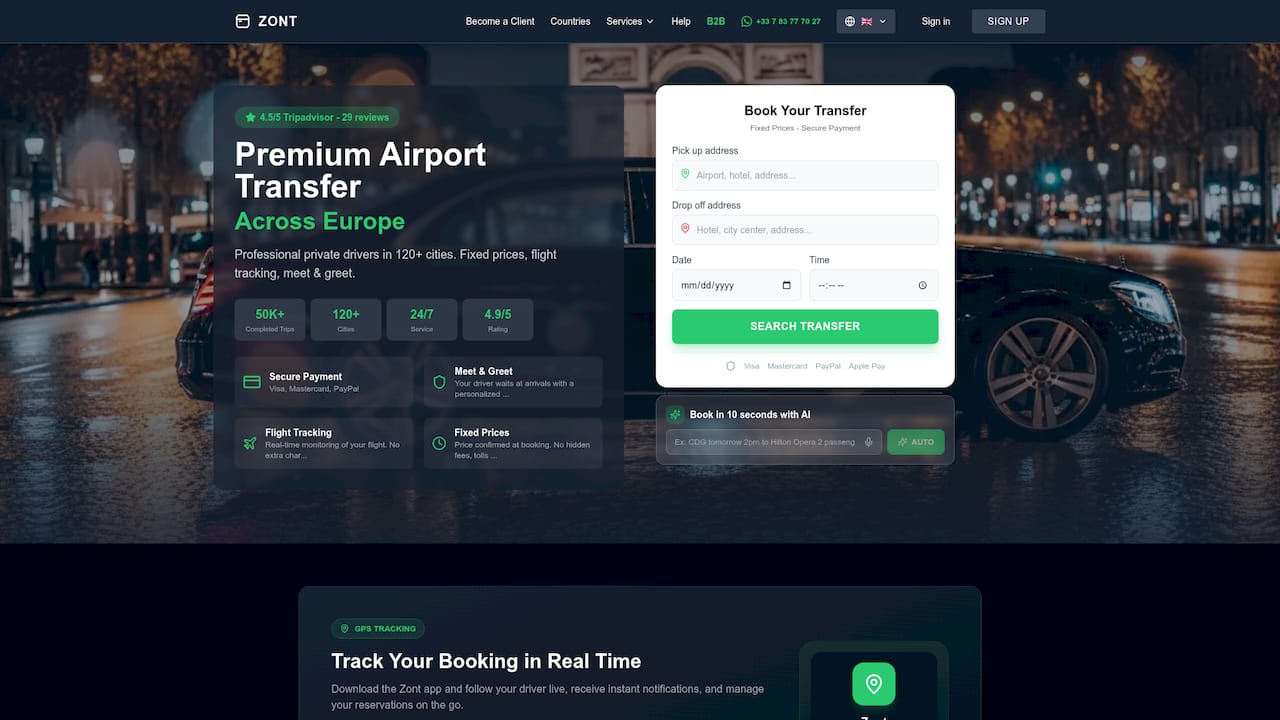
If your delay runs long, contact support directly to request extended waiting time rather than assuming the standard window covers it. For unpredictable early or late arrivals, the same logic applies in reverse. See why early flight arrivals complicate transfers for how dispatch timing works on the other side of the delay problem. Ready to book? Start at Zont’s European transfer hub and enter your flight details before you leave for the airport.
Sources
- Smooth Airport Pickup After Baggage Claim Delays: A Helpful Guide
- What to Do if Your Flight Is Delayed: Airport Pickup Plans That Reduce Stress – Salmon Confidential
- Airport Pickup Timing 2026: Avoid Costly Waiting Fees | Travel Hacks & Credit Card Points | Reise Tipps 2026
FAQ
How Long Do Transfers Typically Wait for Delayed Baggage?
Included waiting-time windows commonly run 30 to 60 minutes for domestic arrivals and up to 120 minutes for international flights, though the exact figure varies by provider. A clear waiting-time policy stated at booking helps you know your window before you fly.
What Should I Do if My Bags Are Lost, Not Just Delayed?
Contact your driver or dispatcher as soon as the airline confirms your luggage isn’t arriving on your flight, and ask about rebooking rather than assuming the standard waiting policy applies to a mishandled-bag scenario.
Does Flight Tracking Really Change When My Driver Arrives?
Yes. Providers using flight tracking dispatch based on actual landing and gate-in times rather than the scheduled arrival, which is what lets the driver time their curbside arrival to match when you’re actually ready.
What Happens if I Miss My Transfer Because of a Long Baggage Delay?
Contact the provider as soon as you know the delay is significant; documented delays with early contact usually qualify for rebooking, while unexplained no-shows typically forfeit the booking.
Is There Insurance That Covers Transfer Delays From Baggage Issues?
Most transfer bookings rely on a contractual waiting-time policy rather than insurance; separate travel insurance may reimburse overtime or rebooking fees tied to a documented flight delay, but that claim goes through your insurer, not the transfer provider.