Train Station to Hotel Transfer: Your 2026 Guide
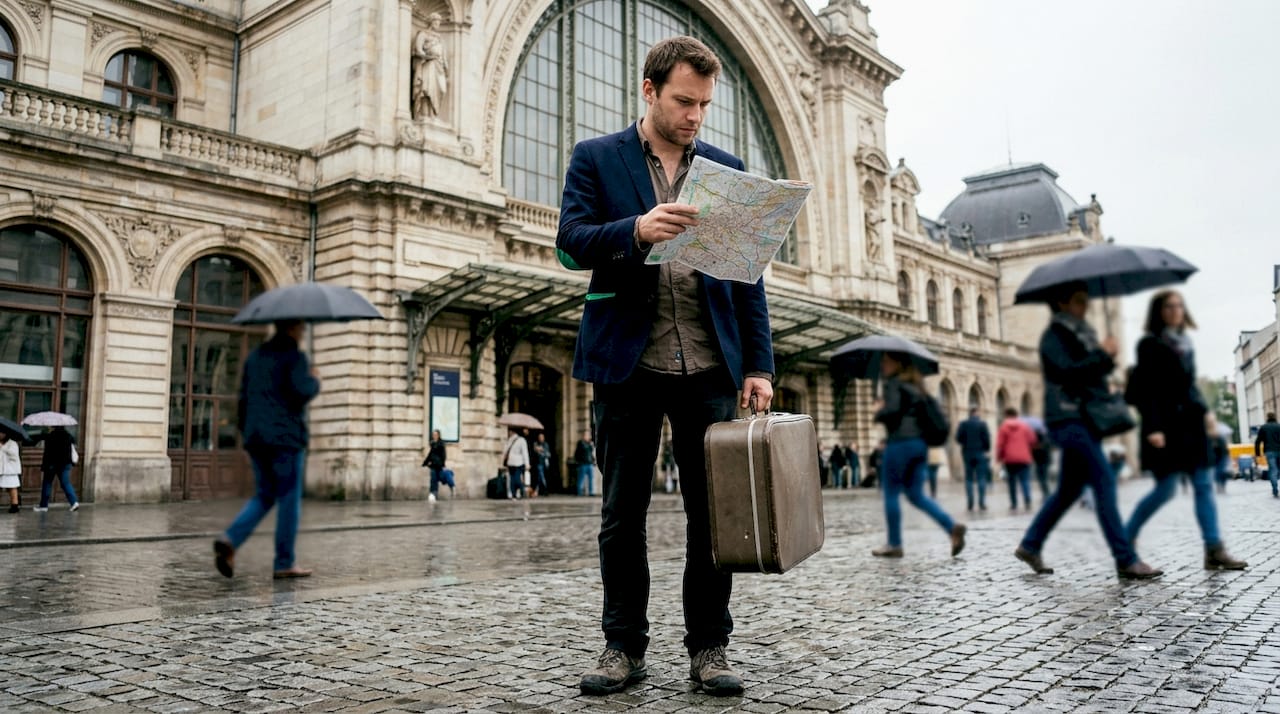
A train station to hotel transfer is a transportation service or arrangement that moves passengers directly from their arriving train station to their hotel. The term covers everything from a five-minute walk to a pre-booked private chauffeur waiting on the platform. Travelers arriving at major European hubs like Paris Gare du Nord, Munich Hbf, or Venice Santa Lucia face real choices about how to cover that final stretch. Getting it wrong means dragging heavy bags up staircases, missing connections, or standing in the rain searching for a taxi. This guide breaks down every option, explains how to choose, and shows you how to book with confidence.
What is a train station to hotel transfer?
A train station to hotel transfer is the industry term for any planned or on-demand transportation that bridges the gap between your train arrival and your hotel check-in. Travel logistics professionals call this the “last-mile” problem. The distance on a map rarely tells the full story. Stairs, underpasses, crowded exits, and luggage all change the equation fast.
The transfer category includes six main service types:
- Walking: Works only when the hotel is steps from the station exit and you carry minimal luggage.
- Public transit: Subways, buses, and local trains cover most major cities at low cost, but require navigation and luggage management.
- Taxis and ride-hailing apps: Available at most large stations, no advance booking needed, but pricing varies and queues can be long.
- Private transfer services: Pre-booked chauffeur-driven vehicles with fixed pricing, meet-and-greet, and door-to-door service.
- Hotel shuttle buses: Some hotels operate scheduled pickups from nearby stations, usually free or low-cost.
- Specialized transfers: Cities like Venice require water taxis coordinating land and water legs, making standard taxi logic irrelevant.
| Transfer Type | Cost Level | Advance Booking | Best For |
|---|---|---|---|
| Walking | Free | None | Light bags, close hotels |
| Public transit | Low | None | Budget travelers, simple routes |
| Taxi / ride-hailing | Medium | Optional | Flexible timing, moderate luggage |
| Private transfer | Medium-High | Required | Reliability, heavy luggage, first visits |
| Hotel shuttle | Low or free | Sometimes | Guests of participating hotels |
| Water taxi (Venice) | High | Recommended | Venice arrivals with luggage |
How do you choose the best transfer option?
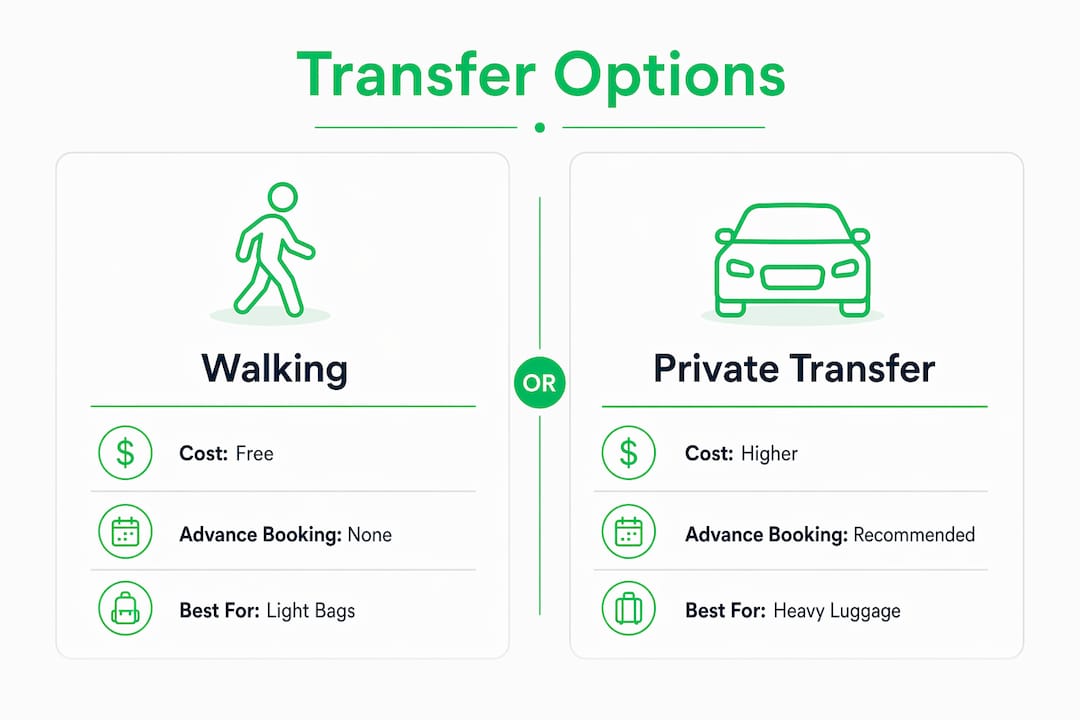
The right transfer choice depends on the weakest point in your arrival chain, not the shortest distance. Arrival-planning guides recommend evaluating the “weakest link” in the journey, since luggage and weather can flip the best option even when the hotel is close. That insight changes how you should think about every transfer decision.
Ask yourself these questions before you book anything:
- How much luggage do you have? Two rolling suitcases on a crowded subway during rush hour is a miserable experience.
- How complex is the route? A single subway stop is manageable. Three transfers with a connection are not.
- What time do you arrive? Late-night arrivals shrink your public transit options fast.
- What is the weather? A 10-minute walk in July is pleasant. The same walk in February rain with bags is not.
- Is this your first time in this city? Unfamiliar station layouts add stress and time.
Walking makes sense when your hotel is within 500 meters of the exit, the route is flat, and you carry one small bag. The moment heavy luggage enters the picture, luggage friction tips the decision toward a taxi or private transfer. Public transit is the right call for budget-conscious travelers on simple, well-signed routes with manageable bags.
Pro Tip: Download offline maps and save your hotel address before you board the train. Phone batteries die and station Wi-Fi is unreliable. A dead phone at a foreign train station turns a simple transfer into a genuine problem.

What should you expect from a pre-booked private transfer?
Pre-booked private transfers are the most predictable form of hotel pickup from a train station. Here is what a standard private transfer experience looks like, step by step:
- Book online in advance. You enter your train arrival details, hotel address, and passenger count. Fixed pricing is confirmed at booking with no surprise fees.
- Receive driver confirmation. You get the driver’s name, vehicle details, and a contact number before you travel.
- Arrive and meet your driver. The driver stands at the station exit or a designated meeting point holding a sign with your name. Meet-and-greet services reduce traveler uncertainty by confirming the pickup location before arrival.
- Load your luggage. Professional drivers assist with bags. Vehicles are sized for your group and luggage volume.
- Ride directly to your hotel. No detours, no shared stops, no negotiating with a meter.
“Drivers meet travelers upon arrival and wait even if trains are delayed, enhancing reliability for travelers.” — Budapest private arrival transfer service description
That waiting guarantee matters more than most travelers realize. Train delays are common across European rail networks. A private transfer driver absorbs that delay without charging you extra or canceling. A taxi queue does not wait for anyone.
Private transfers in Budapest receive consistent praise for punctuality and driver professionalism. In Venice, the complexity goes further. Multimodal transfers coordinate a land driver from Venice Santa Lucia to the dock, then a water taxi to your hotel canal entrance. Each leg is timed and linked. Miss one, and the chain breaks.
How does luggage affect your transfer choice?
Luggage is the single most underestimated factor in train station to hotel transportation decisions. Venice travel advice warns that stairs and bridges make walking impractical with heavy bags, recommending vaporetto water buses or taxis for safer access. That same logic applies at Munich Hbf, where underpasses and platform distances catch first-time visitors off guard.
Heavy luggage changes the math in three specific ways. First, public transit becomes physically difficult when bags cannot fit through turnstiles or block narrow aisles. Second, walking routes that look simple on a map often include stairs, cobblestones, or steep inclines that are brutal with rolling suitcases. Third, the time cost of struggling with bags on public transit often exceeds the price difference between a subway ticket and a taxi.
Major rail hubs like Munich Hbf and Paris Gare du Nord have multiple exits, and choosing the wrong one adds 10 minutes and a flight of stairs to your journey. Knowing which exit aligns with your transfer point is not obvious from inside the station.
Pro Tip: Tell your transfer provider exactly how many bags you have when you book. A sedan fits two standard suitcases comfortably. Three large bags plus carry-ons require a van. Showing up with more luggage than the vehicle can hold creates delays and awkward renegotiations on the curb.
For travelers who want to lighten their load before the transfer, luggage storage options at major train stations let you drop bags and explore the city before checking in. This strategy works well when you arrive hours before hotel check-in time.
What are the best practices for booking your transfer?
Booking a train station transfer service correctly is as important as choosing the right mode. A poorly managed booking creates the same stress as no booking at all.
- Book at least 24 hours in advance. Last-minute private transfer availability drops sharply in peak travel seasons, especially in Paris, Rome, and Amsterdam.
- Confirm pickup details 24–48 hours before arrival. Send your driver the train number, arrival platform if known, and your phone number. This one step prevents most missed pickups.
- Communicate delays immediately. If your train is running late, message your driver. Most private transfer services monitor train schedules, but a direct message removes all doubt.
- Use services with meet-and-greet and driver tracking. Knowing your driver’s location in real time removes the anxiety of scanning a crowd for your name sign.
- Have a backup option ready. Save the local taxi app for your destination city before you travel. If a private transfer falls through, you need a plan B that does not require searching for Wi-Fi.
Research the provider’s cancellation policy before you pay. Reputable services offer free cancellation up to 24 hours before pickup. Providers without a clear policy are a risk you do not need to take.
Pro Tip: Screenshot your booking confirmation, driver details, and hotel address before you board the train. If your phone loses signal in a tunnel or your battery dies, you still have everything you need.
Understanding meet-and-greet workflows in advance helps you know exactly where to look and what to expect when you step off the train. The difference between a smooth arrival and a stressful one often comes down to that single piece of preparation.
Key takeaways
A train station to hotel transfer succeeds or fails based on luggage, route complexity, and whether you pre-booked a reliable service before you arrived.
| Point | Details |
|---|---|
| Define your transfer type early | Choose between walking, public transit, taxi, private transfer, or shuttle based on luggage and route. |
| Luggage drives the decision | Heavy bags make taxis or private transfers more practical than public transit, even on short routes. |
| Pre-book for reliability | Private transfers guarantee a waiting driver regardless of train delays, removing arrival uncertainty. |
| Confirm details before travel | Send your driver the train number and your phone number 24–48 hours before arrival. |
| Always have a backup plan | Save a local taxi app offline in case your primary transfer falls through. |
What 15 years of covering travel taught me about station transfers
Most travelers underestimate the last mile. They plan the flight, book the hotel, and assume the gap in between will sort itself out. It rarely does, especially in cities they have never visited before.
The single biggest mistake I see is choosing a transfer based on map distance. A 900-meter walk from Munich Hbf looks trivial on Google Maps. Add two suitcases, a backpack, a wrong exit, and a broken escalator, and that walk takes 25 minutes and costs you energy you needed for the rest of the day. Transfer complexity lives in the details, not the distance.
My honest recommendation for first-time visitors to any major European city is to pre-book a private transfer for the first arrival. The cost difference over a taxi is often small. The difference in experience is significant. You step off the train and someone is already holding your name. That moment removes a specific kind of travel anxiety that is hard to describe until you have felt it.
Technology helps, but it also fails. I have watched travelers spend 20 minutes at a station exit trying to connect to Wi-Fi to pull up a ride-hailing app. A pre-booked transfer with a driver already on site is immune to that problem. Use apps as backup, not as your primary plan.
The travelers who arrive calmly are the ones who treated the transfer as part of the trip, not an afterthought. Research the station layout. Know which exit to use. Tell your driver your exact train number. Those three steps cost you 10 minutes of planning and save you an hour of stress.
— Arthur
Arrive stress-free with zont cab
Planning a train arrival in Europe and want a driver waiting when you step off? Zont Cab covers private transfers across Europe with fixed pricing, professional drivers, and meet-and-greet service at major train stations. No hidden fees. No waiting in taxi lines.
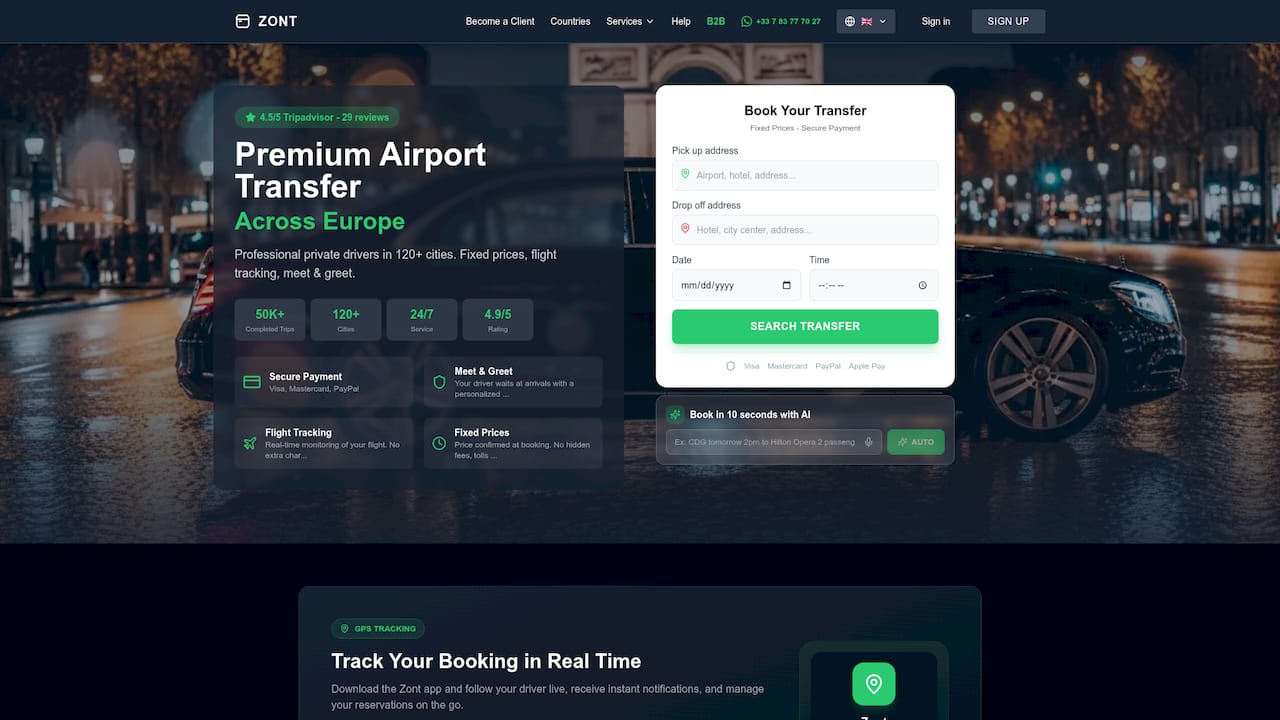
Zont Cab operates in over 120 European cities, including Paris, where the Gare du Nord private transfer service places a driver at the station exit with your name on a sign. Vehicles range from executive sedans to spacious vans for groups with heavy luggage. Every booking includes a confirmed driver, direct hotel drop-off, and a cancellation policy you can trust. Book in advance through the Zont Cab platform, confirm your train details, and arrive knowing the hardest part is already handled.
FAQ
What is a train station to hotel transfer?
A train station to hotel transfer is any transportation service or arrangement that moves a traveler from their arriving train station directly to their hotel. Options include walking, public transit, taxis, private chauffeur services, and hotel shuttles.
How far in advance should i book a private transfer?
Book at least 24 hours before your arrival, and confirm driver details 24–48 hours ahead. During peak travel seasons in cities like Paris or Rome, booking further in advance reduces the risk of unavailability.
What happens if my train is delayed?
Private transfer drivers wait for travelers even when trains run late, at no extra charge. Taxis and ride-hailing apps do not offer this guarantee, which is the primary reliability advantage of pre-booked services.
Is walking from the train station to the hotel ever a good idea?
Walking works when the hotel is very close to the station exit, the route is flat, and you carry minimal luggage. Venice travel guides warn that stairs and bridges make walking impractical with heavy bags, and the same applies at many large European rail hubs.
How do multimodal transfers work in cities like venice?
In Venice, a coordinated private transfer combines a land driver from Venice Santa Lucia station to the dock, then a water taxi to your hotel. Each leg is timed and linked, so missing one step disrupts the entire chain.