Why Airport Queues Waste Time: Fast Fixes for Travelers
Airport queues waste time for one structural reason: arrival rate temporarily exceeds service capacity at chokepoints like security, bag drop, check-in counters, and immigration. Even a small mismatch, such as several flights landing closely together, can lock in a backlog that may take significant time to clear. The single most effective traveler fix is enrolling in an expedited screening program before your next trip. For airports, the evidence points to one lever above all others: start every peak period with the shortest possible queue.
Three things you can do right now:
- Enroll in TSA PreCheck or CLEAR (or both) to bypass standard screening lanes and cut security time significantly.
- Shift your arrival window to avoid the first 30 minutes of a morning or midday wave, when queues are already building.
- If your connection is tight, book a pre-arranged airport transfer with real-time flight tracking, or ask about VIP meet-and-greet lanes at your terminal.
Table of Contents
- Why airport queues waste time: the mechanics behind every long line
- Operational causes and common bottlenecks that make queues worse
- What airports do to reduce wasted time: tech, staffing, and demand-shaping
- How travelers can reduce time lost in airport queues
- How wasted queue time affects travelers and airports
- Why “no queue” isn’t the right goal
- How airports measure wait times and why published estimates can mislead
- The airport “red zone” and how stress makes queues feel longer
- Practical checklist: before you leave home and at the airport
- Key Takeaways
- The case for accepting some friction
Why airport queues waste time: the mechanics behind every long line
Queues form when more passengers arrive than the system can process. That sounds obvious, but the math behind it is brutal. When a security checkpoint processes 200 passengers per hour and 250 arrive in that same hour, the 50-person surplus does not disappear at the end of the hour. It compounds. The next wave of arrivals joins a line that is already 50 people deep, and the checkpoint never catches up until demand drops.
This is the core insight from queuing-system research applied to airport terminals: the problem is not average capacity but variability. Flight schedules create waves. Three departures clustered at 7:00 AM, 7:10 AM, and 7:20 AM push hundreds of passengers into security within a 40-minute window. Even if the checkpoint handles 1,500 passengers per day with no problem, that morning wave can produce a 45-minute wait.
| Concept | What it means in practice |
|---|---|
| Arrival rate | Passengers reaching a checkpoint per unit of time; driven by flight schedules |
| Service rate | Passengers processed per lane per hour; fixed by staffing and equipment |
| Utilization | Arrival rate divided by service rate; above ~80% and waits grow fast |
| Variability | Unpredictable surges (late inbounds, group check-ins) that spike arrival rate |
| Start-of-peak effect | A queue already present when a peak begins locks in a backlog that staffing cannot easily recover |
The start-of-peak effect deserves special attention. If a security lane opens with 40 people already waiting, every new arrival joins a moving line that never fully drains. Entering a peak with a near-empty queue is the single most cost-effective way to keep average waits low, because the math of recovery is asymmetric: it takes far more capacity to drain a backlog than to prevent one.
Operational causes and common bottlenecks that make queues worse
Security lanes get the most attention, but they are one of several chokepoints that generate airport line delays:
- Security screening: Lane count, staffing, and passenger compliance all affect throughput. Non-compliant bags (liquids over 3.4 oz, laptops not removed) trigger re-screening and slow the entire lane.
- Bag drop and check-in counters: Airlines often open counters in batches, creating a surge at opening time. Self-service kiosks help but require staff oversight, and a single broken unit can redirect 20 passengers to a staffed counter.
- Immigration and customs: Processing times vary by officer and passenger documentation. A single complex case can hold up an entire queue for several minutes.
- Gate bottlenecks: Boarding group confusion, oversized carry-ons, and late gate changes concentrate passengers in narrow corridors.
- Broken equipment: A single inoperative X-ray belt or e-passport gate can significantly reduce throughput at that checkpoint.
- Poor signage and layout: When passengers cannot see where a queue ends or where secondary checkpoints are, they default to the most visible option, concentrating demand artificially.
Staffing and rostering amplify every one of these problems. Airports typically staff to a forecast, but forecasts are built on scheduled departures, not actual passenger behavior. When a flight runs early or a connecting bank arrives ahead of schedule, the checkpoint is already understaffed for the surge. “Panic opening” of additional lanes helps, but a lane takes time to spin up: a new officer needs to log in, calibrate equipment, and clear the initial rush before reaching full throughput. That lag can be several minutes, during which the queue continues to grow.
Physical design matters more than most travelers realize. A terminal with a single security entry point, regardless of how many lanes it contains, creates a funnel. Passengers who cannot see the full queue length make conservative choices and arrive even earlier, which paradoxically increases congestion at peak times.
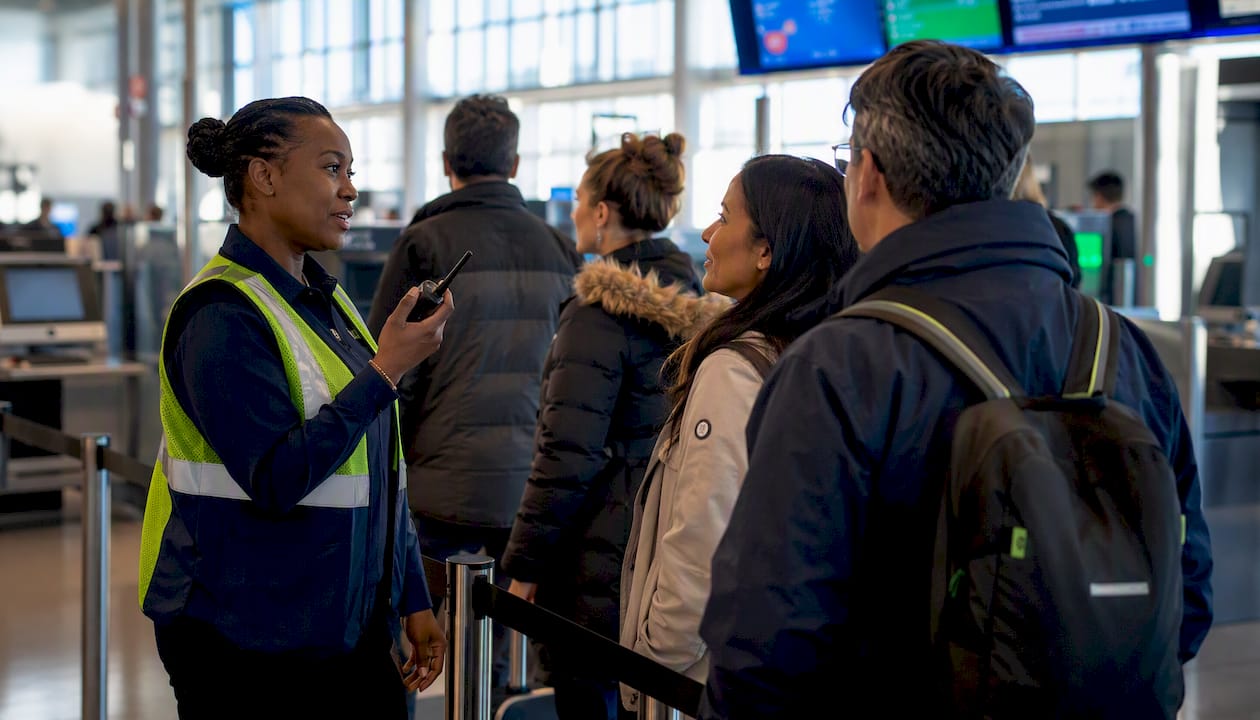
Pro Tip: When you reach a security area, scan for secondary checkpoints before joining the nearest line. Most passengers default to the checkpoint closest to their airline’s signage, leaving secondary checkpoints noticeably less crowded. Walking an extra two minutes can save 20.
What airports do to reduce wasted time: tech, staffing, and demand-shaping
Airports balance cost against service level. The goal is a right-sized queue, not zero queue. Eliminating queues entirely would require permanent over-staffing at every checkpoint, which is economically unsustainable and operationally inefficient during off-peak hours.
| Tool category | How it works | Key trade-off |
|---|---|---|
| Sensors and queue management systems (QMS) | Real-time queue-length sensing feeds dashboards; managers open lanes before waits hit thresholds | High upfront cost; requires trained staff to act on data |
| Reservation / Spot Saver systems | Passengers pre-book a security entry window up to six days ahead | Reduces peak demand but requires passenger adoption |
| Automation and biometrics | Self-service bag drop, e-gates, facial recognition speed individual processing | Privacy concerns; ID fallback needed; limited family compatibility |
| Lane mix and rostering | Dedicated PreCheck/CLEAR lanes, dynamic lane opening based on forecasts | Requires accurate demand forecasting and flexible staffing contracts |
Philadelphia International Airport (PHL) offers a well-documented example of sensor-backed QMS deployment. Overhead sensors track queue lengths at security checkpoints in real time, feeding a management dashboard that allows supervisors to open additional lanes before wait times breach service-level thresholds. The system does not eliminate queues, but it reduces the lag between a surge and a staffing response. That lag reduction is where most of the time savings come from.
Reservation programs like Spot Saver are free at airports including JFK Terminal 4, Seattle-Tacoma (SEA), Minneapolis-St. Paul (MSP), Phoenix Sky Harbor (PHX), and Orlando (MCO). They work by spreading demand across time slots, which flattens the arrival curve and reduces peak utilization. The catch: they only work if enough passengers use them. Low adoption rates leave the peak largely unchanged.
Biometrics and automation speed individual processing times but introduce their own friction. Facial recognition gates fail on a small percentage of passengers, requiring officer intervention. Families with children under a certain age often cannot use PreCheck lanes together. And any biometric system needs a physical ID fallback, which adds a step when the technology does not cooperate.
How travelers can reduce time lost in airport queues
The most reliable single action any traveler can take is enrolling in TSA PreCheck. PreCheck members use dedicated lanes where shoes, laptops, and liquids stay in the bag. CLEAR adds a biometric identity verification step that moves members to the front of the PreCheck or standard lane ID check. The MyTSA app lets you check current wait times at your airport, confirm what items are permitted, and read real-time delay reports from other travelers.
Before you leave home:
- Enroll in TSA PreCheck (membership requires an in-person appointment and background check) or CLEAR (biometric enrollment, available at most major US airports).
- Check the MyTSA app the night before for your airport’s typical wait patterns.
- Complete online check-in and download your boarding pass to your phone.
- If you have checked bags, use airline app bag-drop check-in to reduce counter time.
- Reserve a security time slot if your airport offers Spot Saver or a similar program.
- Pack liquids in a clear, accessible bag at the top of your carry-on. Laptops should be easy to remove.
At the airport:
- Arrive with a purposeful buffer well in advance of your flight, allowing extra time for security and other processes depending on your journey type.
- Look for secondary security checkpoints before joining the first line you see.
- Watch lane signage actively. A PreCheck lane that opens mid-queue can cut your wait in half.
- Families traveling with children should confirm PreCheck lane eligibility in advance. Young children may use PreCheck lanes with an enrolled adult, but biometric touchless ID systems have operational limits for minors.
- If you are running late, ask a TSA officer about expedited processing options. Most airports have a process for passengers within 30 minutes of departure.
The 45-minute rule is often cited as the minimum security buffer, but treat it as a floor, not a target. At major hubs like LAX, JFK, or O’Hare during morning peaks, 45 minutes is not enough. The MyTSA app’s real-time data is more useful than any fixed rule.
For travelers with tight connections, a pre-booked transfer with flight tracking removes one major variable from the equation. Knowing your ground transport is monitoring your flight status and adjusting in real time reduces the stress load before you even reach the terminal.
How wasted queue time affects travelers and airports
Time lost in queues is not just an inconvenience. Missed connections are the most visible cost: a passenger who misses a connection triggers rebooking, hotel vouchers, and customer service workload that costs airlines significantly more than the original ticket margin. For travelers, a missed connection can mean a lost day, a missed event, or a business meeting that cannot be rescheduled.
A common service-level target in airport operations is that 90% of passengers should clear security within 10 minutes. When that threshold is breached consistently, the downstream effects compound quickly: longer queues reduce the time passengers spend in retail and food areas, cutting non-aeronautical revenue that many airports depend on to subsidize aeronautical fees.
Copenhagen Optimization’s analysis of start-of-peak dynamics makes the cost concrete: a queue that enters a peak period already 50 people deep can take the entire peak to drain, meaning every passenger in that wave waits longer than necessary. The cost is not just individual minutes. It is the aggregate of hundreds of passengers each losing 15–30 minutes, multiplied across every peak period in a year.
The psychological cost is real and measurable. Airports generate a specific stress profile: loss of control, environmental unpredictability, time pressure, and social crowding all activate the same biological stress response. Passengers who arrive stressed spend less, complain more, and are more likely to miss connections because stress impairs decision-making. Understanding how connecting flight transfers are coordinated can help travelers plan more realistic buffers and reduce that stress load before it builds.
Irregular operations, such as flight delays and cancellations, multiply all of these effects. A single delayed inbound flight can suddenly add a large number of passengers to a security queue, overwhelming a checkpoint that was previously operating smoothly.
Why “no queue” isn’t the right goal
The IATA Level of Service (LoS) framework is the planning standard airports use to size terminal sub-systems. It defines an “Optimum” LoS as the balance point between passenger comfort and cost efficiency. Designing for zero queues means staffing for peak-of-peak demand at all times, which is economically unsustainable.
The trade-offs of aggressively pursuing zero queues:
- Cost of idle capacity: Staffing every lane at full capacity during off-peak hours means paying for throughput that is not needed. Most airports cannot absorb that cost without raising fees.
- Staffing inflexibility: Security officers require certification and cannot be hired and dismissed on a shift-by-shift basis. Permanent over-staffing to eliminate queues creates labor contracts that are difficult to unwind.
- Passenger expectation management: Zero queues at one terminal create expectations that other terminals cannot meet, generating complaints even when service is objectively adequate.
The smarter target is what Copenhagen Optimization calls a right-sized queue: enough capacity to process demand within the service-level agreement, with minimal queue at the start of each peak. Demand-shaping programs like security slot reservations, paired with accurate forecasting and flexible rostering, are more cost-effective than permanent over-staffing. The goal is not to eliminate waiting but to make it predictable and short.
How airports measure wait times and why published estimates can mislead
Airports track queue performance through a set of standard KPIs. Throughput measures passengers processed per hour per lane. Queue length is a snapshot count at a given moment. Average wait time is the mean time from queue entry to processing completion. The 90th percentile wait is more operationally meaningful: it captures the experience of the slowest 10% of passengers, which is where service-level agreements are typically set. Gate-to-gate dwell time measures the full terminal experience from security entry to gate arrival.
Each data source has accuracy limits. Overhead sensors provide real-time queue-length estimates but cannot distinguish passengers from staff or measure actual processing time. Manual sampling by staff is accurate but infrequent and subject to observer bias. Self-reported staff tallies are the least reliable. Third-party apps like MyTSA aggregate traveler-reported data, which is timely but unverified.
Published wait-time displays show historical averages or recent snapshots, not live queue depth. A display showing “8 minutes” may reflect conditions from 15 minutes ago, before a flight wave arrived.
The PHL sensor-QMS example illustrates both the value and the limits of real-time data. Sensors give supervisors faster visibility into queue growth, but the data only helps if staffing decisions follow quickly. A dashboard that shows a growing queue but triggers no lane opening within five minutes has not solved the problem.
Pro Tip: Treat published wait times as a directional signal, not a guarantee. Check the MyTSA app for traveler-reported conditions within the last 30 minutes, and add a buffer on top of whatever the display shows during peak hours.
The airport “red zone” and how stress makes queues feel longer
The airport red zone is a biological stress response, not just a feeling. USA Today’s reporting on traveler psychology describes it as the period between arrival and boarding, characterized by loss of control, environmental unpredictability, and time pressure. These are the exact conditions that activate the body’s threat-detection system, which is why even a 10-minute wait at security can feel like 30.
“The red zone is not just psychological discomfort. It is a biological stress response that impairs decision-making, increases perceived time, and reduces the ability to adapt to changing conditions.” — behavioral stress research cited by USA Today
Behavioral fixes that actually work:
- Preflight rituals: A consistent pre-airport routine (same bag layout, same departure checklist) reduces decision fatigue before you arrive.
- Purposeful arrival buffers: Helper Advice’s research distinguishes between “extra time” (passive waiting that amplifies stress) and “purposeful time” (a specific activity planned for the airport, such as a meal, a call, or reading). The latter converts waiting into personal time.
- Grounding objects: A familiar item in your carry-on, a specific podcast, or a planned coffee stop gives your brain a concrete task instead of fixating on the queue.
- Decision rules: Decide before you reach the gate whether you will leave for food or stay put. Indecision under time pressure is a significant stress amplifier.
One caution on biometrics and families: TSA PreCheck and Touchless ID save real time, but they have operational limits. Biometric systems occasionally fail, and travelers must carry a physical ID as a fallback. Families with children should verify lane eligibility before assuming the whole group can use PreCheck together.
Most passengers walk to the checkpoint closest to their airline’s signage. Secondary checkpoints at the same terminal are often significantly less crowded, simply because they are less visible. That two-minute walk is one of the highest-return, lowest-cost moves available to any traveler.
Practical checklist: before you leave home and at the airport
| Traveler action | What the airport or operator provides |
|---|---|
| Enroll in TSA PreCheck or CLEAR before travel | Dedicated PreCheck/CLEAR lanes at most major US airports |
| Reserve a Spot Saver security slot if available | Free reservation systems at JFK T4, SEA, MSP, PHX, MCO |
| Download the MyTSA app and check wait times | Real-time sensor and traveler-reported data |
| Complete online check-in and use mobile boarding pass | Self-service bag drop at most major carriers |
| Pack liquids in a clear bag at the top of carry-on | Automated screening lanes at select airports |
| Plan a purposeful airport activity to use buffer time | Lounges, retail, and food options near gates |
| Confirm PreCheck eligibility for all family members | Officer-assisted lane access for edge cases |
If you’re tight on time:
- Go directly to a secondary security checkpoint. The main checkpoint near your airline’s check-in desk is almost always the most crowded.
- Ask a TSA officer about expedited processing if you are within 30 minutes of departure. Most airports have a protocol.
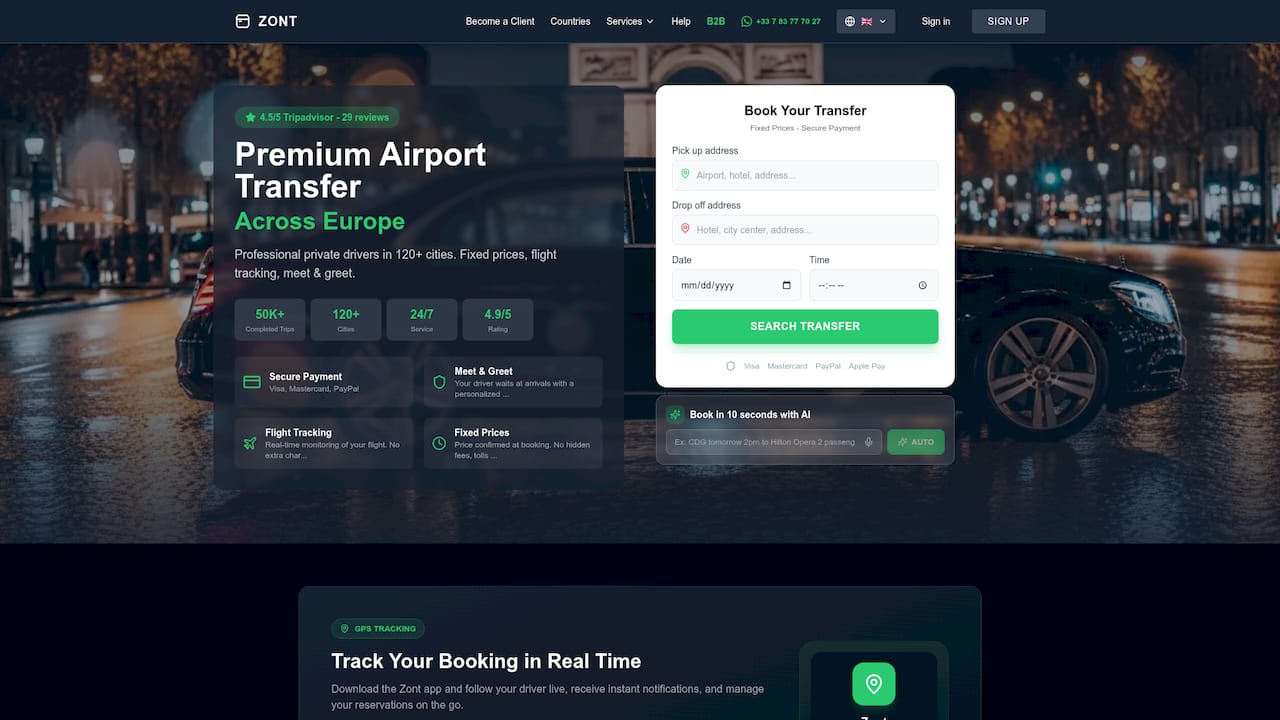
- Book a pre-arranged airport transfer with real-time flight tracking. Zont Cab’s airport transfer service covers 120+ cities across Europe with flight monitoring, meet-and-greet, and fixed pricing, removing ground-transport uncertainty from a tight itinerary. For travelers who want the full premium experience, VIP airport service with dedicated meet-and-assist can bypass standard queues entirely.
Key Takeaways
Airport queues waste time because arrival rate exceeds service capacity at predictable chokepoints, and the most effective fixes, for both travelers and airports, address that mismatch before the peak begins.
| Point | Details |
|---|---|
| Arrival rate mismatch | Queues form when passengers arrive faster than checkpoints can process them, especially during flight waves. |
| Start-of-peak effect | Entering a peak with a long queue locks in a backlog; airports should minimize queue depth before each peak begins. |
| Expedited programs work | TSA PreCheck and CLEAR are the single most reliable traveler tools for cutting security wait times. |
| Right-sized, not zero | IATA’s LoS framework targets an optimum service level; eliminating queues entirely is cost-prohibitive and operationally impractical. |
| Behavioral fixes reduce perceived wait | Purposeful arrival buffers and secondary checkpoint selection reduce both actual and perceived time loss. |
The case for accepting some friction
The conversation about airport queues usually goes in one direction: how do we eliminate them? After working through the operational evidence, I think that framing is wrong, and it leads travelers and airports to make worse decisions.
A queue is not a failure. It is a signal that demand is real and that the system is running near its designed capacity. The IATA LoS framework exists precisely because the alternative, staffing for zero queues at all times, produces idle capacity that no airport can afford and no traveler actually pays for. The right question is not “why is there a queue?” but “is this queue the right size for this moment?”
For travelers, that reframe is practical. Stop treating every queue as a system failure and start treating it as a planning input. Enroll in PreCheck. Check the MyTSA app before you leave. Shift your arrival by 20 minutes to miss the first wave. Those three moves cost almost nothing and return real time. The behavioral research on purposeful buffers makes the same point from a different angle: the travelers who handle airports best are not the ones who arrive with the least time to spare. They are the ones who arrive with a plan for the time they have.
One tip worth adopting before your next trip: pick one item from the checklist above and actually do it. Not all of them. One. PreCheck enrollment if you fly more than twice a year. A Spot Saver reservation if your airport offers it. A secondary checkpoint walk-through if you are at a hub. Small, specific changes to how you move through an airport compound over dozens of trips into hours of time recovered.
Further reading and authoritative sources
IATA Level of Service best practice is the planning standard airports use to size terminal sub-systems. It defines the “Optimum” LoS concept and explains why designing for zero queues is economically unsustainable. Essential reading for anyone who wants to understand how airports make capacity decisions.
Copenhagen Optimization: Airport queues, right-sized not zero is the clearest operational explanation of start-of-peak dynamics and why demand-shaping programs outperform reactive lane opening. The analysis of queue recovery asymmetry is directly applicable to both airport planning and traveler timing decisions.
USA Today: Why airports turn even calm travelers into nervous wrecks covers the airport red zone as a biological stress response. The behavioral framing is grounded in stress research and gives travelers a concrete vocabulary for what they experience between arrival and boarding.
Helper Advice: Beat the airport red zone translates the red zone research into practical tactics, including purposeful buffers, secondary checkpoint selection, and grounding objects. The distinction between passive extra time and purposeful time is the most useful single insight in the behavioral literature on airport stress.
ABC7NY: How to find airport security wait times and tips to mitigate long lines covers the MyTSA app, Spot Saver reservation programs, and the operational limits of TSA PreCheck and biometric ID for families. Practical and US-specific.
ScienceDirect: Airport terminal building capacity evaluation using queuing system provides the academic foundation for queuing-theory applications in airport terminals. The analysis of arrival rate, service rate, and utilization thresholds underpins the mechanics described throughout this article.
DHS: Check Wait Times is the official TSA and CBP resource for current wait-time data at US airports and land border crossings. The MyTSA app links from this page and is the most reliable real-time tool available to US travelers.