Why Direct Airport Routes Save Business Time

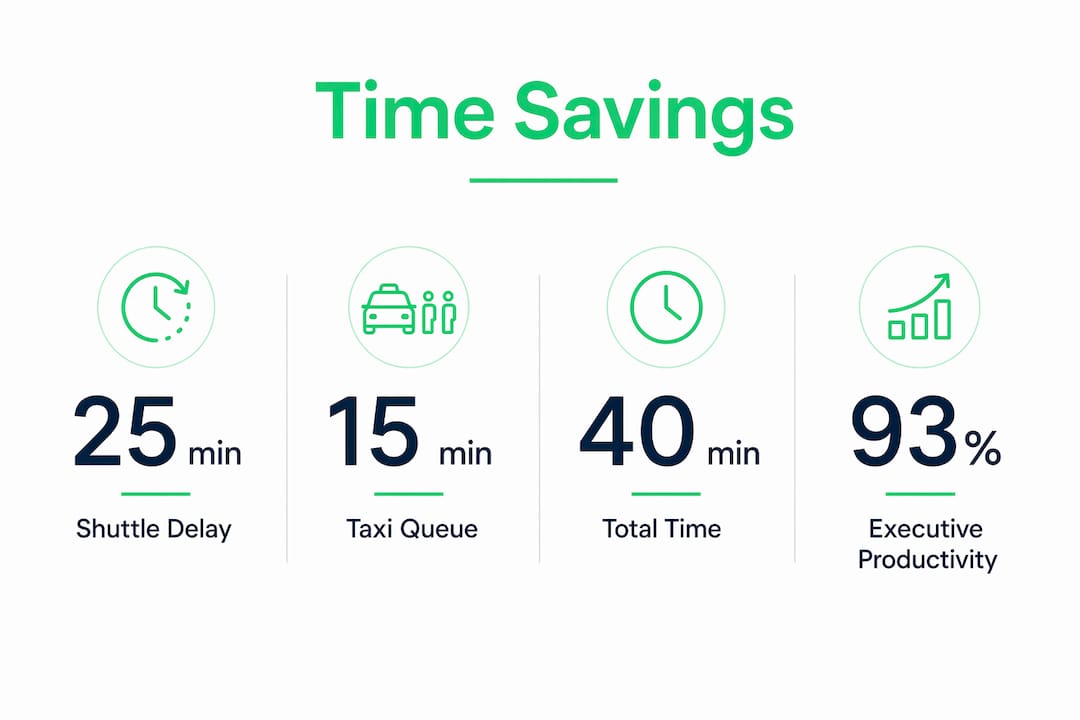
Direct airport routes cut door-to-door travel time and protect the productive hours executives can’t afford to lose. When travel runs smoothly, 93% of executives report being more productive, and 44% say the improvement is significant. The mechanism is straightforward: a pre-booked private transfer with a single driver, a fixed route, and no intermediate stops removes every friction point between the arrivals hall and your destination.
The core time-savers in a direct transfer:
- No intermediate passenger stops or route deviations
- No handovers between drivers or transit modes
- No queuing at taxi ranks or rideshare pickup zones
- Shorter effective walk time via arrivals-hall meet and greet
- No rebooking or re-queuing if your flight lands early or late
Table of Contents
- Why direct routes save business time: the mechanics
- How much time do you actually save?
- When a direct transfer is worth paying for
- How to pick a transfer provider that actually delivers
- What to expect on the day: booking timeline and pickup
- The ROI case for corporate travel managers
- Key Takeaways
- The case for treating ground transport as seriously as the flight itself
- Zont Cab delivers direct airport transfers across Europe
- Useful sources
Why direct routes save business time: the mechanics
The time lost on a non-direct transfer isn’t just the extra miles. It’s the compounding friction: a shared shuttle that waits for three other passengers, a taxi rank queue at peak hour, a driver who doesn’t know your terminal exit. Each adds unpredictability, and unpredictability is what breaks focus.
On the operational side, a direct private transfer eliminates stops, passenger handovers, additional luggage handling cycles, and the walk from a remote pickup zone. At busy airports, the walk from gate to taxi or rideshare areas can add a significant amount of time to your door-to-door time. Arrivals-hall meet and greet bypasses all of that.
The human side matters just as much. A private cabin gives you a controlled environment with fewer distractions, reliable power, and connectivity. Blacklane’s Finding Flow report identifies crowded or noisy environments, inadequate technology, and delays or uncertainty as the top barriers to executive focus during travel. A direct private transfer removes all three at once.

Pro Tip: Book a provider that offers live flight tracking and arrivals-hall meet and greet as standard, not as add-ons. These two features together are what guarantee the direct route actually starts the moment you clear customs, not ten minutes later at a distant curb.
How much time do you actually save?
The numbers vary by airport size and transfer type, but the ranges are consistent across large hubs.
| Scenario | Shared shuttle / public transit | Direct private transfer | Time saved |
|---|---|---|---|
| City-center transfer, mid-size airport | 60–90 min | 30–45 min | 15–25 minutes |
| Long-haul arrival, large terminal (e.g., Heathrow, Frankfurt) | 90–120 min | — | — |
| Multi-leg group transfer, 4+ passengers | 90–150 min | — | 50–90 min |
Pre-booked chauffeur pickups at arrivals halls save 15–25 minutes compared with walking to taxi ranks and waiting in queues at large airports, even before accounting for the shared-shuttle wait time.
What do those minutes convert to? A 45-minute recovery on a transfer is enough to review a pitch deck, run a pre-meeting call, or draft a client follow-up. For an executive billing at $200 per hour, that’s $150 of productive time recovered on a single leg. Multiply that across a team traveling weekly and the math becomes a budget line, not a perk.
When a direct transfer is worth paying for
Not every trip justifies a premium transfer. These scenarios are where the ROI is clearest:
- Same-day meetings: Landing and presenting within two to three hours leaves no buffer for a shared shuttle’s unpredictability.
- Tight connection windows: A missed pickup after a delayed flight can cascade into a missed meeting, not just a late arrival.
- High-stakes client visits: First impressions include how composed you are when you walk in. Forty minutes in a taxi queue does not help.
- Multi-city itineraries: Each leg compounds; one delay on a shared transfer can unravel the rest of the day.
- Team or event logistics: Coordinating four people on a shared shuttle is a coordination tax. One vehicle, one driver, one pickup.
A quick decision checklist:
- Is your first meeting within three hours of landing?
- Does your itinerary have fewer than 90 minutes of buffer between legs?
- Are you traveling with colleagues who need to debrief en route?
- Is this a client-facing trip where composure on arrival matters?
- Is your company tracking travel attrition or duty-of-care compliance?
If you answered yes to two or more, a direct private transfer is the lower-risk choice. The false economy to avoid: booking a shared shuttle to save $30 on a trip where your time is worth $150 per hour.
How to pick a transfer provider that actually delivers
Not every “private transfer” is genuinely direct. Here’s what to verify before booking:
- Live flight tracking: The driver adjusts pickup time automatically if your flight is early or delayed.
- Arrivals-hall meet and greet: Driver waits inside the terminal with a name board, not at a curbside zone you have to find.
- Defined driver wait window: Know exactly how long the driver holds before the booking is considered a no-show.
- Fixed pricing: No surge, no meter, no ambiguity. You see the price before you confirm.
- Verified on-time record: Look for a published rating from a third-party platform, not just the provider’s own testimonials.
- Vehicle options that match your work needs: A sedan for solo executives, a minivan for teams or families with luggage.
Questions worth putting in a procurement email: “Does your driver track my flight in real time?” “Where exactly does the driver wait?” “What is your wait policy if I’m delayed at customs?” “Is the quoted price the final price, including tolls and fees?”
Red flags: no mention of flight tracking, surge pricing clauses, pickup points listed as “curbside” with no arrivals-hall option, and no published on-time performance data.
Pro Tip: Run a pilot booking on a lower-stakes trip before committing a corporate account. Track the actual door-to-door time, driver wait behavior, and invoice clarity. One real data point beats any sales deck.
What to expect on the day: booking timeline and pickup
Book routine transfers at least 24 hours in advance. For complex trips — multi-stop itineraries, group bookings, or early-morning departures — 48–72 hours gives the provider time to assign the right vehicle and driver. Pre-booking airport transportation also locks in the fixed price before demand spikes.
On arrival day, a quality provider’s driver will:
- Monitor your flight in real time and adjust arrival time if the flight is early or late
- Wait in the arrivals hall with a name board, not at a pickup zone outside
- Assist with luggage from the moment you meet
- Hold for a defined wait window (typically 45–60 minutes after landing for international flights)
If your flight lands early, a provider with live tracking will already be there. If you’re delayed at customs, the driver waits. If you miss the pickup entirely, a 24/7 support line should be reachable to rebook without penalty within a reasonable window. Early arrivals create their own complications that a tracked booking handles automatically.
According to the Blacklane Finding Flow report, 81% of executives said disrupted travel created extra catch-up work after returning home, and 79% reported reduced decision-making quality. A driver who tracks your flight and waits in the terminal is the single cheapest insurance against both.
The ROI case for corporate travel managers
Here’s a simple framework for justifying premium transfer spend to stakeholders:
- Calculate the hourly fully loaded rate for the traveler (salary plus benefits, divided by working hours). For a senior executive at $200/hour, 45 minutes recovered equals $150 per trip.
- Add hidden cost categories: back-office reconciliation time on variable invoices, catch-up work after disrupted travel, and decision-quality loss on high-stakes trips.
- Factor attrition risk: travel friction directly increases turnover intentions among road warriors. Replacing a senior salesperson costs multiples of their annual salary.
- Run a 90-day pilot: track door-to-door times, on-time rates, and invoice consolidation savings. Report back with a cost-per-recovered-hour metric.
Consolidated fixed-rate invoicing also cuts back-office reconciliation time. Variable taxi receipts require manual review; a single fixed invoice per trip does not. For corporate travel programs, that administrative saving can rival the in-transit time saving over a quarter.
Key Takeaways
Direct airport routes save measurable door-to-door time and protect executive productivity by removing every friction point between the arrivals hall and the destination.
| Point | Details |
|---|---|
| Productivity impact | 93% of executives report being more productive when travel runs smoothly; 44% say the improvement is significant. |
| Terminal time saved | Arrivals-hall meet and greet saves 15–25 minutes versus walking to taxi ranks at large airports. |
| ROI per trip | 45 minutes recovered for a $200/hour executive equals $150 of productive time per leg. |
| When it matters most | Same-day meetings, tight connections, and client-facing trips have the clearest payoff. |
| Zont Cab | Covers 120+ European cities with live flight tracking, fixed pricing, and verified meet and greet across 50,000+ completed trips. |
The case for treating ground transport as seriously as the flight itself
Most corporate travel policies specify airline class, hotel tier, and per-diem rates down to the dollar. Ground transport is usually an afterthought — “book whatever’s convenient.” That gap is where productivity leaks.
The benefits of executive airport transfers go beyond comfort. The research is clear: disrupted travel reduces decision quality, creates catch-up work, and raises attrition risk. A direct private transfer with live flight tracking and arrivals-hall pickup is the simplest intervention that addresses all three. It’s not a luxury upgrade. It’s a policy decision with a measurable return.
Zont Cab operates across 120+ cities in Europe, has completed over 50,000 trips, and holds a 4.5-star verified TripAdvisor rating. Those numbers matter because on-time performance at scale is harder to fake than a marketing claim.
Zont Cab delivers direct airport transfers across Europe
Every feature that makes a direct transfer actually direct — live flight tracking, arrivals-hall meet and greet, fixed pricing with no hidden fees, premium vehicles from Mercedes sedans to minivans for groups — is standard with Zont Cab, not an upsell.
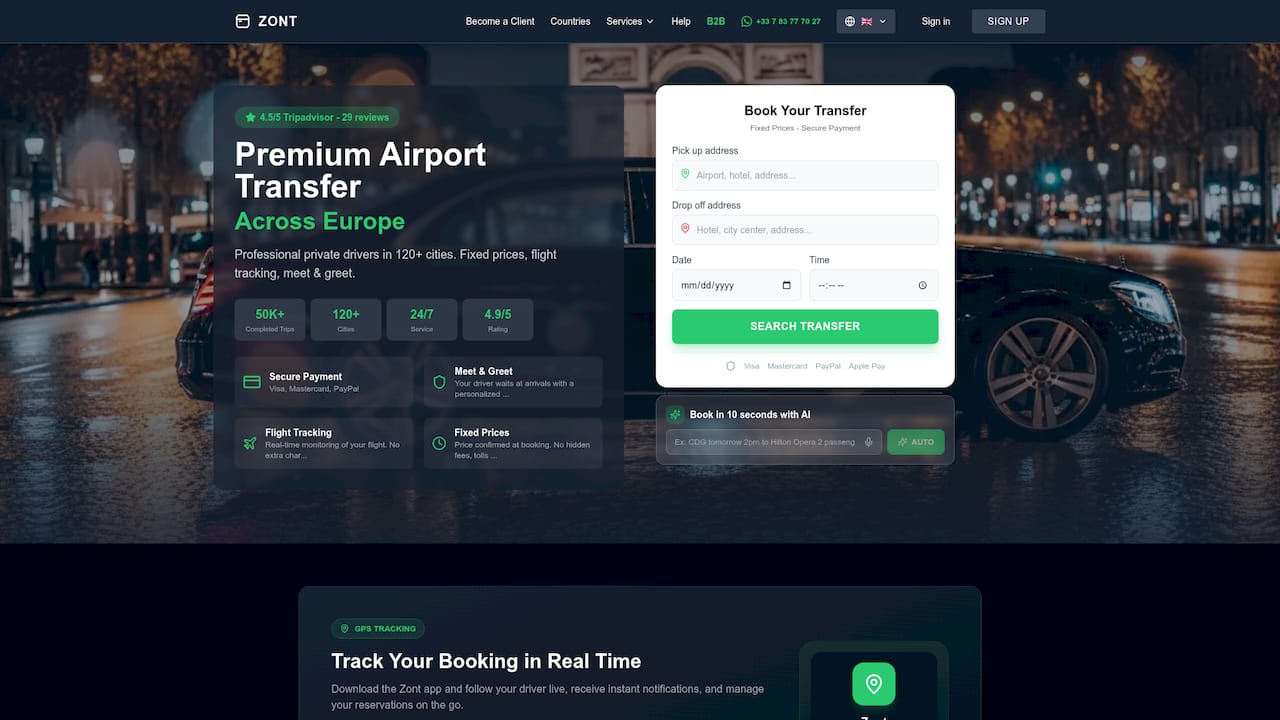
For travel managers, Zont Cab’s corporate transfer program offers consolidated invoicing and account management across all European destinations. For solo executives and leisure travelers, the booking takes under two minutes and the price is locked before you confirm. Check all European destinations and book your next direct transfer today.
Useful sources
- Blacklane Finding Flow report — Travel Daily News: Source for the 93%, 44%, 81%, and 79% executive productivity and disruption figures used throughout.
- Why Your Corporate Travel Policy Should Include Chauffeur Service — Arion: Source for the $150 recovered productivity example and the strategic-asset framing in the ROI section.
- How Corporate Travelers Save Time with Airport Chauffeur Services — Abu Dhabi Airport Transfer: Source for the 15–25 minute arrivals-hall saving and the 30–60 minute gate-to-taxi walk time at large airports.
- Business Travel With Chauffeur Service: 12 Benefits — MyPrivateTransfers: Background on fixed pricing, meet and greet, and consolidated invoicing as productivity mechanisms.
- The negative effects of travel friction among road warriors — ScienceDirect: Academic source for travel friction, attrition risk, and turnover intentions among frequent business travelers.
- Zont Cab — Premium Airport Transfer Service in Europe: Source for Zont Cab’s coverage (120+ cities), trip count (50,000+), and verified TripAdvisor rating (4.5 stars).
- Business Travel Best Practices for Corporate Professionals: Independent guidance for corporate travel managers on building efficient travel programs.