Why Schengen Travel Simplifies Transfers for Luxury Travelers

The Schengen Area removes routine internal border checks across 26 European countries, which means your private transfer can drive from Paris to Amsterdam or Frankfurt to Zurich without stopping for passport control. That single fact changes the entire math of door-to-door travel. Internal travel in Schengen usually occurs without additional waiting times at borders, and no repeated document checks interrupt your route. For U.S. travelers, the 90-day limit applies to the entire Schengen zone, not per country, and your passport must stay valid at least three months beyond your planned departure. Zont Cab builds its cross-border service around exactly this framework.
Before your transfer departs, three things are worth confirming:
- Carry your passport even on internal Schengen legs — spot checks happen.
- Verify your operator uses real-time flight tracking, not a static pickup window.
- Check your 90/180-day count before booking a multi-city itinerary.
Pro Tip: Book your transfer before you land. Operators with live flight monitoring can adjust pickup timing if your inbound flight is delayed, so you are never waiting at the curb.
Table of Contents
- How does the Schengen Area actually work for travelers?
- What Schengen rules actually change for your private transfer
- How to choose and book a cross-border private transfer
- Key Takeaways
- An operator’s view on running cross-border transfers
- Why Zont Cab is built for Schengen cross-border transfers
- Useful sources and further reading
How does the Schengen Area actually work for travelers?
The Schengen framework is best understood as a security architecture, not simply an absence of checkpoints. The European Commission concentrates identity and document checks at external borders, then lets internal movement run freely. Shared information systems, the Schengen Information System (SIS) and the Visa Information System (VIS), allow national authorities to coordinate without stopping every car at every crossing.
For U.S. travelers, entry conditions are straightforward. Your passport must be valid for at least three months beyond your departure date, and you can stay up to 90 days in any 180-day period across the entire zone. That 90/180 rule is cumulative: a week in Spain, two weeks in Italy, and ten days in Germany all count toward the same clock.
The scale of internal movement this system supports is striking. Europeans make an estimated 1.25 billion journeys within the Schengen area every year. That volume would be impossible with systematic border stops.
One exception worth knowing: national authorities can reintroduce temporary internal checks based on specific security intelligence. These are not permanent, but they do happen, which is why experienced transfer operators keep passenger documentation ready regardless of the route.
What Schengen rules actually change for your private transfer
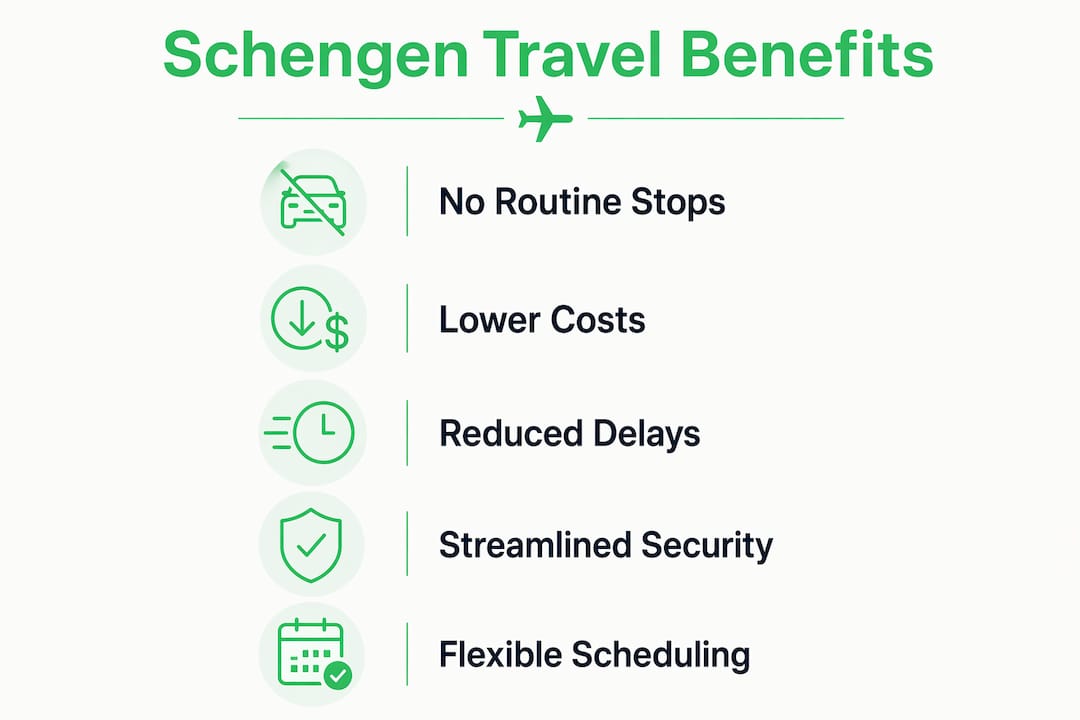
The practical payoff for private transfer buyers is direct. A chauffeur driving you from Brussels to Cologne does not pull over at the German border, wait in a vehicle queue, or ask you to present documents to a border officer. The route runs uninterrupted.
Here is what that means in concrete terms:
- Fewer stops, faster door-to-door times. A cross-border drive that would take 3.5 hours stays at 3.5 hours instead of stretching to 4.5 with border processing.
- Predictable schedules. Fixed-route pricing and timing work because the operator knows the journey will not hit an unpredictable queue mid-route.
- Simpler multi-city itineraries. A Paris to Geneva to Milan sequence is one continuous chauffeur engagement, not three separate bookings with three separate border clearances.
- Cleaner meet & greet logistics. Your driver meets you at arrivals once; there is no secondary checkpoint to coordinate around.
The Schengen framework lowers administrative costs and reduces time risk for cross-border transport, which is why operators can offer fixed pricing on routes that cross multiple national borders.
Two residual considerations matter. First, occasional spot checks near internal borders still occur. Keep your passport accessible, not buried in checked luggage. Second, if any leg of your trip crosses into a non-Schengen country, the rules change entirely. The UK, Ireland, and several Balkan states sit outside the Schengen zone, so a transfer from Paris to London triggers full passport control and potential vehicle checks.

The EU’s Entry-Exit System (EES), which began collecting biometric data at external Schengen borders as of October 12, 2025, adds processing time at your first point of entry. Facial images, fingerprints, and passport data are collected on arrival. This only affects the external-border crossing, not internal legs, but it does mean your first arrival into Schengen may take longer than you expect.
Pro Tip: If you are arriving at a major hub like Frankfurt or Amsterdam for the first time under EES, add 30–45 minutes to your expected immigration processing time and confirm your transfer operator monitors your flight in real time.
How to choose and book a cross-border private transfer
Not every transfer operator is equipped for cross-border work. Here is a practical checklist to use before you confirm a booking.
Pre-booking checklist
- Flight number and real-time tracking confirmation from the operator
- Passenger count and luggage volume (minivans for families, sedans for pairs)
- Child seat requirements stated at booking, not at pickup
- Multilingual driver availability if you need it
- Meet & greet location: arrivals hall, name board, or curbside
Questions to ask every operator
- Do you have cross-border operating licenses and insurance for every country on the route?
- Are tolls and road fees included in the quoted price, or billed separately?
- Is the price fixed, or does it change with traffic or waiting time?
- What is your waiting-time policy if EES processing runs long?
- What is the cancellation window and refund policy?
For guaranteed airport pickup service, fixed pricing should cover the full route, tolls included. Any operator who cannot answer the toll question clearly is likely to add charges after the fact.
Timing guidance: For first-entry Schengen arrivals under EES, build in at least 45 minutes beyond your standard immigration estimate. For internal Schengen connections, standard pickup windows apply, though flight tracking remains important for delays. Multi-leg itineraries benefit from hourly chauffeur hire rather than point-to-point bookings, since waiting time between stops is already factored into the rate.
Pricing for cross-border transfers typically reflects the base route distance, applicable tolls (Swiss motorway vignette, Austrian highway fees, French autoroute tolls), and any cross-border supplement the operator charges. Ask for a fully itemized quote. If convenience in business travel is a priority for your team, a fixed all-in price is the only format worth accepting.
Pro Tip: Travel managers booking for executives should request a written confirmation that includes the driver’s name, vehicle plate, and a direct contact number. That detail alone eliminates most airport pickup confusion.
Key Takeaways
Schengen’s removal of routine internal border checks is the single biggest structural advantage for private cross-border transfers in Europe, cutting door-to-door time and enabling fixed-price routing across multiple countries.
| Point | Details |
|---|---|
| No routine internal stops | Schengen removes systematic border checks, so cross-border chauffeur routes run uninterrupted. |
| 90/180-day rule is cumulative | U.S. travelers get 90 days across the entire Schengen zone, not per country. |
| EES adds first-entry time | Biometric processing at external borders since October 2025 means your first Schengen arrival takes longer. |
| Non-Schengen legs need extra time | Transfers into the UK, Ireland, or Balkan non-members trigger full border control. |
| Zont Cab covers 120+ cities | Fixed pricing, flight tracking, and meet & greet across 120+ European cities with 50,000+ completed trips. |
An operator’s view on running cross-border transfers
Running transfers across Schengen borders is operationally cleaner than most travelers expect, but it rewards preparation. The absence of routine internal checks means a driver can commit to a fixed arrival window with real confidence. What still requires active management is the external-border entry, particularly now that EES biometric processing is live.
Zont Cab’s approach centers on three things: live flight monitoring that adjusts pickup timing automatically, a meet & greet protocol where the driver holds a name board in the arrivals hall, and fixed pricing that covers the full route with no surprise toll additions. Across more than 50,000 completed trips and a 4.5-star TripAdvisor rating, those three elements consistently resolve the friction points travelers actually encounter.
The EES adjustment is a good example of how the playbook works in practice. When EES queues at a major hub run longer than the standard immigration estimate, Zont Cab drivers receive an updated pickup window through the flight-tracking system rather than waiting at the curb. The traveler exits to a driver who is already there, not one who left after a 30-minute no-show window expired.
Why Zont Cab is built for Schengen cross-border transfers
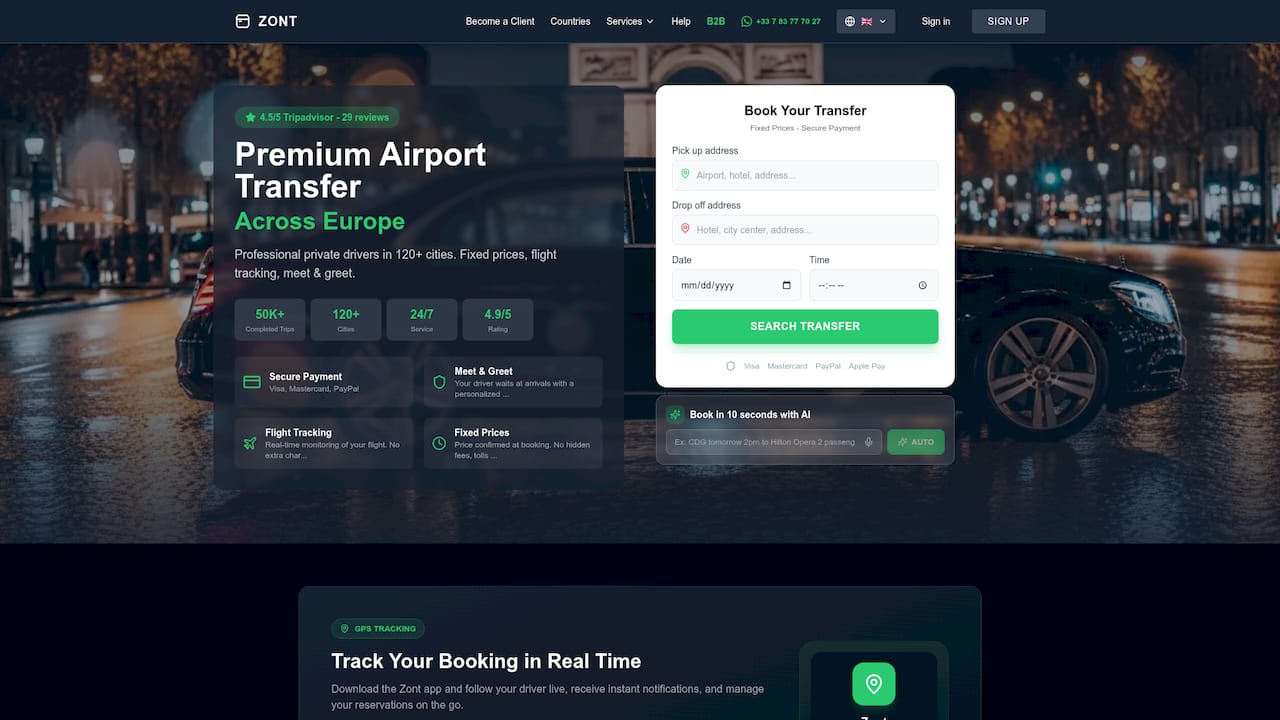
Zont Cab covers airport transfers across Europe in 120+ cities, with fixed pricing that includes tolls, a meet & greet driver in every arrivals hall, and live flight tracking on every booking. Every vehicle in the fleet, from Mercedes sedans to minivans for families, carries full cross-border insurance and licensing for the routes it operates. There are no variable billing surprises and no separate toll invoices after the fact.
For travelers who have just read through the checklist above, Zont Cab answers every item on it. Confirm your route, get a fixed quote, and your driver handles the rest, including EES timing adjustments on first-entry arrivals. Book your cross-border transfer at zont.cab.
Useful sources and further reading
Authoritative references to verify Schengen rules and U.S. traveler guidance:
- Schengen Area: European Commission overview — primary source on how internal border controls are abolished and external borders managed
- The Schengen area explained: Council of the EU — Consilium explainer covering the 1.25 billion annual journeys figure and temporary check provisions
- Schengen guide: European Parliament — accessible overview of border-free travel rights and Frontex’s role
- EUR-Lex Schengen summary — legal framework covering the Schengen Borders Code and visa rules
- U.S. State Department: Travelers in Europe — official U.S. guidance on the 90/180-day rule, passport validity, and EES biometric requirements
- Schengen Area: Wikipedia — quick reference for member and non-member country lists
- Zont Cab: airport transfers across Europe — booking and service overview
- How connecting flight transfers are coordinated: Zont Cab blog — operational detail on multi-leg transfer coordination