Why Airport Transfers Miss Flights: Causes Explained

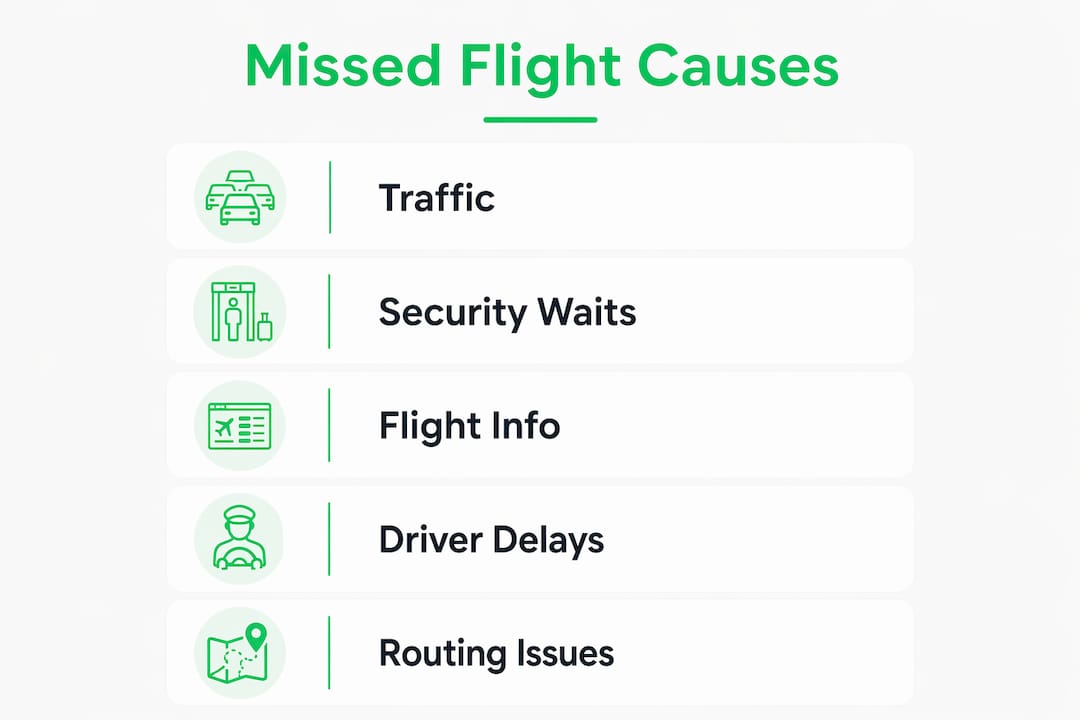
Airport transfers miss flights for three reasons that repeat across every major US hub: traffic that arrives without warning, security wait times that bear no resemblance to what an app predicted, and pickup timing that was set against a schedule rather than a live flight. Understanding why connections fail is the first step toward never experiencing one.
The core causes, quickly:
- Unexpected road congestion near terminal curbsides, especially at airports like LAX where last-mile gridlock is structural, not occasional
- Inaccurate security wait estimates from apps that lag behind real-time staffing conditions
- Static pickup scheduling that ignores actual flight progress, gate changes, or FAA ground stops
- No backup plan when the primary route or provider fails
- Missing flight number at booking, which prevents dynamic coordination entirely
Premium transfer services address all five. Services like Zont Cab use real-time flight tracking, driver communication protocols, and alternate routing to absorb the shocks that turn a routine pickup into a missed departure.
Table of Contents
- 1. Why do airport transfers miss flights in the first place?
- 2. Real-time flight tracking changes everything for transfer reliability
- 3. Best practices that actually prevent missed flights
- 4. Why your flight number is the most important detail you can provide
- 5. The problem with trusting security wait time apps
- 6. How Zont Cab prevents missed flights on every trip
- Zont Cab is built for travelers who can’t afford to miss a flight
- Key Takeaways
1. Why do airport transfers miss flights in the first place?
The most common causes of missed flights during transfers aren’t dramatic. They’re mundane failures that compound quietly until there’s no time left.
Terminal curbside congestion is the leading culprit at major US hubs. Ride-hailing vehicles, hotel shuttles, rental car buses, and private cars all compete for the same limited curb space. At LAX, that bottleneck exists regardless of what time you leave the hotel.
- FAA ground stops cascade fast. A ground stop at one East Coast hub can ripple into nationwide delays within an hour, disrupting connecting transfers that were booked against a now-irrelevant schedule.
- Security wait times vary by terminal, not just by airport. At JFK, the gap between Terminal 4 and Terminal 7 wait times can be significant enough to change whether you make your flight.
- Overreliance on a single route or provider is the most common ground-transport failure. When that one option stalls, there’s nothing behind it.
- Premature arrivals create bottlenecks. Airports now recommend arriving 90 minutes before departure based on dynamic calculations, not the old “arrive as early as possible” logic that actually worsens security queues.
- Flight delays aren’t communicated to the driver. Without live tracking, a driver dispatched for a 2:00 PM arrival has no way to know the flight landed at 1:35 PM or 2:45 PM.
Understanding how connecting flight transfers are coordinated reveals how many of these failures are preventable with the right systems in place.
2. Real-time flight tracking changes everything for transfer reliability
Flight tracking is the single biggest operational difference between a transfer that works and one that doesn’t. Without it, a driver is guessing.
When a provider monitors your flight number in real time, dispatch adjusts automatically. If your inbound flight is delayed 40 minutes, the driver’s departure time shifts accordingly. If the flight arrives early, the car is already waiting. That kind of dynamic scheduling is what separates a guaranteed transfer from a scheduled guess.
- Gate and terminal accuracy. Flight tracking confirms not just arrival time but the specific terminal and gate, so the driver isn’t circling the wrong concourse.
- Driver communication improves. Live updates give dispatchers something concrete to relay, which means you get accurate ETAs instead of vague reassurances.
- Early arrivals are handled, not missed. Early flight arrivals complicate transfers significantly when there’s no tracking in place. A driver who expected you at 3:15 PM won’t be ready at 2:50 PM without a live data feed.
Pro Tip: When booking any transfer, ask specifically whether the provider monitors your flight number in real time or simply sets a pickup time and holds it. The answer tells you everything about how they’ll handle a delay.

3. Best practices that actually prevent missed flights
Most transfer failures are avoidable. The travelers who consistently make their flights do a few specific things differently.
- Book in advance with a provider that guarantees punctuality. Last-minute bookings leave no time to vet the provider or communicate flight details. Pre-booking airport transportation gives the service time to plan routing, confirm terminal logistics, and assign the right vehicle.
- Check terminal-specific security wait times, not airport-wide averages. Individual airport websites update more frequently than federal apps. Official airport social accounts often post real-time screening conditions faster than any third-party tool.
- Use flexible transfer options with backup routing. Major US hubs operate at or beyond capacity, making single-route dependency a genuine risk. A provider with alternate routes can reroute around an accident or road closure without losing time.
- Pre-book security time slots where available. Programs like Spot Saver (available at JFK Terminal 4, Seattle-Tacoma, Minneapolis-St. Paul, Phoenix, and Orlando) let you reserve a security lane entry time up to six days in advance.
- Stay in contact with your driver. Confirm pickup location, terminal, and any flight changes at least an hour before departure. Don’t assume the provider already knows.
Pro Tip: Never rely on a single wait-time app as your only data source. Cross-reference the TSA app with the airport’s own website and its official social media feed. On days with staffing shortages, those three sources can show wildly different numbers, and only one of them reflects what’s actually happening at the checkpoint.
For a broader look at what goes wrong on the ground, the common airport taxi mistakes travelers make are worth reviewing before your next booking.
4. Why your flight number is the most important detail you can provide
Providing your flight number at booking isn’t a formality. It’s the data point that makes everything else possible.
Flight number coordination gives a transfer provider access to official tracking feeds, which means they know your actual arrival time, not the scheduled one. That distinction matters most when flights run early or late. Without the flight number, the provider is working from a static schedule that may be wrong by 30 minutes in either direction.
- Terminal and gate confirmation. Airlines change gates. A flight number lets dispatch verify the correct pickup point in real time rather than sending a driver to the wrong terminal.
- Reduced risk from early arrivals. When a flight lands ahead of schedule, a provider with live tracking can respond. One without it cannot.
- Providers like Zont Cab require the flight number precisely because it’s the foundation of their guaranteed service model. It’s not optional data; it’s the mechanism that makes on-time pickup possible.
5. The problem with trusting security wait time apps
Security wait time apps are useful, but treating them as precise or current is a mistake that costs travelers their flights.
Aggregate apps pull from historical data and user reports. When TSA staffing drops sharply, as it has during government funding gaps when thousands of officers called out at major airports including Atlanta, Baltimore, and Houston, those apps reflect yesterday’s conditions, not today’s.
- Terminal-specific gaps are invisible in aggregate data. Security wait times can vary by a factor of three between terminals at the same airport. An app showing a 12-minute average means nothing if you’re in the terminal with a 35-minute line.
- Federal apps go dark during funding disruptions. The My TSA app has displayed warnings during government shutdowns stating it “will not be actively managed,” leaving travelers with outdated data at exactly the wrong moment.
- Airport websites and social media are more reliable. Individual airport sites update terminal-specific wait times more frequently. For real-time accuracy, check the airport’s official social accounts.
- Pre-booking a security slot hedges the risk. Where Spot Saver or Reserve programs are available, a reserved time slot removes the unpredictability entirely.
For travelers relying on airport transfer best practices, factoring in terminal-specific security data is one of the most consistently overlooked steps.
6. How Zont Cab prevents missed flights on every trip
Zont Cab’s approach to transfer reliability is built around the specific failure points that cause missed flights: bad timing, poor communication, and no fallback when conditions change.
Every booking integrates real-time flight tracking tied to the passenger’s flight number. Drivers receive live updates on arrival times, gate assignments, and terminal changes. When a flight is delayed, the pickup adjusts. When it lands early, the driver is already positioned. That’s not a feature; it’s the baseline.
- Backup routing is standard. Road congestion is treated as a given, not an exception. Zont Cab dispatchers maintain alternate routes for every major transfer and activate them proactively when traffic data warrants it.
- Personalized meet and greet service means the driver is at the correct terminal with your name displayed, eliminating the confusion that costs time at busy arrivals halls.
- Fixed pricing with no hidden fees removes the incentive to rush or cut corners on timing.
Zont Cab holds a high TripAdvisor rating across many completed trips, with travelers consistently citing punctuality and professionalism as the defining qualities of the service.
The comparing airport transfer providers guide lays out exactly what separates services that guarantee arrival from those that simply schedule it and hope.
Zont Cab is built for travelers who can’t afford to miss a flight
Missing a flight because of a ground transfer failure is one of the most preventable travel problems there is. The fix isn’t arriving three hours early. It’s choosing a provider whose entire operation is designed around the variables that cause transfers to fail.
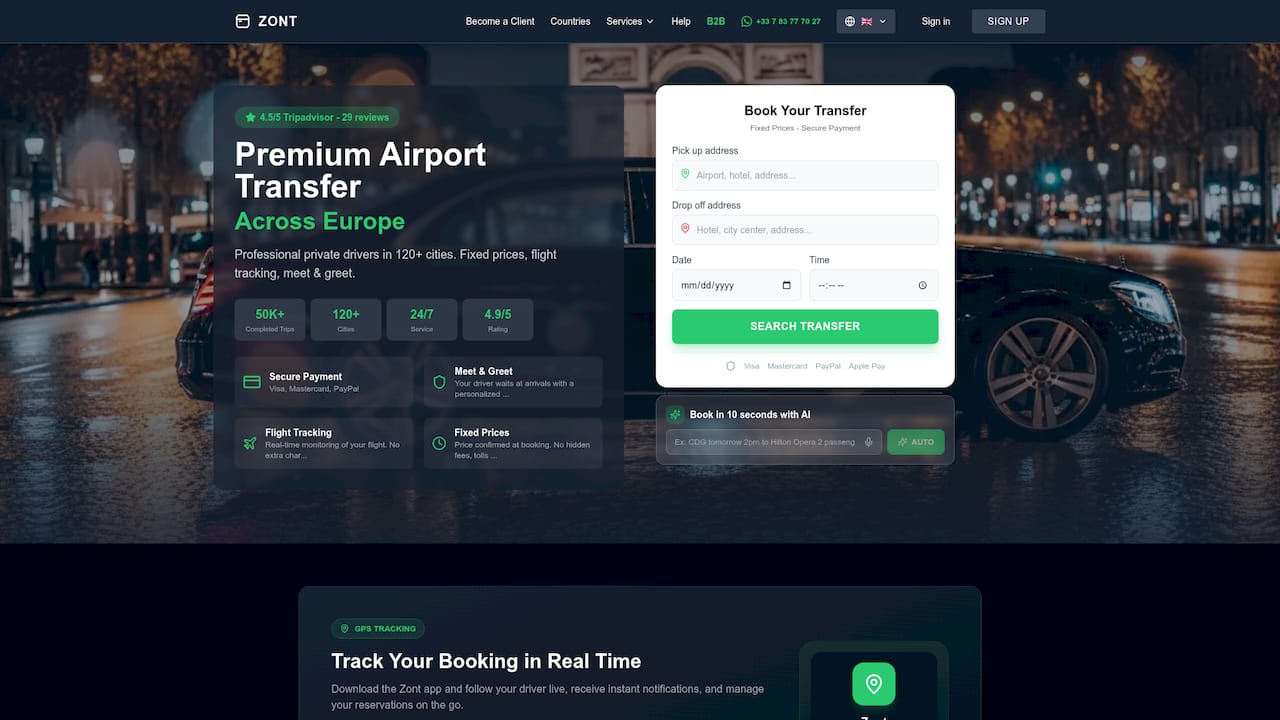
Zont Cab combines real-time flight tracking, terminal-specific logistics, backup routing, and direct driver communication into a single fixed-price booking. No surprises on the invoice, no driver who doesn’t know your gate changed, no single route that leaves you stranded when traffic locks up. For travelers who need to be at the gate on time, every time, that’s the difference between a transfer service and a guarantee.
Book your premium airport transfer and see why over 50,000 trips have been completed with a 4.5-star rating. Or browse all available destinations to find service in your city.
Key Takeaways
Airport transfers miss flights most often because of traffic congestion, inaccurate security wait estimates, and pickup timing set against a static schedule rather than a live flight.
| Point | Details |
|---|---|
| Traffic is structural, not occasional | Last-mile curbside congestion at major US hubs is a predictable risk, not a rare event. |
| Flight number enables real-time coordination | Without it, providers cannot adjust for delays, early arrivals, or gate changes. |
| Security app data lags behind reality | Terminal-specific wait times can vary by a factor of three; airport websites update faster. |
| Backup routing is non-negotiable | Single-route dependency is the most common cause of ground-transport missed flights. |
| Zont Cab guarantees the transfer | Real-time tracking, backup routes, and 50,000+ completed trips at a 4.5-star TripAdvisor rating. |