Arrive Stress Free: Grenoble Airport to Alpe d’Huez in 1h30–2h

For families, groups, and anyone traveling with ski bags, a private pre-booked transfer is the most reliable way to cover the roughly 1h30 to 2 hours between Grenoble Airport and Alpe d’Huez, door-to-door. Solo travelers on a tighter budget can take the seasonal shared coach for a lower per-person fare, though it runs on a fixed schedule with multiple stops. Self-driving and taxis sit in between: flexible, but subject to mountain roads and winter equipment rules.
TL;DR:
- Private transfers offer the fastest, most reliable door-to-door service, typically taking 1h30 to 2 hours, ideal for families and those with ski equipment.
- Shared coach services are cheaper but may include multiple stops and take longer, especially during peak seasons or with delayed flights.
- Booking early and aligning your coach departure with your flight’s landing time helps prevent missed connections due to weather or delays.
- Renting a car requires winter tires or chains and may be challenging for first-time alpine drivers unfamiliar with mountain roads.
- Travelers with mobility issues should prioritize private transfers that can accommodate wheelchairs, as shared coaches may involve stairs and limited accessibility.
Table of Contents
- Which transfer option fits your trip?
- Bus and shared shuttle services: timetables, stops, and luggage rules
- Private pre-booked transfers: door-to-door service and pricing factors
- Self-drive, taxis, and rideshare: mountain roads and winter rules
- Arrival logistics at Alpe d’Huez: drop-off, parking, and resort shuttles
- Booking and winter-season tips to avoid common mishaps
- Accessibility options for travellers with reduced mobility
- First-time arrival at Grenoble Airport: what to expect
- How weather affects transfers, and what to do about it
- Which transfer fits your trip?
- Booking a private transfer with Zont Cab
- FAQ
- Sources
Which transfer option fits your trip?
The right choice depends on group size, luggage, and how much control you want over your schedule.
- Private transfer: door-to-door, around 1h30 to 2h, best for families, groups, and anyone with ski bags or boot bags; costs more per booking but less per person when shared among a group.
- Shared coach or shuttle: the cheapest scheduled option at roughly 1h30 to 2h30 depending on stops, ideal for solo travelers or couples who don’t mind a multi-stop ride.
- Taxi or rideshare: convenient for last-minute plans or small parties, but fares and availability vary and winter wait times can stretch.
- Self-drive rental: flexible for multi-resort trips, but requires winter tires or chains and comfort with hairpin mountain roads.
If you land late at night, travel with young children, or carry more than one ski bag per person, a private transfer removes the guesswork. If you’re traveling alone with a single bag and flexible timing, the shared coach is worth the wait at the stops.
Bus and shared shuttle services: timetables, stops, and luggage rules
Seasonal coach services connect Grenoble Airport, and sometimes Grenoble city center, to Alpe d’Huez during the winter months, generally December through April, with schedules timed around incoming flights. These dedicated winter coaches reduce waiting time at the airport, though a private transfer still removes the uncertainty that comes with a shared, multi-stop route.
Shared coaches and low-cost seasonal operators such as Ben’s Bus have historically run regular transfers linking scheduled flights to resorts like Alpe d’Huez throughout the season, according to the Alpes Isère transfer overview. Journey time typically runs 1h30 to 2h30, depending on the route and how many resorts the coach serves before reaching Alpe d’Huez.
Booking usually happens through the official resort transport pages or the shuttle operator’s own site, and it pays to check in advance:
- Luggage allowances are often capped at one suitcase plus one ski bag per passenger.
- Seats fill quickly during school holiday weeks, so early booking secures a spot on the flight-aligned departure.
- Payment is typically due at booking, with limited flexibility for schedule changes.
The upside is cost and a fixed, published schedule. The downside is less control: multiple stops mean a longer ride and less predictable arrival time at your accommodation.
Pro Tip: Book the coach departure that lines up with your flight’s scheduled arrival, not your boarding time, since winter delays can push the next available shuttle back by hours.
Private pre-booked transfers: door-to-door service and pricing factors
A private transfer typically takes about 1h30 to 2 hours from Grenoble Airport to Alpe d’Huez in good conditions, and it tends to be faster and more predictable in winter because the driver goes straight to your accommodation without intermediate stops. Industry guidance on alpine transfers notes that flight tracking and a personalized meet and greet cut down on the stress of delayed landings, which matters most when traveling with children or bulky ski equipment.
Pricing on a private transfer depends on several variables including vehicle size, number of passengers, trip type (one-way or round trip), and seasonality, with peak-season fares typically higher than in shoulder seasons.
A private transfer’s main advantage is timing certainty: door-to-door service in roughly 1h30 to 2 hours means one pickup, no transfers, and a driver who already knows your flight status.
Before booking, confirm that the vehicle has dedicated ski storage, that its stated capacity matches your group and bag count, and that the operator’s cancellation and delay policy covers a late landing without extra fees.
Self-drive, taxis, and rideshare: mountain roads and winter rules
Driving from Grenoble Airport to Alpe d’Huez covers about eighty kilometers, and the final stretch climbs through the resort’s well-known 21 hairpin bends. Roads are cleared regularly in winter, but French regulations require winter tires or snow chains on vehicles traveling through mountain zones between November and March, so confirm this when renting a car.
A few practical notes for anyone driving or taking a taxi:
- Rental cars booked for winter should come with winter tires already fitted, not just chains in the trunk.
- Taxi fares vary by time of day and demand, and availability can thin out late at night or during storms.
- Rideshare coverage in rural Isère is inconsistent compared to city areas, so don’t count on it as a backup plan.
- Parking at the resort is limited near the center, pushing most drivers toward covered lots on the outskirts.
Taxis make sense for small groups with light luggage and flexible timing, but for anyone unfamiliar with alpine driving, a pre-booked private transfer avoids both the hairpins and the tire-chain question entirely.
Pro Tip: If you’re renting a car, request winter tires at the counter rather than assuming they’re standard, since not every rental fleet in the region fits them by default.
Arrival logistics at Alpe d’Huez: drop-off, parking, and resort shuttles
Most transfers and coaches drop passengers near the resort center or at one of the covered car parks, such as Le Coulet, Les Bergers, or Eclose. Alpe d’Huez actively promotes car-free movement once you arrive, encouraging visitors to leave vehicles in covered municipal parking and rely on free shuttles and gondolas instead.
Two gondola lifts and a network of free intra-resort shuttle buses move visitors between neighborhoods and lift access points throughout the winter season, which keeps the village largely free of car traffic in peak weeks.
- Confirm with your accommodation whether it’s walkable from the main drop-off point or requires a shuttle connection.
- Pack ski bags with wheels or a shoulder strap, since the last few hundred meters from a car park to a chalet door often isn’t served by vehicle traffic.
- Ask your transfer driver to confirm the exact drop-off address rather than a general resort zone, especially for accommodations tucked into smaller lanes.
Booking and winter-season tips to avoid common mishaps
Winter weeks fill up fast, and a little planning avoids the scramble that hits unprepared travelers in February half-term or the Christmas fortnight.
- Book your transfer or coach seat as soon as your flight is confirmed, especially around school holidays.
- Match your coach or shuttle departure to your actual flight arrival time, not an estimate.
- Check that your chosen vehicle has ski-rack or boot storage sized for your group’s equipment before paying.
- Choose a flexible or cancellable option if your flight carries any risk of winter delay.
- Check airport and road notices the morning of travel, since mountain routes can shift with weather.
Group-sharing a private transfer across a few families often lands close to the shared coach’s per-person cost while keeping the door-to-door convenience, and booking coach seats several weeks ahead sometimes unlocks early-bird pricing.
Pro Tip: Save your transfer confirmation and driver contact offline, since mountain signal near Alpe d’Huez can be patchy right when you need to coordinate a pickup.
Accessibility options for travellers with reduced mobility
Travelers with reduced mobility have a few practical paths between Grenoble Airport and Alpe d’Huez, though options narrow compared to flat-terrain destinations. Private transfers tend to work best for this group, since a pre-booked vehicle can be requested with extra space for a folded wheelchair or mobility aid, and the driver can assist directly at the curb rather than leaving passengers to manage stairs or long walks at a coach stop.
Shared coaches are less practical for wheelchair users, since boarding typically involves steps and storage is shared among several passengers. If a coach is the only option within budget, it’s worth contacting the operator directly before booking to confirm what accommodations, if any, exist for mobility equipment.
Within Alpe d’Huez itself, the resort’s free intra-resort shuttles and the two gondola lifts serve as the main way to move between neighborhoods without a car, and accessibility features vary by vehicle and lift. It’s worth checking directly with the resort’s transport services ahead of a visit to confirm which shuttles and lift cabins accommodate wheelchairs or limited mobility, since this detail isn’t always published on general transport pages.

When booking any private transfer, flag mobility needs at the time of reservation rather than on arrival, since vehicle assignment and loading time both depend on knowing in advance.
First-time arrival at Grenoble Airport: what to expect
Grenoble Alpes-Isère Airport sits in Saint-Étienne-de-Saint-Geoirs, which is farther from Grenoble city than many first-time visitors expect, roughly 45 minutes by road, and this distance is part of why transfer options to Alpe d’Huez run directly from the airport rather than routing through the city center.
The terminal itself is small, which works in a traveler’s favor: baggage claim, car rental counters, and transfer or taxi pickup points are all within a short walk of each other, with no long transit between zones. Signage is in French and English, and ground transport desks near the arrivals area can usually point newcomers toward coach stops or taxi ranks if a pre-booked transfer hasn’t been arranged.
Because the airport primarily handles seasonal and low-cost flights rather than year-round long-haul traffic, services at the terminal thin out outside peak ski weeks, so a flight landing in low season may find fewer staffed counters open. If you’ve pre-booked a private transfer, confirm your driver’s meeting point before travel, since Zont Cab-style flight-tracked transfers typically arrange a specific pickup zone rather than a general curbside wait.
First-time visitors driving onward should note that the airport’s exit roads lead toward smaller departmental roads before joining the main route to the Alpe d’Huez valley, so a GPS set in advance saves confusion in the rental car lot.
How weather affects transfers, and what to do about it
Snowfall, fog, and high winds can all slow the route between Grenoble Airport and Alpe d’Huez, particularly on the final climb through the resort’s hairpin sections, where local authorities sometimes require chains even on vehicles already fitted with winter tires. Heavy snow can also affect flight schedules themselves, which ripples into coach and transfer timing on the ground.

Shared coaches run on fixed schedules and have limited ability to adjust for a delayed flight or a closed road, which means a traveler stuck behind a weather delay may miss their booked departure entirely. Private transfers with flight tracking are built to absorb this kind of disruption, since the driver monitors the actual landing time and adjusts the pickup rather than working from a printed timetable.
For self-drivers, checking regional road notices before setting out is worth the five minutes it takes, since temporary chain requirements or closures on the climb to Alpe d’Huez are announced locally and change quickly during active storms. Building in a buffer of an extra hour on a snowy travel day, and having a backup plan such as an overnight stay in Grenoble if the pass closes, keeps a weather delay from turning into a stranded night in a parking lot.
Whichever option you choose, winter travel in the Alps rewards flexibility more than speed.
Which transfer fits your trip?
For families, large groups, or anyone hauling multiple ski bags, a private transfer is the pick that removes the most friction from an already long travel day. Solo travelers comfortable with a multi-stop ride and a fixed schedule can save money on the shared coach without much added stress. A dependable private transfer service with flight tracking built in is what turns a winter arrival into a non-event rather than a gamble.
— Arthur
Booking a private transfer with Zont Cab
We built our transfer service around the exact problem winter travelers run into: unpredictable flights, heavy ski bags, and the stress of figuring out ground transport after a long trip. We track your flight in real time, meet you at arrivals with a personalized greeting, and move your group straight to Alpe d’Huez in a vehicle sized for your party and your equipment, without multi-stop coaches or last-minute scramble for a taxi.
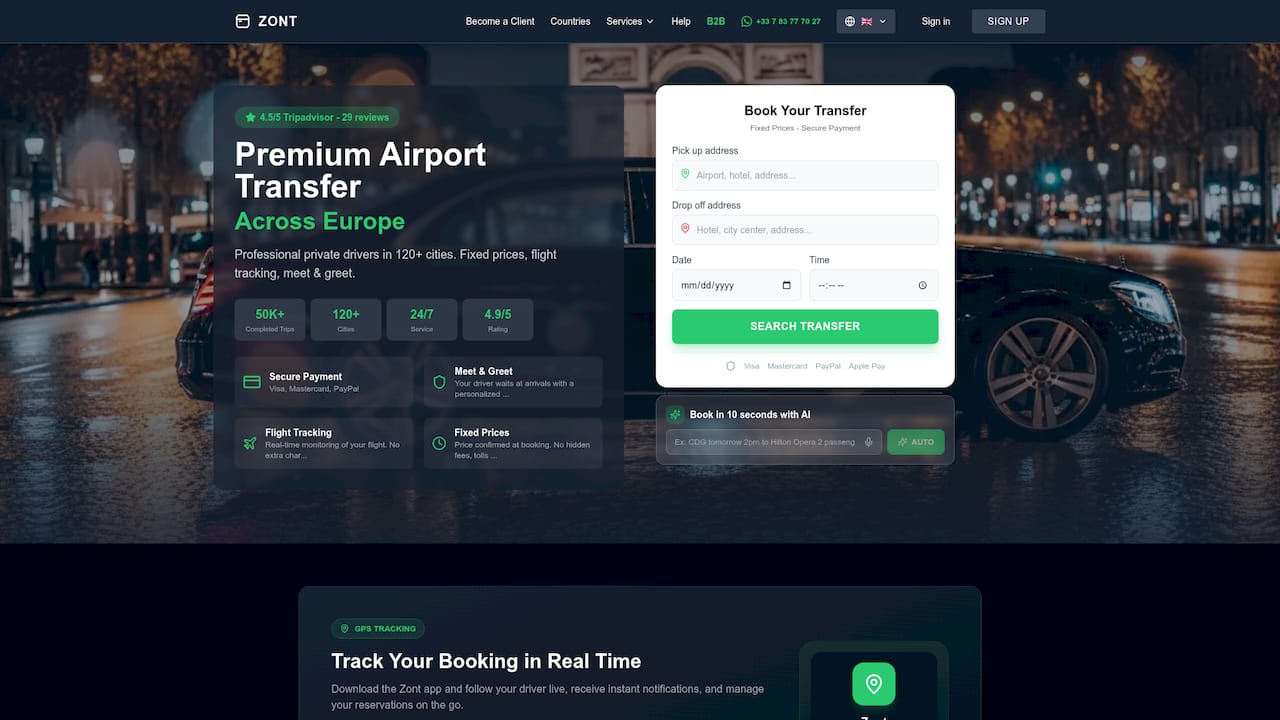
Our pricing is fixed before you travel, so there are no surprise add-ons. We operate across more than 120 cities in Europe, which means the same booking process covers your return leg or any other trip you’re planning.
- Flight monitoring adjusts your pickup automatically if your plane lands late.
- Vehicle options range from sedans to larger vans for groups with full ski gear.
- Fixed pricing is confirmed at booking, with no hidden fees added afterward.
Check availability and book your Grenoble Airport transfer with us directly, or explore our 8-seat vehicle options if you’re traveling with a larger group.
FAQ
Which airport is closest to Alpe d’Huez, France?
Grenoble Alpes-Isère Airport is the closest major airport to Alpe d’Huez, located in Saint-Étienne-de-Saint-Geoirs. It serves as the main gateway for winter travelers heading to the resort, with both seasonal coach services and private transfers departing from the terminal.
How can I get a transfer from Grenoble Airport to Alpe d’Huez?
The main options are a seasonal shared coach, a pre-booked private transfer, a taxi, or a self-drive rental car. A private transfer offers door-to-door service with flight tracking and meet and greet, while the shared coach is the lower-cost scheduled alternative.
How long is the transfer from Grenoble to Alpe d’Huez?
A private transfer typically takes about 1h30 to 2 hours in good winter conditions. Shared coaches often take longer, roughly 1h30 to 2h30, depending on the number of stops along the route.
How much does a taxi cost from Grenoble to Alpe d’Huez?
Taxi fares vary by time of day, demand, and weather conditions, and no single published rate applies across all operators. For predictable, fixed pricing with no surprise charges, a pre-booked private transfer is generally the more transparent option for this route.
Is renting a car a good option for getting to Alpe d’Huez in winter?
Self-driving works for travelers comfortable with mountain roads and the resort’s 21 hairpin bends, but French regulations require winter tires or chains on vehicles in mountain zones between November and March. For first-time visitors or anyone unfamiliar with alpine driving, a pre-booked transfer avoids that learning curve entirely.
Sources
- Alpe d’Huez — access and transport (transaltitude / coach info)
- Fly to Grenoble - Alpes Isère: shuttle and transfer overview