Hourly Chauffeur Rates in France: Why €55 Is Only the Start

Hourly chauffeur rates in France typically vary by vehicle tier and operator, with most setting a 1 to 3 hour minimum booking for sedans and longer minimums for vans. The quoted hourly figure almost never matches your final invoice: tolls, waiting time, and gratuity usually push the total higher.
TL;DR:
- Standard sedans cost €45 to €65 per hour, business sedans €65 to €90, and luxury sedans €90 to €120; Paris events can raise rates.
- Sedans usually require a 1 to 3 hour minimum; vans require 3 to 4 hours, while longer packages lower the effective hourly rate.
- Tolls, parking, waiting, and gratuity add costs; airport pickups often include a grace period of 15 minutes, while night and holiday surcharges may also apply.
- For groups of four or more with luggage, one van at €80 to €130 per hour may cost less than booking two sedans.
- Ask for the all in total, minimum hours, and extension rules before booking; fixed point to point transfers may cost less for one predictable leg.
Table of Contents
- Typical hourly rate ranges in France, by vehicle tier and service level
- Booking minimums set your invoice floor
- What “all-in” means for a French booking
- How vehicle type and service duration affect price and choice
- How to estimate total cost for your trip before booking
- Why Zont stands out for hourly chauffeur bookings in France
- When hourly disposal is the smarter choice
- Book hourly chauffeur service with Zont: where to check rates and availability
- FAQ
- Sources
Typical hourly rate ranges in France, by vehicle tier and service level
Hourly chauffeur pricing in France splits cleanly by vehicle class, and the gap between tiers is wide enough to change your budget by double. An economy or standard sedan, the kind most VTC operators use for everyday business trips, generally runs €45 to €65 per hour. Move up to a business or executive sedan, like a Mercedes E-Class, and you’re looking at €65 to €90 per hour. The luxury tier, typically an S-Class or equivalent, runs €90 to €120 per hour. Vans and minibusses for groups of six to eight passengers often sit between €80 and €130 per hour, since the vehicle itself costs more to operate and insure.
- Economy/standard sedan: roughly €45 to €65 per hour, 1 to 3 passengers, light luggage.
- Business/executive sedan: roughly €65 to €90 per hour, suited to client meetings or airport runs with a professional feel.
- Luxury sedan (S-Class tier): roughly €90 to €120 per hour, used for events, VIP transport, or long business days.
- Van or minibus (7 to 8 seats): roughly €80 to €130 per hour, built for groups or extra luggage.
Paris commands a premium over smaller French cities. Demand density, traffic patterns, and the sheer number of short, stop-heavy bookings in the capital push rates toward the higher end of each band. Event periods change the math too: Fashion Week, major conferences, or the Cannes Film Festival calendar can pull luxury sedan and van rates toward their peak, sometimes beyond the ranges above, because availability tightens.
A 2026 industry analysis of hourly chauffeur pricing found that headline hourly rates can understate the final invoice by 40 to 70% once gratuity, tolls, surcharges, and taxes are factored in, a pattern observed in the NYC hourly chauffeur market but one that maps closely onto how French operators layer their own fees.
Sample quote math makes the ranges concrete. A standard sedan at €55 per hour with a 2 hour minimum gives a base of €110 before any extras. A business sedan at €75 per hour booked for a 4 hour half-day block runs €300 at the base rate. A van at €100 per hour for a 3 hour airport-to-hotel-to-dinner run comes to €300 as well, which is often cheaper than booking two sedans for the same group. These are headline totals only; the next sections cover what typically gets added on top.

Booking minimums set your invoice floor
Every hourly chauffeur booking in France comes with a minimum duration, and that minimum applies whether you use the full block or not. Book a 2 hour minimum and finish your errands in 90 minutes, and you still pay for 2 hours. Minimums exist because operators need to cover driver time, positioning, and fuel even for short jobs, and they vary meaningfully by vehicle class.
- Sedans (standard, business, or luxury) typically carry a 1 to 3 hour minimum, with 2 hours being the most common baseline for city bookings in Paris.
- Vans and minibusses usually require a 3 to 4 hour minimum, reflecting the higher fixed cost of running a larger vehicle even for a short trip.
- Half-day packages, usually defined as 4 to 6 hours, reduce the effective per-hour cost compared to booking the same hours in two separate short reservations.
- Full-day packages, typically 8 to 10 hours, offer the lowest per-hour rate of all, since operators price them to secure a full day of guaranteed revenue rather than scattered bookings.
- Extensions during an active ride are almost always billed in 30 minute or 1 hour increments at the same hourly rate, sometimes with a short grace period before the clock restarts.
The practical takeaway: if you expect your trip to run close to a round number of hours, booking the package upfront is almost always cheaper than booking short and extending on the fly, since many operators charge a slight premium for last-minute extensions arranged mid-ride rather than at confirmation.
What “all-in” means for a French booking
The headline hourly rate is only the starting point. French chauffeur bookings commonly add several layers before you see a final number, and knowing them ahead of time keeps your budget honest.
- Péage (tolls): any motorway stretch between cities or to regional airports like Beauvais typically adds real toll costs, billed at cost or as a flat estimate.
- Parking fees: venue, event, or hotel parking charges are generally passed through directly.
- Waiting or standby time: most operators include a grace period, often 15 minutes for airport pickups, before charging waiting time at or near the hourly rate.
- Night and holiday surcharges: rides late at night or on public holidays often carry an uplift, a practice rooted in how VTC services differ from regulated taxis in how they structure pricing.
- Meet and greet fees: some operators charge separately for a named driver holding a sign inside an airport terminal, though others fold this into the base rate.
- Gratuity: not mandatory in France, but commonly added voluntarily or built into a “service compris” line.
This layered pricing isn’t unique to France. The same NYC-focused industry analysis cited above found that the all-in total in mature chauffeur markets can run 30 to 60% higher than the headline hourly figure once every layer is included, a useful buffer to apply when budgeting for a French booking.
Worked example: book a business sedan at €75 per hour for a 4 hour Paris disposal. Base cost is €300.
This market-driven pricing is possible because VTC services in France operate on pre-booked reservations rather than street-hail fare meters. French legislative guidance draws a clear line between the VTC pre-booking model and regulated taxi fares, which is why hourly disposal rates can vary by vehicle type and duration instead of following a fixed meter.
How vehicle type and service duration affect price and choice
The vehicle you choose should match the job, not just the budget line. A standard sedan works well for a solo business traveler moving between two or three meetings. A business sedan adds comfort and a more polished arrival for client-facing days. The luxury tier makes sense for galas, weddings, or any trip where the vehicle itself is part of the impression you’re making. Vans and minibusses solve a different problem entirely: capacity.
- Solo or pair travel, tight schedule: a standard or business sedan covers it without paying for unused seats.
- Group of four or more with luggage: a single van at €80 to €130 per hour is usually cheaper than booking two sedans to cover the same group.
- Events, weddings, VIP arrivals: the luxury sedan tier justifies its premium through comfort and presentation rather than capacity.
- Multi-stop business days: longer bookings (half-day or full-day) typically drop the effective per-hour rate well below a short 1 or 2 hour disposal.
Operating costs explain why vans cost more per hour despite carrying more people: fuel consumption, insurance, and maintenance all scale up with vehicle size, and operators price accordingly rather than charging per seat.
Pro Tip: If your trip involves four or more stops across a single day, a half-day or full-day disposal almost always beats booking separate point-to-point rides, both on price and on convenience.
Short disposals carry a cost penalty of their own. A 1 hour booking still requires the driver to position the vehicle, absorb traffic risk, and hold the slot exclusively for you, so the per-hour rate on a 1 hour minimum is typically the highest in the entire pricing structure. Stretching to even a 3 hour block usually brings the effective rate down noticeably.
How to estimate total cost for your trip before booking
A quick five-step checklist turns a confusing quote into a number you can actually compare across operators.
- Identify your vehicle tier and headline hourly rate, along with the operator’s stated minimum booking length.
- Add expected tolls and parking. Check an official toll calculator for any motorway stretch in your route, and estimate venue or hotel parking separately.
- Add likely waiting or standby charges, especially for airport pickups where flight delays can push you past the included grace period, and check the operator’s extension policy in advance.
- Add a gratuity estimate, commonly 10%, plus any night or public holiday uplift that applies to your pickup time.
- Round up and compare the total against a point-to-point quote for the same route, since a fixed transfer price can sometimes beat an hourly disposal for a single leg.
Pro Tip: Ask for the all-in total at confirmation, not just the hourly rate. Operators that hold a fixed price once you book, rather than estimating it, remove most of the guesswork from this checklist.
This five-step method works for any operator you’re comparing, and it turns a vague hourly figure into a number that actually matches what lands on your card afterward.
Why Zont stands out for hourly chauffeur bookings in France
We built our Driver at Disposal product around the exact gap this guide describes: the difference between a headline quote and what you actually pay. Our hourly bookings carry fixed pricing confirmed before the ride starts, so the layers covered above don’t turn into surprises on your invoice. Every booking includes real-time flight tracking and a personalized meet and greet when it starts at an airport, which directly addresses the two most common failure points in hourly chauffeur hire: missed pickups and hidden fees.
We operate premium vehicle tiers across many cities in Europe, and our service record includes high customer ratings and thousands of completed trips.
When hourly disposal is the smarter choice
Hourly disposal wins when your day has multiple stops: a business trip with three meetings, a wedding with a ceremony and a reception, a sightseeing day with no fixed itinerary. The vehicle stays with you regardless of traffic or detours. Point-to-point pricing wins for a single, predictable leg, like an airport run with one clear destination. On a booking call, ask for the all-in total, the minimum hours, and the extension policy before you commit.
— Arthur
Book hourly chauffeur service with Zont: where to check rates and availability
If the layered pricing above left you wanting one clear number instead of five line items, that’s exactly what our hourly disposal product is built to give you. We quote a fixed rate before you book, and that number holds regardless of traffic, extra stops, or a slightly longer wait at the curb.
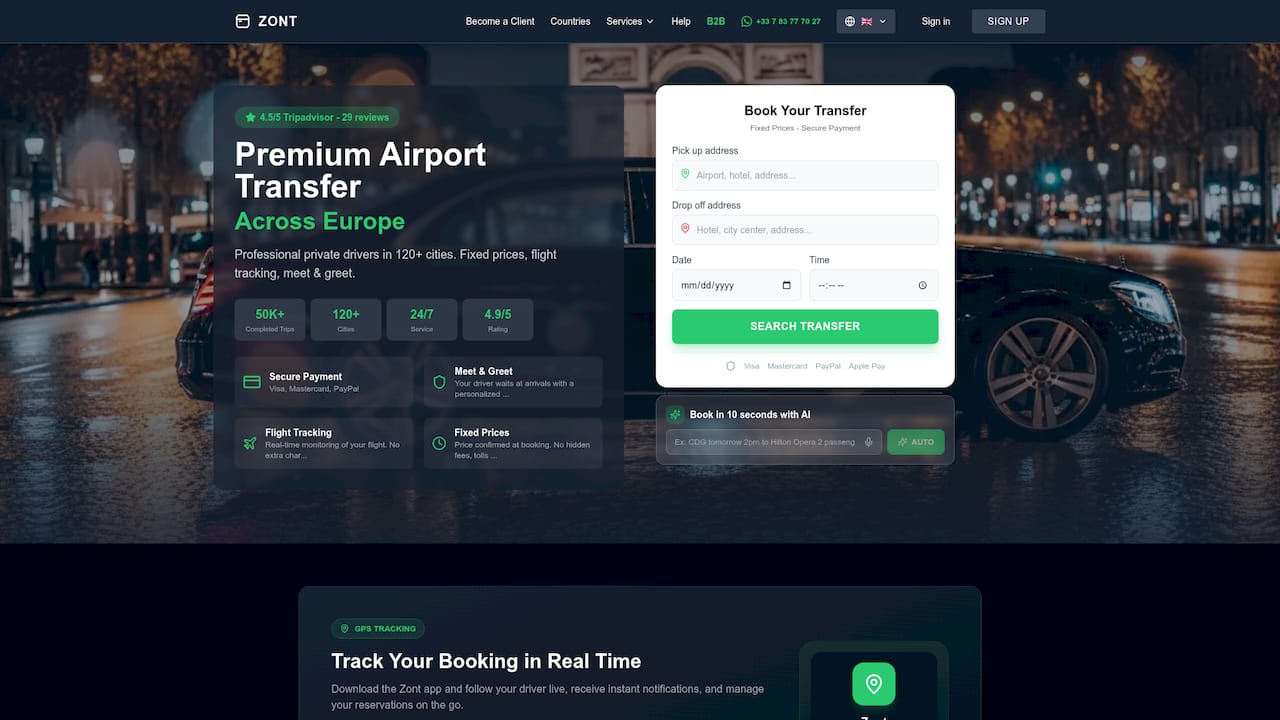
- Check live hourly rates and vehicle availability on our Driver at Disposal page for Paris.
- Compare fixed-price airport transfers on our Paris airport transfer page if a single leg fits your trip better than an hourly block.
- Browse French-language booking terms and vehicle options on our chauffeur mis à disposition page.
Whichever option fits your day, you’ll see the full price before you confirm, not after.
FAQ
How much does a private driver cost in Paris?
A private driver in Paris typically costs €45 to €65 per hour for a standard sedan and €65 to €120 per hour for business or luxury tiers, with most bookings requiring a 1 to 3 hour minimum. Tolls, waiting time, and gratuity usually add to that base figure, so budget above the headline rate.
What is the cheapest way to get around France?
Public transit, including regional trains and city metro systems, is generally the lowest-cost way to move around France for budget-conscious travelers without luggage or time constraints. A private chauffeur costs more but removes the uncertainty of schedules, transfers, and carrying luggage across multiple stations.
How much is an ER visit in France?
Emergency room costs in France depend heavily on your insurance status and whether you’re covered under the French health system or traveling as a visitor, and we don’t operate in that space, so we can’t quote a reliable figure here. Travelers should check with their insurance provider or a French hospital directly for current emergency care costs.
How much is Uber in France?
Uber fares in France are typically metered and vary by city, time of day, and demand, which makes them different from the fixed hourly or point-to-point pricing used by VTC chauffeur services. For a predictable total instead of a surge-priced fare, a fixed-rate transfer or hourly disposal booking tends to give a clearer answer upfront.
Sources
- Legifrance — French VTC legal framework
- Business Class Journal — NYC hourly chauffeur rates 2026 (pricing layers analysis)